Archive for the ‘Uncategorized’ Category

Help the Lions Help Others

July 7, 2010

(Click here to go to this blog’s home page.)

Daddy is on the left with (I think) auctioneer Jay Arnold during a Lions Club auction when it used to be held at Rolfe's Post Office parking lot. The view is looking northerly. Daddy was in charge of the Lions Club auction for several years. I remember he'd contact area residents, including all of the business owners in town, for donations. (Click photo to enlarge.)

A previous post includes information about my dad’s (Deane Gunderson) “Bubbles in the Wine” weekly column that he wrote in the ’70s for The Rolfe Arrow. Below is another of his “Bubbles” columns, this time having to do with the Rolfe (Iowa) Lions Club annual auction.

This Saturday, July 10th at 11:00 AM, during Greater Rolfe Days will once again be the Lions’ annual auction. It will be held at the gazebo on Main Street. (I’ll be in the library across the street selling prints of Mother’s watercolors. The prints profits will go toward digitizing 101 years of Rolfe newspapers so they will eventually be accessible at no charge on the web.)

Before my dad passed away last week, he requested that in lieu of flowers, any memorial contributions be made to the Rolfe Lions Club (P.O. Box 101, Rolfe, Iowa 50581). He’d be just as glad if you stopped by the gazebo this coming Saturday and bought something for way more than it was worth in an effort to “Help the Lions Help Others.”

Also, at 10:00 AM on Saturday, just before the auction, will be the Greater Rolfe Days parade…with the Rolfe Lions as Grand Marshals. How fitting!

BUBBLES in the WINE

In the March 6, 1975, issue of The Rolfe Arrow

by Deane Gunderson

Elsewhere in this issue is an ad about the annual Lions Club sale which this year will be held March 8 at 1:30 p.m. The proceeds “Help The Lions Help Others.”

The Lions, officially known as Lions International, has over a million Lions club members in 147 countries. The purpose stated in the constitution is to serve others. Our club has [?] members. Roger Witt is our president; Pat Wood is our secretary and has been a Zone chairman.

The main projects of the national organization are related to serving the blind. They are:

(1) Operation of an eye bank — a storage of eyes in medical centers for the replacement of faulty eyes.

(2) Sponsoring a school for leader dogs.

(3) Collecting discarded eyeglasses which are checked and redistributed through a national center. (We’ll take yours.)

Our neighboring towns of Palmer, Gilmore City, Laurens, and West Bend have Lions Clubs. Some towns have clubs that are more for fun and the pulling of practical jokes on each other at the meetings. Our Rolfe club is a serious club and is very intent on the service angle. Proof of this is this list of local activities:

(1) Easter sunrise services.

(2) Easter Egg hunt.

(3) Scholastic banquet for honor roll students.

(4) College educational fund for two handicapped children, one now in college.

(5) Summer Little League program.

(6) Eye glasses for the needy students in Rolfe School. The students remain anonymous as far as the Lions are concerned.

(7) Christmas baskets for the elderly and/or needy.

(8) Ushering for basketball games.

(9) Installation of house numbers, street signs and sidewalk benches.

The Lions are grateful to the merchants and other people of Rolfe for their generous support of our projects. Almost every merchant will be donating some new merchandise for the sale, and other people will be donating worthwhile used items — some real goodies. Homemade baked goods will be donated. The auctioneering and clerking are donated.

We have some fun too. Several years ago we sold one bushel of competing seed corns (buyer’s choice). The price got up to $70. Les Allen and Art Sellers were bidding against each other, but Les had the advantage because he charged half to his landlord*.

So, Saturday, March 8, be in Rolfe, bring your money, take home some bargains, and “Help The Lions Help Others.”

* * * * * * * *

*Hmmm…..The inside joke is that I think that landlord just happened to be someone with the initials of D. G.! That Les was certainly a prankster.

Most likely next week I’ll include information about the Rolfe Lions Club’s current projects. My intent is to later this week post the second audio segment of my conversation with Sharon (Wickre) Rickard. I’ll wait until July 21st to post my dad’s official obituary. His memorial service will be at 11:00 AM on Saturday, July 31st at the Shared Ministry in Rolfe.

(Click here to go to Louise Shimon’s blog’s home page.)

Cumulonimbus Mammatus

June 20, 2010

When I was an undergrad at Iowa State University, I took one agronomy class to help prepare myself for farm-wifery. It turned out that I was pathetic at having any logic or understanding regarding agronomy, including about weather (although, one agronomy concept and visual that stuck with me is that soybean plants are dicotyledens).

The wonders of nature still get lost on me, including weather-related phenomenas. Thank goodness I have Bill to point them out to me, like he did Friday night. We were out for a walk at about 8:30 PM when the humidity was 78% and the temperature was 75 degrees. Sticky.

Looking east-southeast. (Click on photo to enlarge.)

According to my resident expert, the cotton ball-puffy clouds in this photo are mammatus clouds occurring in a large cumulonimbus cloud. (Rats, that a lot of the photo’s cloud detail is lost when viewed on the web.) Cumulonimbus mammatus clouds are typically associated with strong thunderstorms, oftentimes with tornadic activity and very high winds. For that reason, Bill said pilots steer away from this type of cloud.

Wow. At the link in the previous paragraph (in case you don’t want to click on it and read the info) it says, “The individual mammatus lobe average diameters of 1–3 km and lengths on average of 0.5 km.” From the ground they seem so teeny tiny.

(Click here to go to Louise Shimon’s blog’s home page.)

A New Concept in Agri-Business

June 14, 2010

Looking west-southwest approximately 3 miles south of Manson, Iowa, at the intersection of Highways N65 (N/S) and D26 (E/W). (Click on photo to enlarge.)

.

Am I the only one who thinks this seems just a little surreal?

Information about the history of Younkers is available at the links below. I have no idea as to the accuracy of the information.

In case you don’t know anything about Younkers stores, they were probably ***the*** department stores for many of us growing up in the Midwest, at least for me in the ’60s and ’70s. (Anymore, for customer service and a few other reasons, I seldom step foot inside any Younkers store.) The Gates department store in Fort Dodge was a nearby favorite, as well.

http://www.fundinguniverse.com/company-histories/Younkers-Inc-Company-History.html

http://en.wikipedia.org/wiki/Younkers

http://www.younkersdepartmentstore.net/

* * * * * * * *

(Click here to go to Louise Shimon’s blog’s home page.)
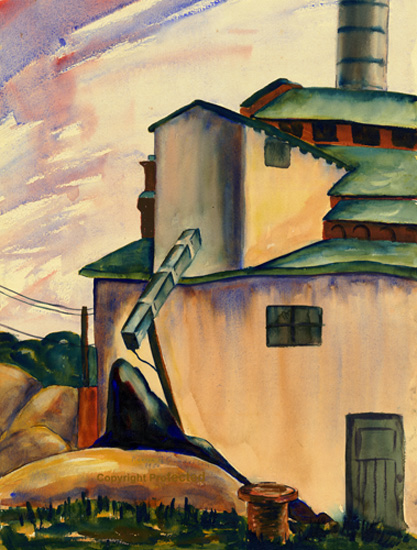
Vantage Point for “ISU Heating Plant” Watercolor by Marion Gunderson

June 7, 2010

In the previous post I explained how I learned the identity of the building in Mother’s (Marion Gunderson) watercolor of Iowa State University’s heating plant.

Mother’s notes indicate she painted the 1951 watercolor “From charcoal sketch done while at ISU.” She was a student at Iowa State during the period of 1937-1941. In other words, there was at least a ten-year span between when she created the charcoal sketch and when she painted the watercolor.

I wondered what Mother’s vantage point might have been as she created her sketch (later used as the reference for her watercolor). In an effort to learn more about the vantage point, I contacted Jeffrey Witt, Iowa State’s Assistant Director of Utilities.

.

ISU Heating Plant, Ames, Iowa, watercolor by Marion Gunderson, 1951. Medium limited edition: 13.25″ W x 17.5″ H (approximate size of the original), $35. Large: 15″ W x ~20″ H, $45. (Click on image to enlarge. To order, see * below.)

.

.

Vantage-Point Explanation and Photos from ISU’s Jeffrey Witt March 2010

This painting [immediately above] appears to have been done looking south and east towards the power plant from the north side. We do not have any photographs of the plant from this perspective but there may be some in the Special Collections section at Parks Library. I was able to find two views of the plant from that general timeframe and one a few years later. These [below] are scans from a historical account of the power plant put together by one of our staff.

.

.

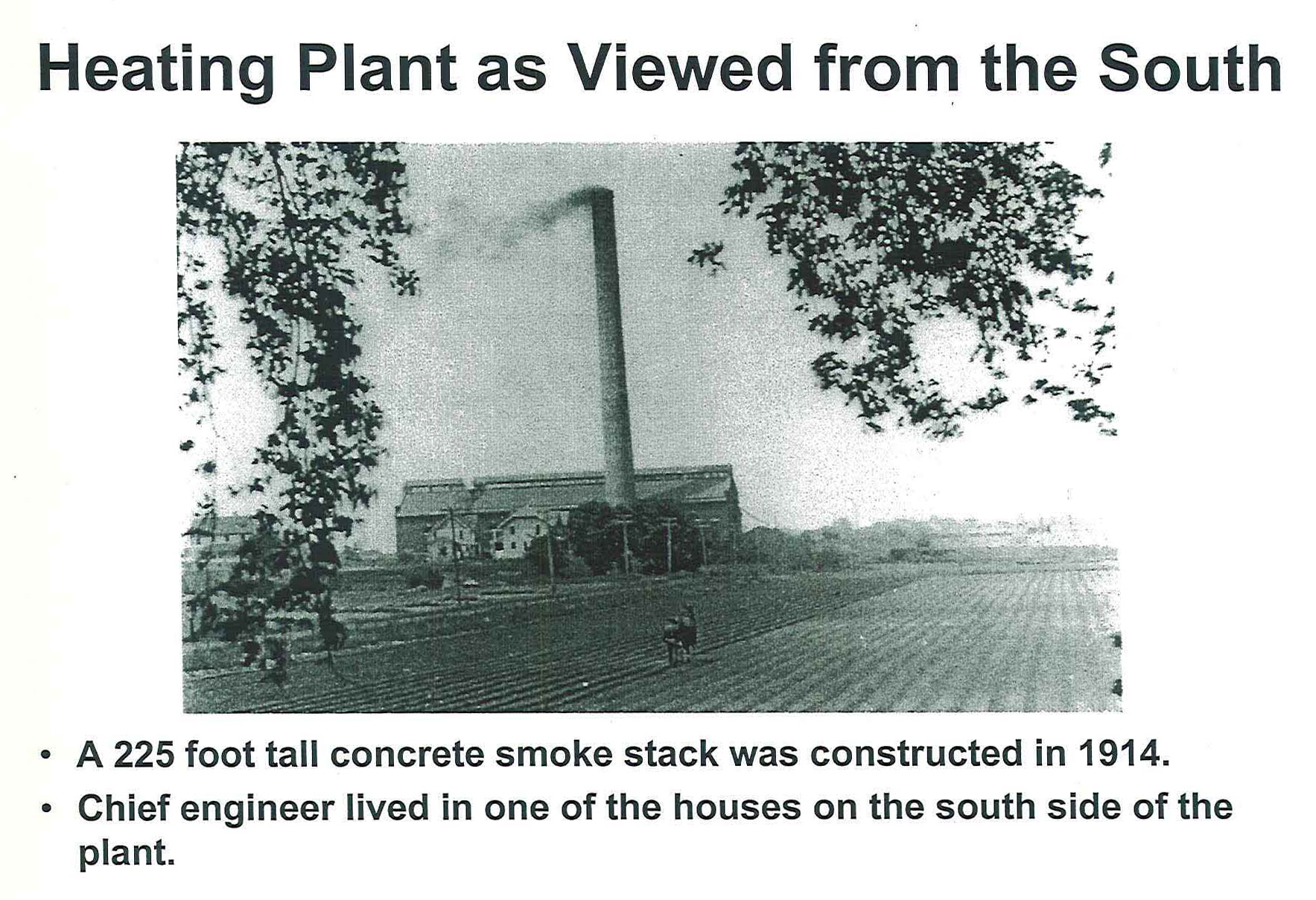
“The first picture.” (Click on photo to enlarge.)

The first picture [immediately above] is looking at the plant from the east looking west. This photograph was before the large concrete smokestack was constructed. The concrete smokestack shows in the background of the painting.

.

.

“The second picture.” (Click on photo to enlarge.)

The second picture [immediately above] is looking at the plant from the south looking north and a bit west. We believe this picture was taken in the 1930s about the time the sketch was done.

.

.

The third picture [immediately below] is an aerial view of the plant from the north and west looking southeast and was taken in 1954. The plant had a major addition in 1948-49 so it looks different than the previous pictures. It looks to me like the artist may have done the sketch while standing in the vicinity of the 4 white oil tanks that show in the foreground of this picture.

“The third picture.” (Click on photo to enlarge.)

The power plant depicted in the sketch and painting was built in 1906 and includes an addition in 1914. The facility would have looked similar until 1948-49 when it was modified to look like the 1954 picture [immediately above]. Another major addition was added to the south in 1968 and a 3rd major addition to the north in 1986-87. Over the years we have built on all four sides and on top of the original 1906 power plant. The original power plant supplied steam for heating and electricity for the campus. Today’s power plant still provides heating steam and electricity and we started providing all the cooling for campus with the addition in 1968.

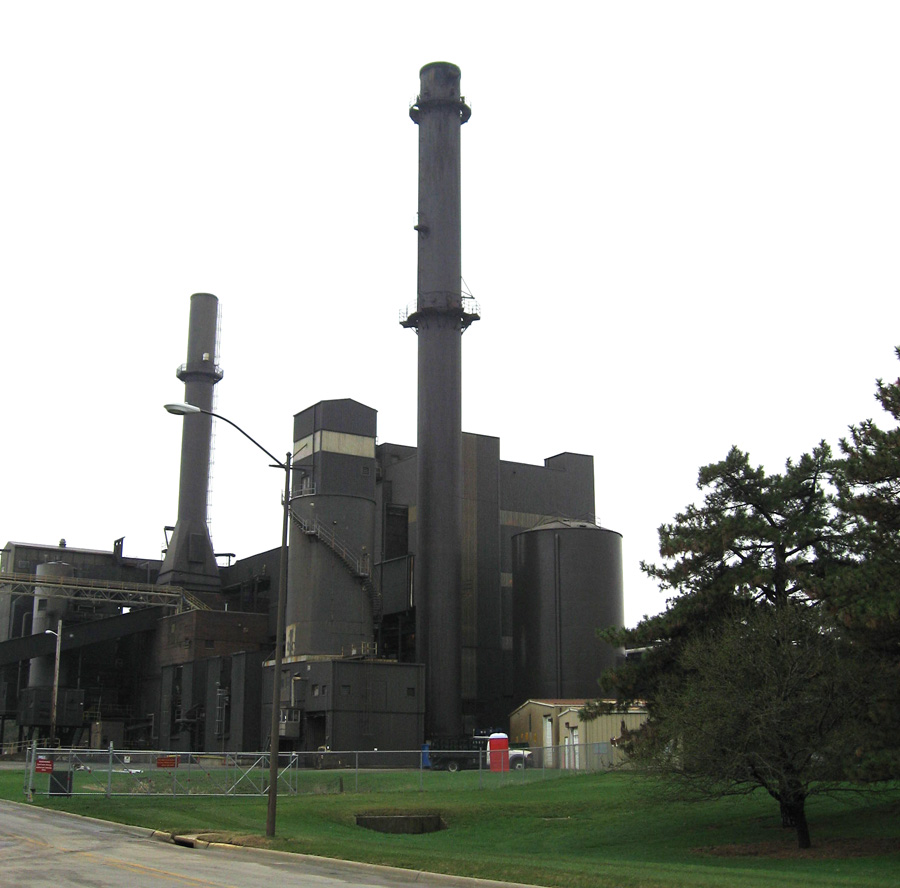
The power plant is in the same location. I included a photograph for your reference [immediately below]. The photograph is looking east and north at the plant from the west and south. The area where the artist likely stood is still there as well. It is a green metal shed** located north of the power plant that is used by the facilities department for equipment storage. You can locate the power plant if you go to ISU’s website and look at the campus maps.***

“Photograph for your reference” of current power plant.

* * * * * * * *

* * * * * * * *

*To check on availability of prints at various locations, please email me at mariongundersonart@gmail.com. You may also order online. (The ISU Heating Plant prints are online in the “Potpourri” category.)

**In the photo at this link, the “green” storage shed looks more yellow/tan. In reality, it is green.

***In the next post I’ll include web sites providing more information about the heating/power plant.

(Click here to go to Louise Shimon’s blog’s home page.)

Iowa State University Power Plant + Marion Gunderson = ?

May 24, 2010

Iowa State University Power Plant, viewed from the northeast, spring 2010. (Click photo to enlarge.)

What does the green shed in this photo have to do with my mother, Marion Gunderson? My intent is to fill you in over the course of the next two or three posts beginning mid- or late-this week.

The interpretation of the previous sentence is…I don’t have the next posts written yet, but barring any changes with my dad, I’ll post again later this week. For those of you who have asked, and for anyone else, my 91-year-old dad has bounced back from his fall with determination and is doing well. He’s not as “good” as before, but he’s in very good spirits and walking quite a bit.

(Click here to go to Louise Shimon’s blog’s home page.)
“Fluff” Until Things Get Settled

May 17, 2010

We adopted Sammy from a family member of one of Katie's Drake University softball teammates. (Click photo to enlarge.)

I don’t get too excited when I read other people’s happenings-of-the-day chit-chat blog posts, so I don’t expect you to, either. However, this post will need to suffice as a filler until we get my dad squared away after his fall almost two weeks ago. He didn’t fracture/break any bones but he’s not ready to live by himself yet. (He would want to disagree with that statement.) I’ll be going to and from Rolfe quite a bit as he gets stronger.

L to R: Sammy and Miss Kitty. Miss Kitty was rescued one bitterly cold winter by our veterinarian's wife. (Click photo to check out Miss Kitty's tongue-to-nose detail.)

In the meantime, here’s a fluff post of photos of Bill’s and my two cats. Miss Kitty is the black and white cat. She used one of her nine lives a year ago when she bit Bill. I keep trying to convince Bill that Miss Kitty really is a sweetheart, although her unladylike meows do sound just like Marge on the Simpsons.

I’ve got new prints to post about. I’ve also got an audio interview about Rolfe that I’ll post within the next month or so. For the next week or two my posts might be “fluff,” or…let’s just call them “smelling the roses.”

(Click here to go to Louise Shimon’s blog’s home page.)

Double Vision (Or, our tax dollars at work?)

May 15, 2010

I’m still traveling to and from Rolfe quite a bit to be with my dad while he is recovering from his spill. Within a week or two I should be back to posting more regularly. For now…the signage in these photos isn’t exactly newsworthy, but just struck me as odd and ridiculous (and a teeny bit humorous).

Looking south toward Lohrville, Iowa. The exact location is the intersection of 230th St. and Sigourney Ave., just north of what will be the extension of Highway 20. (Click photo to enlarge.)

.

On the other side of the highway, looking north toward Manson, Iowa. (Click photo to enlarge.)

.

Service Signing, L.C. and Iowa Plains Signing, Inc. are the two companies providing this "double vision" signage. (Click photo to enlarge.)

(Click here to go to Louise Shimon’s blog’s home page.)

Picture Framing Materials: Know Your Stuff (if you don’t already) — Part III

May 3, 2010

After Part I and Part II, this is the last post for a while about mats and glass. Even for me, three posts about mats and glass is a bit much.

For a quick read of helpful facts about kinds of glass, mats and other considerations within the context of framing artwork, check out Mona Majorowicz’s “Picture Framing Materials Guide for Artwork” Squidoo lens. If you read it and find it helpful, if you’d scroll to the end of the lens and leave a comment for Mona, even if brief, it would boost the lens’ Squidoo ranking.

The following photo is of two mats and the corner of a picture. They were framed together in the ’90s, but are pulled apart in this photo to illustrate the fading effects from not using acid-free mats and not using conservation clear glass. Admittedly, the text on the photo takes some muddling through.

(Click photo to enlarge.)

.

Today I’m with my 4-year-old grandson celebrating his birthday. The mid-week is full. Unless I surprise myself, I’ll wait until the end of the week to post again.

(Click here to go to Louise Shimon’s blog’s home page.)
Picture Framing Materials: Know Your Stuff (if you don’t already) — Part II

April 30, 2010

(Click here to go to this blog’s home page. If you haven’t already, for optimum understanding, read Part I before you read this Part II post.)


This original watercolor by Mother (Marion Gunderson) is now protected by museum glass* which blocks 98% of UV rays. Notice that the glare is very minimal. Before this week, the glass used here was just regular clear, which blocks only about 47% of UV rays. With regular glass previously on this painting at this particular location, the glare prohibited anyone from seeing the detail of the painting unless the viewer was very close to the painting. Even with just a single mat, I didn't want to use regular non-glare glass (which also blocks 47% of UV rays) because I wanted brilliant color and crisp detail. Even with just one mat, that brilliance and clarity would not be as likely with the filmy look of non-glare glass in combination with a mat. The reason for that is when there is any distance between artwork and the glass, even if it is just the thickness of a mat, some of the brilliance and clarity is lost. This is even more true when a double or triple mat is involved. (Click photo to enlarge.)


Maybe two or three framers in central-Iowa just figured I already knew all about conservation clear glass and therefore never felt the need to tell me about conservation clear glass. That is understandable. But, I was a little miffed recently when I, in the spirit of shopping locally, took the original of Angel in Wine and Blue to be framed at a central-Iowa frame shop. At the same time, I asked that central-Iowa frame shop owner about museum glass for another painting. The owner pointed to a box of conservation clear glass and said that, yes, the shop carried conservation clear and that it is the same thing as museum glass.

Because of Mona Majorowicz at Wild Faces Gallery educating me, I knew this was not true. I said something else to the owner about museum glass. The owner then repeated that conservation clear is the same as museum glass.

WHEHLLL! Knowing that this was not true, I said that I wanted the UV protection benefit of conservation clear, but that I also wanted the minimal glare that is possible with museum glass. (Museum glass also provides protection against 98% of UV rays.) I got a “look” from the shop owner. She then proceeded to tell me that museum glass is so expensive (which it is) and that it would not be cost-effective to purchase it for the shop because of the expense.

Ok, so why didn’t she just tell me that in the first place? Instead, she knowingly tried to pass off the conservation clear glass that she had in stock for museum grade glass.

Back to Wild Faces Gallery…Mona typically doesn’t carry museum glass due to the expense, either; but at least she was up front in telling me that instead of trying to pull one over on me.

* * * * * * * *

If anyone asks, I’m not going to mention the name of the frame shop where I was told that conservation glass is the same as museum glass. My point is not to make a bad name for anyone. Plus, I’ve almost always been pleased with the overall look of my framing done at the shop. My point is for people to become educated about framing materials, if they aren’t already.

*Museum glass is quite expensive. The 20″ x 20″ piece of glass needed for this framed painting was about $120, including labor. Except for maybe one other piece of artwork, I probably won’t use museum glass on anything else because it is so expensive. I will use conservation clear glass on nearly everything I get framed.

(Click here to go to Louise Shimon’s blog’s home page.)

The Way You Look Tonight

April 29, 2010

Click on the photo to see the outline of the treetops.

I know I still need to post Part II about picture framing supplies, but this photo of the moon won the spot for tonight. Actually, just previous to my taking photos, the moon was more orange-y. I know this isn’t the greatest photography, but it was great to be out in the crisp breeze and to see the moon rise above the treetops that you can barely see in the photo.

Part II about picture framing supplies will be posted by Friday.

(Click here to go to this blog’s home page.)