Archive for the ‘Iowa’ Category

There is never enough until it is given away.

June 22, 2010

Daddy (Deane Gunderson) fell again on Sunday. I’m with him a lot and therefore back into short-and-simple posting mode, at least for now.

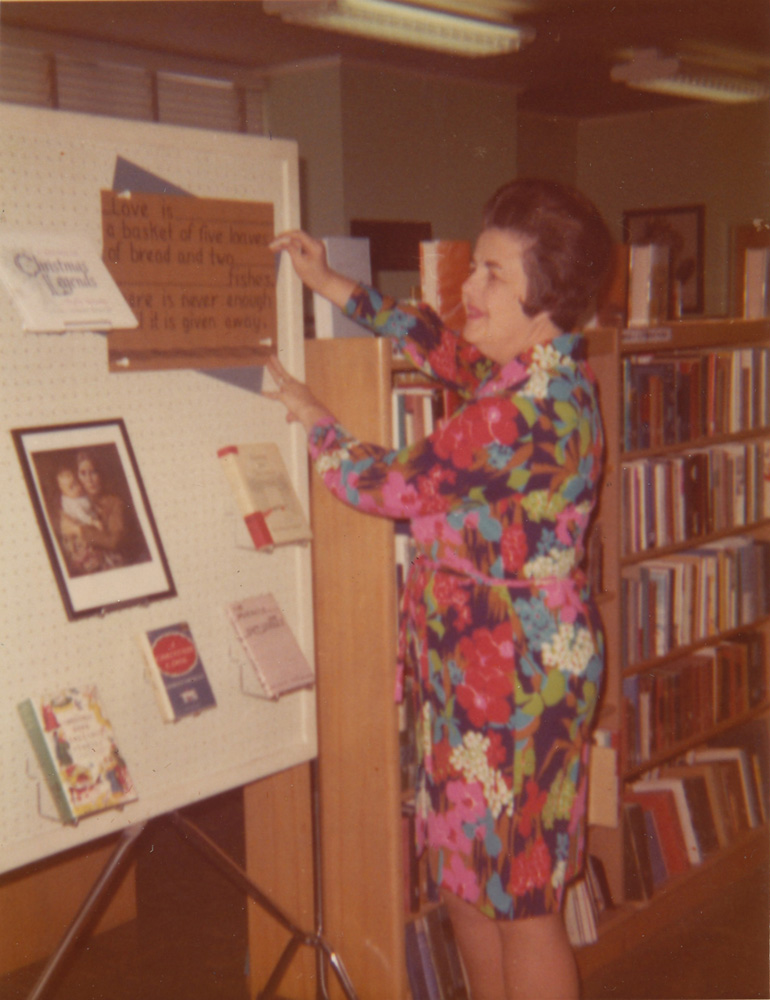
I know that people look at this blog for a variety of reasons. Many people look purely because they want more information about Mother (Marion Gunderson). After I posted the image of the placard from Mother’s 1970 exhibit at Younkers in Des Moines, I thought maybe readers in the “want to learn about Marion” category might like to see Mother in her element (the library) around the time of that 1970 Younkers exhibit.

Mother (Marion Gunderson) in the former Rolfe Public Library, circa 1970. What you see here, including the walls in the background, comprises about 1/4 of the main room of the former library. Does anyone know what the artwork is on the back wall? (Click on photo to enlarge.)

Mother’s note on this photo says, “About 1970.” (That was my sophomore year in high school.) The location is the former Rolfe Public Library where Mother was a librarian for 35 years. Click on the photo to read the saying she took to heart.

It’s sort of fuzzy so (even though I still hope you’ll click on the photo to look more closely), here’s the saying. Simple, but so easy to forget.

LOVE is a basket of five loaves of bread and two fishes.

There is never enough until it is given away.

* * * * * * * *

(Click here to go to Louise Shimon’s blog.)

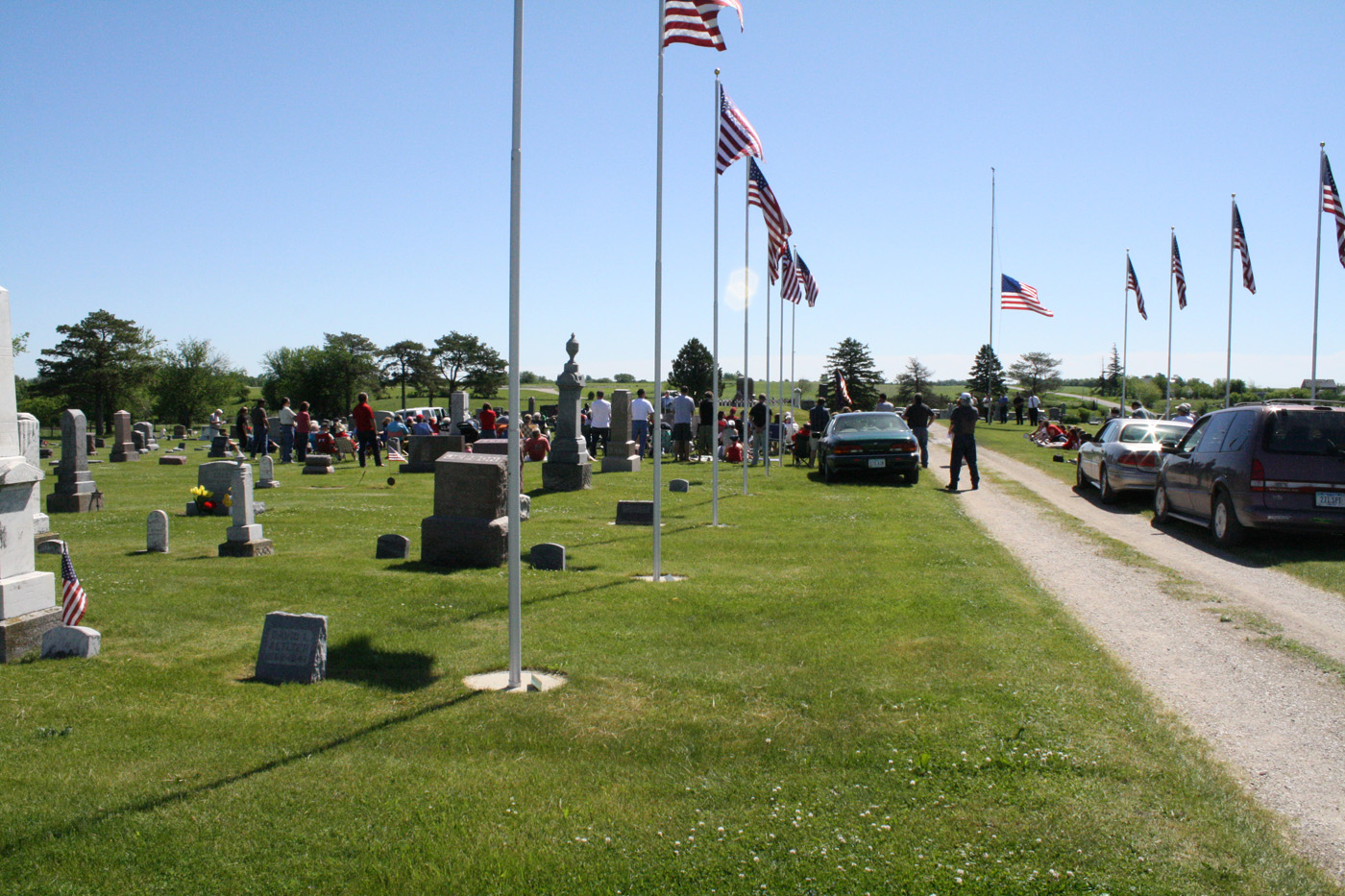
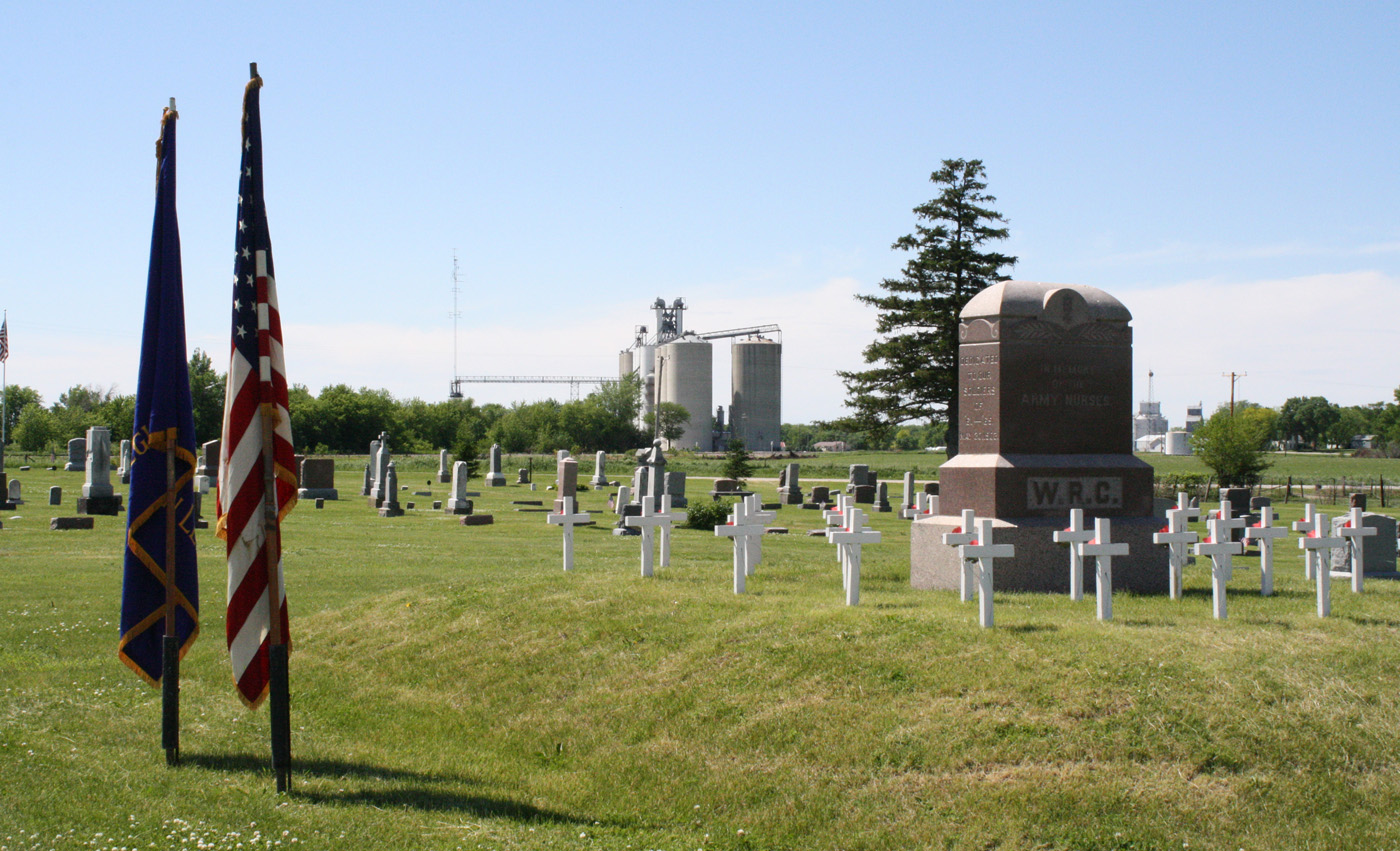
Memorial Day in Rolfe, Iowa

May 31, 2010

Looking west/northwest toward Rolfe. Click on the photo to see that on the shaded (east) side of the large memorial stone it says, “In Memory of the Army Nurses.”

.

Looking east. (Click photo to enlarge.)

.

During today’s service. (Click photo twice to enlarge.)

All three photos were taken of Rolfe’s Clinton-Garfield Cemetery. For information about Rolfe’s cemeteries, click here.

* * * * * * * *

Tomorrow I’ll begin posting information about Mother’s association with the Iowa State University power plant.

(Click here to go to Louise Shimon’s blog’s home page.)

Breakfast with Roger Pohlman and Dave Spaulding

April 23, 2010

(Click here to go to this blog’s home page.)

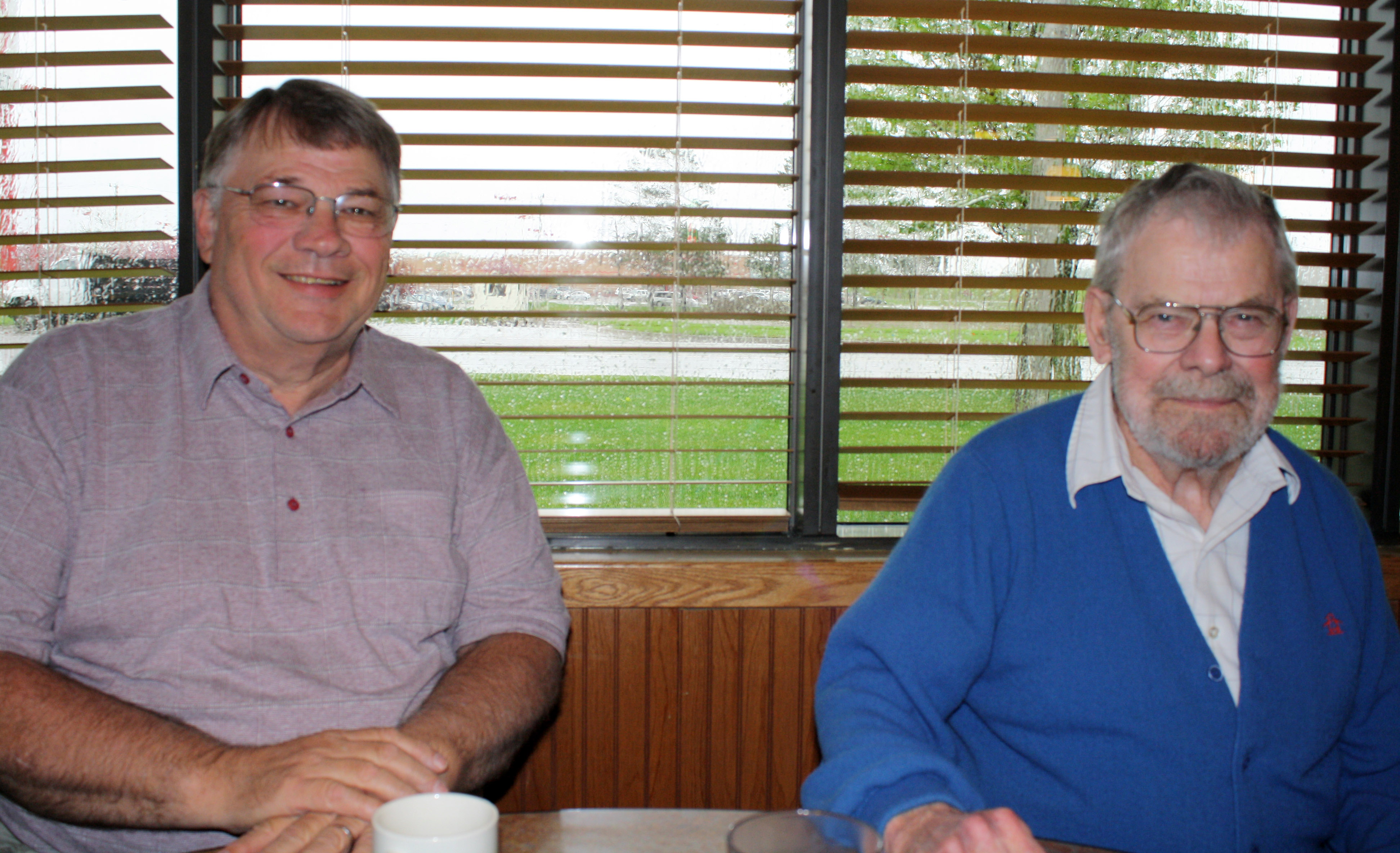
Over breakfast this morning, Bill and I met with Roger Pohlman and Dave Spaulding.

Roger Pohlman and Dave Spaulding, April 23, 2010. Click on the photo to better see the glimmer in those eyes.

Roger Pohlman was Bill’s P.E. and junior high shop teacher, driver education instructor and football and track coach at Rolfe (Iowa) High School during the late ’60s and early ’70s. (He also was an assistant boys basketball coach.) In 1971, after Bill graduated, Roger became Rolfe’s high school principal. He served in that capacity during my junior and senior years and into the mid-’70s.

While both Roger and Dave are legendary as Rolfe faculty members, Dave had the longer tenure at Rolfe (from 1965 until 1983). He definitely provided more opportunity for former students to retell legends! Dave taught almost all the science classes at Rolfe High, as well as Senior Math. (When asked today if he ever coached, he said that he once was a chess coach.)

From the 1970 Rolfe (Iowa) High School yearbook: Mr. Spaulding is at the far left in the second row. Mr. Pohlman is at the far right in the 3rd row. Yes, this is the ENTIRE high school faculty! (Click on the photo to enlarge it.)

I wish I could squish into a short post some of those “do you remember when…” stories about Roger and Dave as educators, or about Rolfe High School and/or the community in general. But a short post wouldn’t do justice to the “Golden Apple” lifelong positive impact they had on Rolfe students in terms of discipline, character and thinking.

It will have to suffice to say that if you went to Rolfe High School and had one or both men for a teacher and/or administrator, you’d know that this morning we had a fun time reminiscing. Also, in your memory bank you’d probably have at least half of the yarns about Rolfe High that we chuckled about today. For example: How long girls’ skirts had to be; getting the switch during P.E. for throwing someone (a human thermometer) in the creek to check the water temperature; someone putting a car on autopilot during driver ed class; a starter’s pistol being used to wake up a student in geometry class; being awarded an F- grade (I did that once.); crawling through a car window in driver ed class after the car went into the ditch. (Who drove the car into the ditch? We don’t know.)

Roger and Dave are very, VERY interested in reconnecting with their former students and fellow staff members, too. If you want to reconnect with them, you may, of course, contact them on your own. When I mentioned this morning that I thought there would be others who’d like to get together with them, the response was, “Set it up and we’ll be there!”

If you have interest in getting together and would like me to set something up, let me know. mariongundersonart@gmail.com

* * * * * * * *

Click here for previous posts about Dave Spaulding.

The newspaper article shown in the most recent post includes a photo of Roger Pohlman, Dick Barrett and the 1969 RHS football team. The photo is fairly dark, but fun to look at, nonetheless.

(Click here to go to Louise Shimon’s blog’s home page.)

101 years (1888-1989) of Rolfe, Iowa, Newspapers Online

April 18, 2010

UPDATE July 12, 2012: The URL for the Rolfe, Iowa, newspaper archives is: http://rolfe.advantage-preservation.com/
ENJOY!

The oral history project endorsed by the Rolfe (Iowa) Public Library board is nearing completion.

The next fabulous project is that of digitizing 101 years of Rolfe newspapers so that they will be online and keyword-searchable.

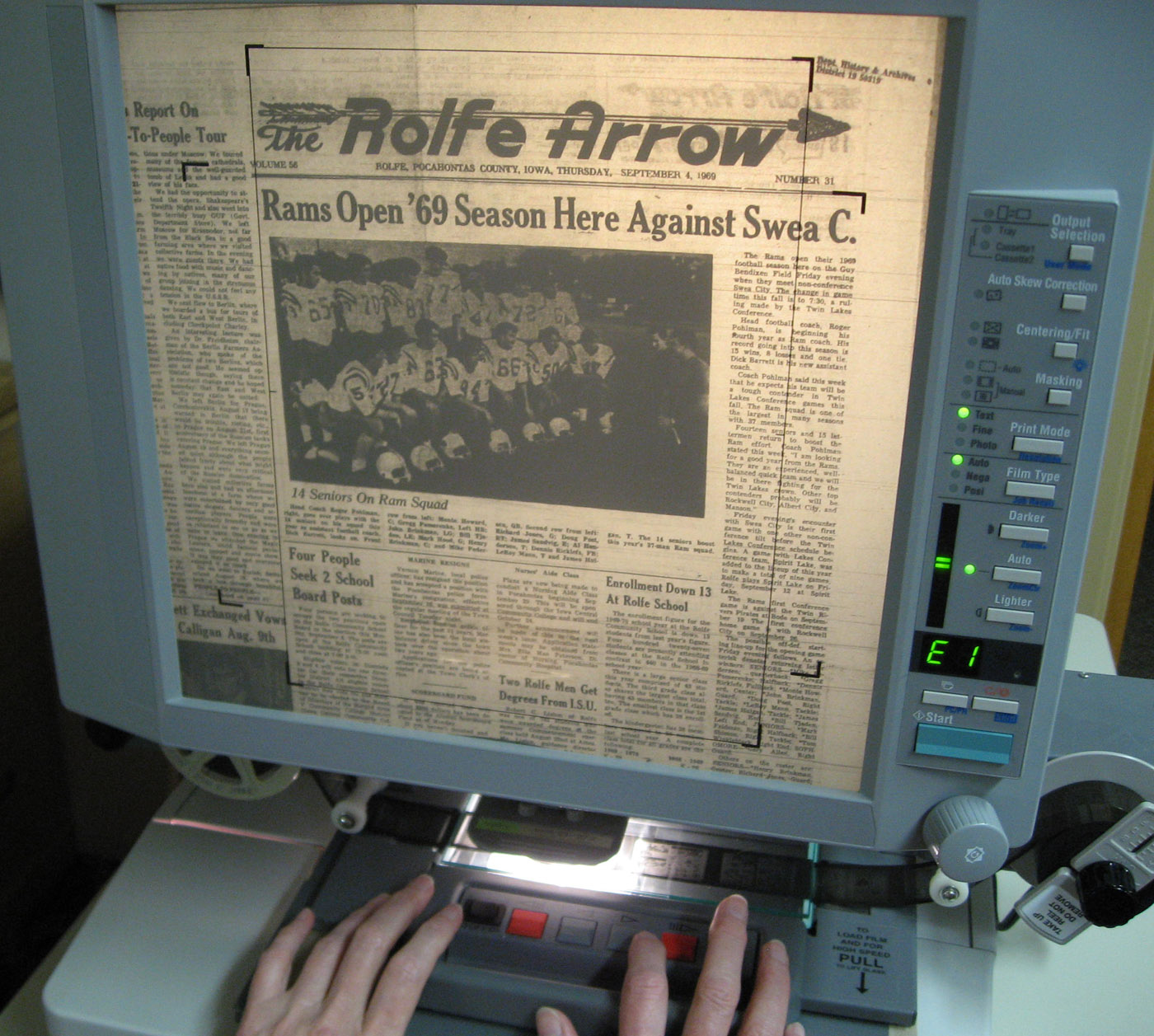
The September 4, 1969, issue of The Rolfe Arrow on microfilm at the Pocahontas Public Library. (Click photo once and then again to enlarge.)

Currently those newspapers from 1888 to 1989* are on microfilm at the Pocahontas Public Library. For many of us who live at a distance, and even for those who live near Pocahontas, sometimes it is a little tricky to get to the Pocahontas library to look at that microfilm.

The Rolfe Public Library board recently endorsed the project of raising funds to digitize those 101 years of Rolfe newspapers. Once they are digitized, any computer with Internet access will be able to access those newspapers (unless the newspaper web site is blocked on a particular network).

Click here for an explanatory document about the project, including microfilm roll ID #s.** If you cannot open the explanatory document, please contact me. (Contact information is given below.) The information is also available at the Rolfe Public Library.

DONATIONS ARE NEEDED FOR PROJECT COMPLETION.

“HOW DO I DONATE?”

The first two pages of the explanatory document are informational, including the time span and ID# for each roll of microfilm. On the third page is a form to be used for donations to the project.

If you want to print just the donation form and not the rest of the information, click here for just the donation form. Directions for donating are on the form. All donation amounts are appreciated. (For the oral history project, donations ranged from $10 to several hundred dollars.)

If you have questions, please contact me for clarity and/or more information. My (Louise Gunderson Shimon) contact information is: 515-465-2746; mariongundersonart@gmail.com; 14106 Green Dr., Perry, Iowa, 50220.

You may also ask at the Rolfe Public Library; however, since I know all the ins and outs of the project, it may be that you are referred to me.

If you’d like to contribute to the project but can’t right now, please give yourself a reminder.

If you think you might like to contribute but don’t currently have time or funds to do so, please write yourself some sort of reminder note or put a twist-tie around your finger!

One important detail is that all contributions should be made to the “Rolfe Public Library Trust.” The word “Trust” is important to include.

On behalf of the Rolfe Public Library board and staff, thank you for your interest in this project.

* * * * * * * *

Questions? Comments? Or, are you thinking I left out a vital piece of information? If so, please let me know.

*There may be a few issues missing.

**Roll ID #s are  provided on page 2 of the explanatory document for anyone who wishes to donate and specify sponsorship of one or more entire rolls of microfilm.

(Click here to go to this blog’s home page.)

“Television is Here” in 1950

April 12, 2010

(Click here to go to this blog’s home page.)

The Arrow (Rolfe, Iowa, newspaper), February 23, 1950. (Click photo to enlarge.)

This ad was published five years before I was born. I can only imagine the excitement generated from the (at that time) newfangled invention of television. If you remember anything about aspects of early televisions, television broadcasts (was the quality very good? dependable?), and/or the J.E. Rickard & Sons store, it would certainly be educational and/or fun to read your comments.

If you comment below (after clicking on the “Leave a Comment” link that is below) and it is your first time commenting on this blog, it takes a little while (sometimes minutes, sometimes hours) for the first-time comment to appear on the blog for others to read. Giving your email address is required, but I’m the only one who sees the email addresses. Giving a web site is not required.

If you do want to share your memories but don’t want to comment below, feel free to email me at mariongundersonart@gmail.com .

I’ve been away from home for several days for a family wedding. When I return, I’ll get the ball rolling and in about a week I’ll fill you in about the next project endorsed by the Rolfe Public Library board.

(Click here to go to Louise Shimon’s blogs’ home page.)

Oh, my!!! You never know what you’ll find in a Rolfe, Iowa, newspaper!

April 3, 2010

(Click here to go to this blog’s home page.)

This past week I photographed advertisements and articles included in decades-old issues of Rolfe, Iowa, newspapers. The photos aren’t of the greatest quality, but, in my opinion, the content is priceless.

From the November 12, 1914, Plover Patriot, A Department of The Arrow. (Click photo to enlarge.)

As you can tell by the caption, this advertisement is from the Plover Patriot department of The [Rolfe] Arrow. Until recently, I had not realized that The Arrow had “department” space dedicated for news and advertisements of neighboring communities.

Because I’m still working on a project, over the course of the next two weeks I’ll post photos from those old issues of the Rolfe newspapers. Even if you might not have a Rolfe background/heritage, I think the history evidenced in the photos will have universal appeal.

(Click here to go to Louise Shimon’s blog’s home page.)

Two Projects: One in the Works and One Near Completion

March 27, 2010

(Click here to go to this blog’s home page.)

I’ve been working on a project. I’ll unveil it within the next three weeks. I want to “go public” with it RIGHT NOW but I need to get a few ducks in a row before I do.

In case you are wondering if the project has to do with prints of Mother’s watercolors…no, it does not. I take that back; indirectly, it does. I’m sure that Mother, having been Marion the Librarian for 35 years for the Rolfe Public Library, would be pleased to know about the project.

I mention all of this because I don’t want the lack of recent posts to make anyone think I’ve been slacking. Quite the contrary.

So far, 75 of the 100 Rolfe, Iowa, 1980-81 oral history tapes have commitments to be sponsored (7 of these yet to be paid).* Of the 25 that have not been sponsored, four of them are recordings of meetings regarding the oral history project. If you subtract those four meetings tapes, that means only 21 of the actual interview tapes are yet to be sponsored. Splendid. What a tribute to those who expended time and energy to interview and be interviewed in 1980 and 1981 to now have their friends and loved ones (and, in some cases, the interviewees, themselves) keep the oral histories alive.

Once all of the 1980-81 oral histories are digitized and cataloged, the oral histories on CDs will be accessible at the Rolfe Public Library.

* * * * * * * *

* Unsponsored tapes may still be sponsored. Because the project is nearing completion, any sponsorships should now be made payable to the “Rolfe Public Library Trust,” and no longer to Wild Faces Gallery. Any questions about the project may be directed to me at mariongundersonart@gmail.com . Questions may also be asked at the library; however library personnel may not be aware of the most recent ins and outs of the project.

Note added March 29th: CD copies of the oral histories (preferably of oral histories already sponsored) may also be ordered for $10.70 each plus $2.30 shipping, with payment to Wild Faces Gallery. For any questions regarding copies you may contact me at mariongundersonart@gmail.com or the gallery at 712-848-3399. (The $29.96 for a sponsorship payable to the Rolfe Public Library Trust includes one “free” copy of the sponsored tape.)

(Click here to go to Louise Shimon’s blog’s home page.)

1940s Construction and Watercolors of the Pocahontas, Iowa, Grain Elevator (Part II)

February 18, 2010

(Click here to go to this blog’s home page.)

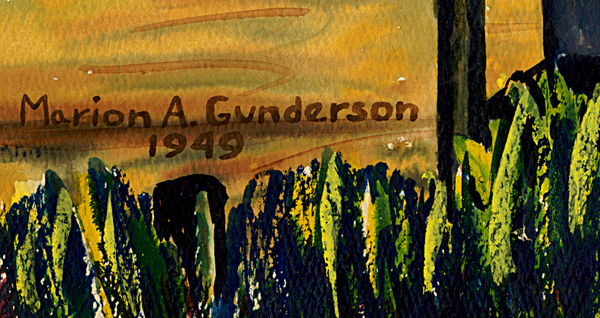
In 1949, Mother (Marion Gunderson) painted two watercolors of the Pocahontas, Iowa, grain elevator/concrete silos. (Information about those two and other watercolors is available at “View and Order Prints.”)

Mother's (Marion Gunderson) signature on one of her 1949 watercolors of the Pocahontas, Iowa, grain elevator.

Not long before Mother painted those watercolors in 1949, Mike Hood, formerly of Pocahontas, watched that same Pocahontas grain elevator being built. The following is a continuation of Part I of Mike’s recollection. Most of the information below is about Mike’s family, but gives a “visual” of the 1940s. Mike was 8 or 9 years old at that time. As you read the rest of his essay, try to imagine looking through his eyes as a child…more than sixty years ago.

* * * * * * * *

By Mike Hood

(continued from Part I)

We had a pony named Fancy and a lovely little four-wheel black buggy with yellow wheels, that I was the right age to use. I could harness the pony and would drive the rig for hours in a hay field of about 10 acres south of our house. That house still stands on the west side of the road one-quarter of a mile north of the Pocahontas County Courthouse. (Grandfather Michael Linnan’s name is on a wall in the courthouse because he was a County Supervisor when it was built in the 1920s.) I remember that sometimes I would meet my cousins and give them a ride for that last quarter mile on the little buggy. I remember, too, that they would be dead tired from the hard work of pouring concrete for those long 12-hour shifts.
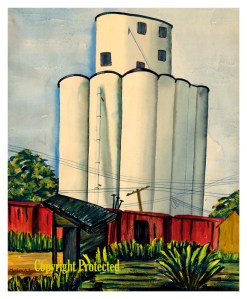
Pocahontas Grain Elevator II prints are available in three sizes: Small (Limited Edition, 10" W x ~12.3" H, $25). Grand (Limited Edition, ~ 17.9" W x 22" H, $50). Largest (20" W x ~24.5" H, same size as the original). Click photo to enlarge.

Jim’s and Frank’s motive, of course, was money for college. Their father, Uncle Charles Linnan, of rural Laurens, rented a 160-acre farm and was not extremely money prosperous in those days. Both of those boys graduated from the University of Iowa. Jim Linnan had a successful career at Ruan in Des Moines, and was the mayor of Clive, Iowa, when he died suddenly of a heart attack in the spring of 1970.

My uncle Bill Linnan was the father of Donald Linnan, of Storm Lake and former County Engineer of Buena Vista County, of Fr. Roger Linnan, who continues as a popular parish priest who served at Jefferson, Manson, Spencer and even now in his 70s at Haywarden, and of Karen Brown, who is married to a retired dentist from Montana, now retired in Sioux City.

All of those cousins were college graduates and were an inspiration to me. I was an editor at Successful Farming and Country America magazines, and now oversee our several farms and photograph antique tractors for calendars.

I remember very clearly sitting on the roof of the chicken house on that Pocahontas farm and counting five concrete grain elevators in what must have been the summer of 1950. Those would have been at Pocahontas, Havelock, Plover, Rolfe and Gilmore City. Obviously, the concrete grain storage technology caught on very rapidly.

We moved from our wonderful Pocahontas 160-acre place to a 305-acre farm bordering Columbia, Missouri, in March of 1951, and in a few years I would be hauling wheat to an old-fashioned tin-sided elevator on hot July days and nights. The famous architect Frank Lloyd Wright called those grain elevators the skyscrapers of the prairies. Indeed!

* * * * * * * *

(Click here to go to Louise Shimon’s blog’s home page.)
1940s Construction and Watercolors of the Pocahontas, Iowa, Grain Elevator (Part I)

February 16, 2010

(Click here to go to this blog’s home page.)

Pocahontas Grain Elevator II prints are available in three sizes: Small (Limited Edition, 10" W x ~12.3" H, $25). Grand (Limited Edition, ~ 17.9" W x 22" H, $50). Largest (20" W x ~24.5" H, same size as the original). Click photo to enlarge.

The November 10th, 2009, Des Moines Register included an article about Mother’s (Marion Gunderson) watercolors and the Rolfe, Iowa, 1980-81 oral history project.* Published alongside that article was a photo of Mother. Also included with that article was this post’s photo (at left) of one of Mother’s painted-in-1949 watercolors of the Pocahontas, Iowa, grain elevator.

Enticed by that Register article, including the image of Mother’s grain elevator watercolor, Mike and Sally Hood of West Des Moines attended the open house.

After the open house I remembered Mike’s telling of his first-hand story of the 1948 or 1949 construction of that same Pocahontas, Iowa, grain elevator.  At my request, Mike was generous to pen that story and allow me to post it here.

* * * * * * *

By Mike Hood

(formerly of Pocahontas, Iowa)

It was exciting to be a little boy perhaps 8 or 9 years old in Pocahontas, Iowa, in the summer of 1948 or 1949 when they were building the huge concrete silos** to enlarge and modernize the main grain elevator in town. It was particularly exciting for me because my Uncle W. B. Linnan was supplying all of the concrete from his Ready-Mix plant on the east edge of town for this structure. (The Ready-Mix plant still stands much as it was then!) Also, two older cousins, brothers Jim and Frank Linnan, who were college students at the University of Iowa, were living with us and working on this project, which was a very good paying job with good hourly wages and, of course, long hours.

I remember that once they started pouring concrete for the grain silos, they had to continue nonstop until it was completed. They used slip forms that were jacked upward and were filled with wet concrete as the construction progressed. As I recall, my cousins worked long 12-hour shifts and walked home from work to our farm.

* * * * * * * *

At this point, I’m interrupting Mike’s essay. I’ll include the rest of it in the next post.  (Part of the remainder of his essay includes information about Mike’s family that he included for his daughters.)

For now, to quickly learn how (or to refresh your memory) the slip forms to which Mike referred were/are used to construct concrete grain elevators, please watch this 33-second YouTube video.

* * * * * * * *

* This oral history project was spearheaded by Mother.

** The silos to which Mike referred are the silos painted twice by Mother in the 1940s.

(Click here to go to Louise Shimon’s blog’s home page.)
Iowa Winter with Wildflower “Sunshine”

January 22, 2010

(Click here to go to this blog’s home page.)

Next week I’ll post about an oral history book that I’ve found to be helpful. Within the next ten days I’ll post an image of Mother’s (Marion Gunderson) watercolor of which we’ve most recently had prints made.  The original and prints are g-o-r-g-e-o-u-s.

On another note, fortunately, Bill and I lost power for only a few hours yesterday. Friends of ours from west central Iowa said this morning that for 1 1/2 miles in either direction of their rural home, there is not a single electrical pole standing. With weighty ice on the power lines, the poles going down is like a domino effect that continues until a line snaps or comes loose from a pole.

* * * * *

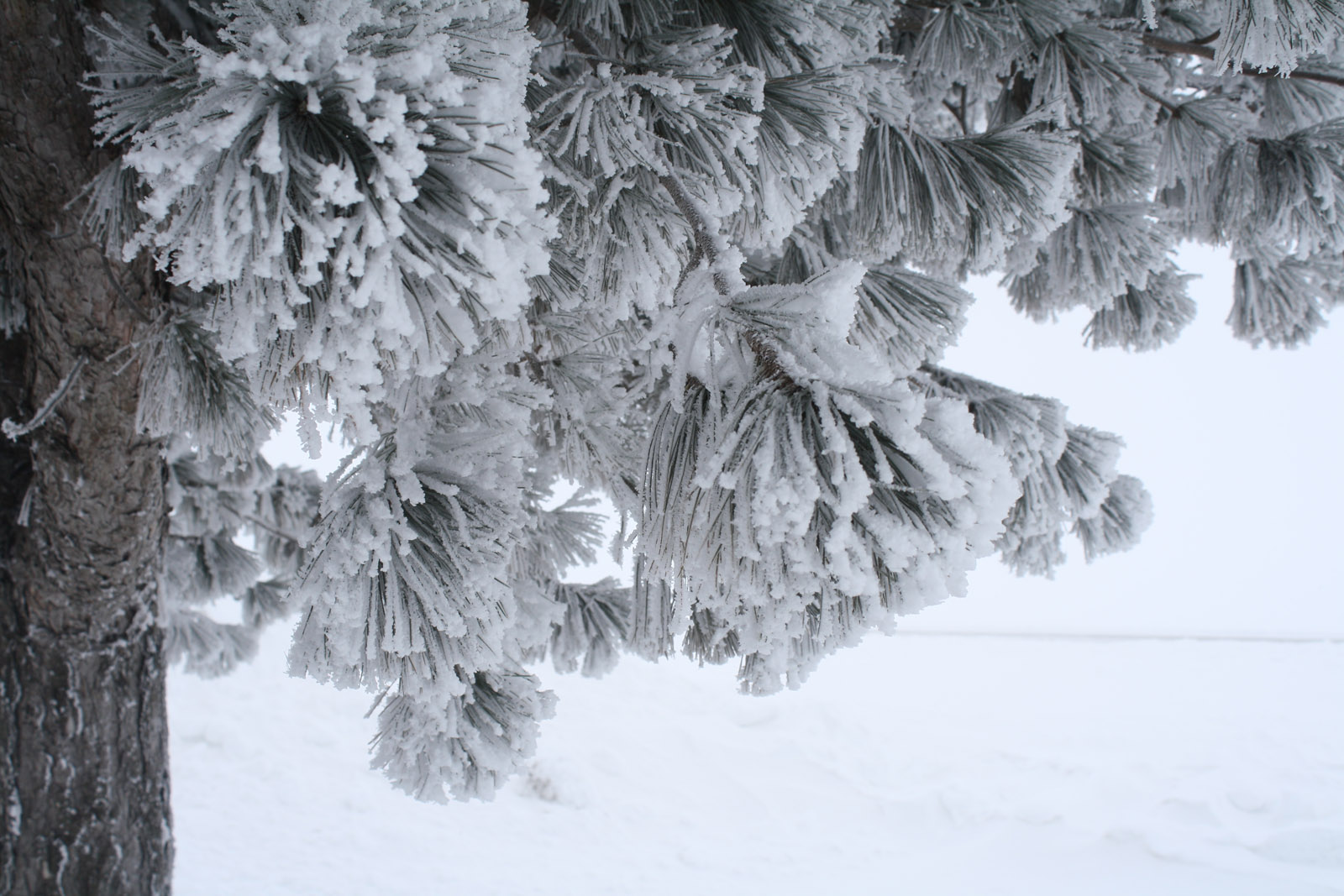
From our wildflower garden. September, 2009. (Click photo to enlarge.)

I’ve been wanting to post a few pre-rain-and-ice winter photos from my time at Gunderland (my dad’s farm) early this week. The wintery weather is getting quite old, especially for those without electricity. Because of that, along with the “gray” weather photos below, to pep things up I decided to throw in the above photo of last September’s “sunshine” and color.

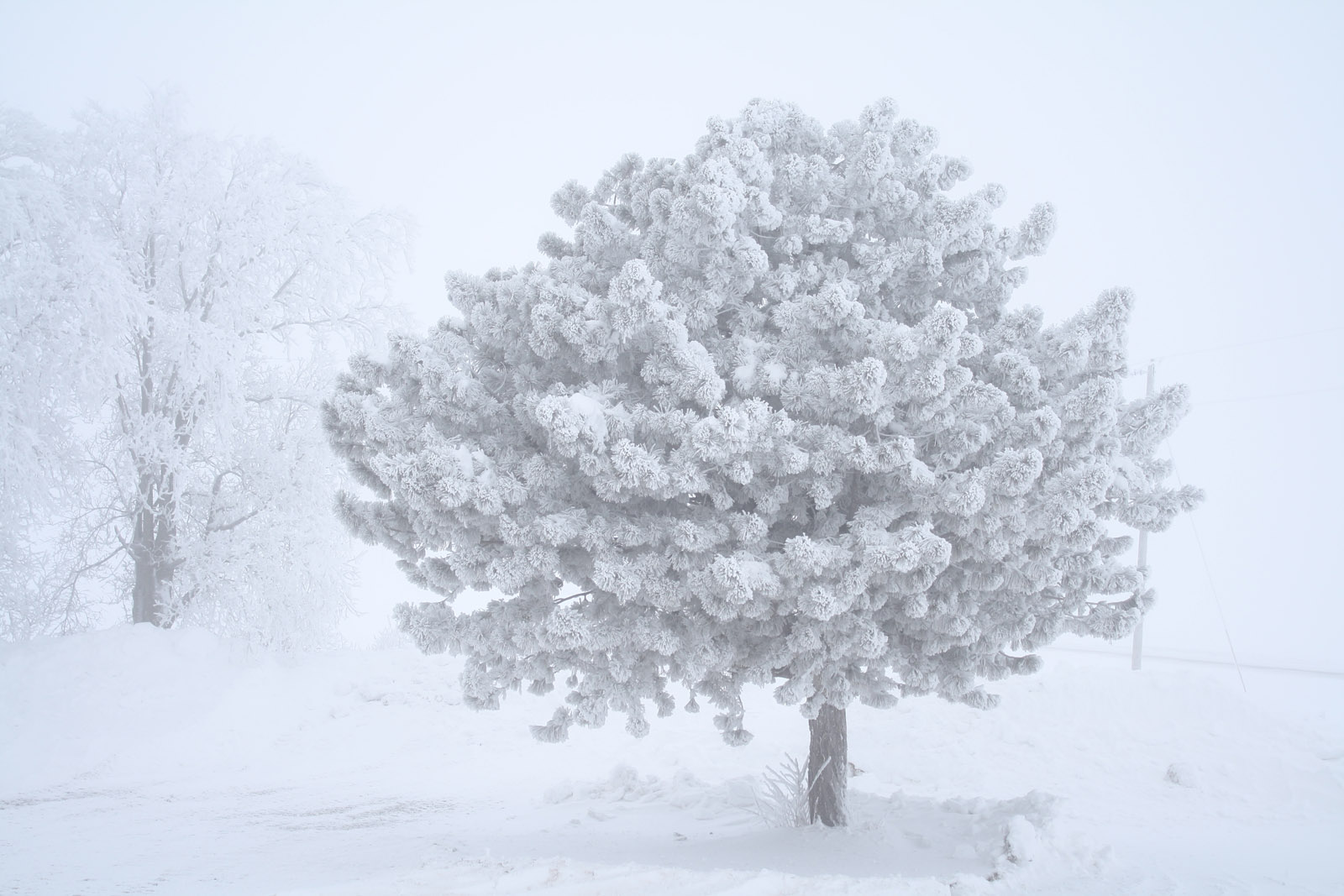
None of these photos are edited, except for resizing (but not cropping) the image files. I thought about Photoshopping these winter photos before posting so they would more closely resemble the actual scenery. I decided against editing them because, for one, I can’t really remember what the actual scenery looked like as far as color and whiteness because it was so foggy that day (Tuesday, January 20th). Also, because the photo shoot that day was an exercise for me in adjusting camera settings, including exposure, I figure I’ll post the original images and learn from them.

Next time I take photos of this wintery nature, I’ll try to have a gray card handy. (I’ll post about the benefit of a gray card sometime, as well. I learned about gray cards in my OLLI Photography Field Trips class.)

The following images are of the same tree at my dad’s farm and from approximately the same direction. For those of you aware of where my dad lives, this tree is to the west of the driveway, close to the gravel road.

Shutter: 1/250; Aperture: f/6.3; Exposure Bias: 1.33; Exposure Program: Aperture Priority; FL: 30 mm; Metering: Pattern; ISO: 200. (Click photo for detail.)

.

Shutter: 1/160; Aperture: f/8.0; Exposure Bias: 1.00; Exposure Program: Normal; FL: 23 mm; Metering: Pattern; ISO: 200. (Click photo to enlarge.)

.

Shutter: 1/400; Aperture: f/5.0; Exposure Bias: 2.00; Exposure Program: Aperture Priority; FL: 36 mm; Metering: Pattern; ISO: 200. (Click photo to enlarge.)

When I took this photo (immediately above), I tried a variety of exposure settings.  If I reduced the exposure at all, the photo looked too dark for how bright the scene actually was. It was pretty bright, but not this chalky white.

UPDATE:  In response to Clara’s comment asking from which direction I took these photos, click here for a photo that includes more of the surroundings.  If you are familiar with the area, the photo should help give bearings.

(Click here to go to Louise Shimon’s blog’s home page.)