Author Archive

Manure Hauling in 1948 (Part I)

January 25, 2011

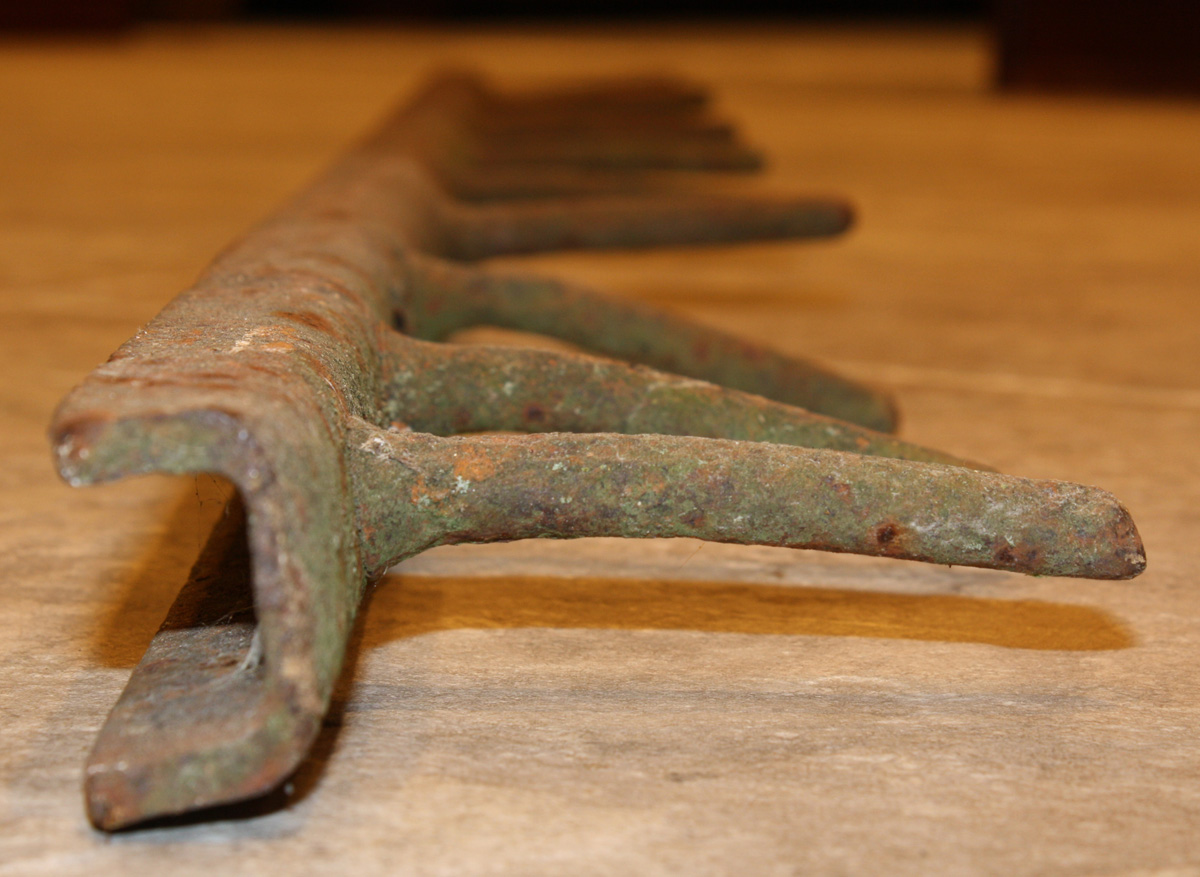
Loel Diggs, formerly of rural Rolfe, Iowa, (D.M.T. ’56) saw my post that included a photo of a manure spreader beater bar. Doing so prompted him to send to me two photos and manure spreader-related memories from his youth.
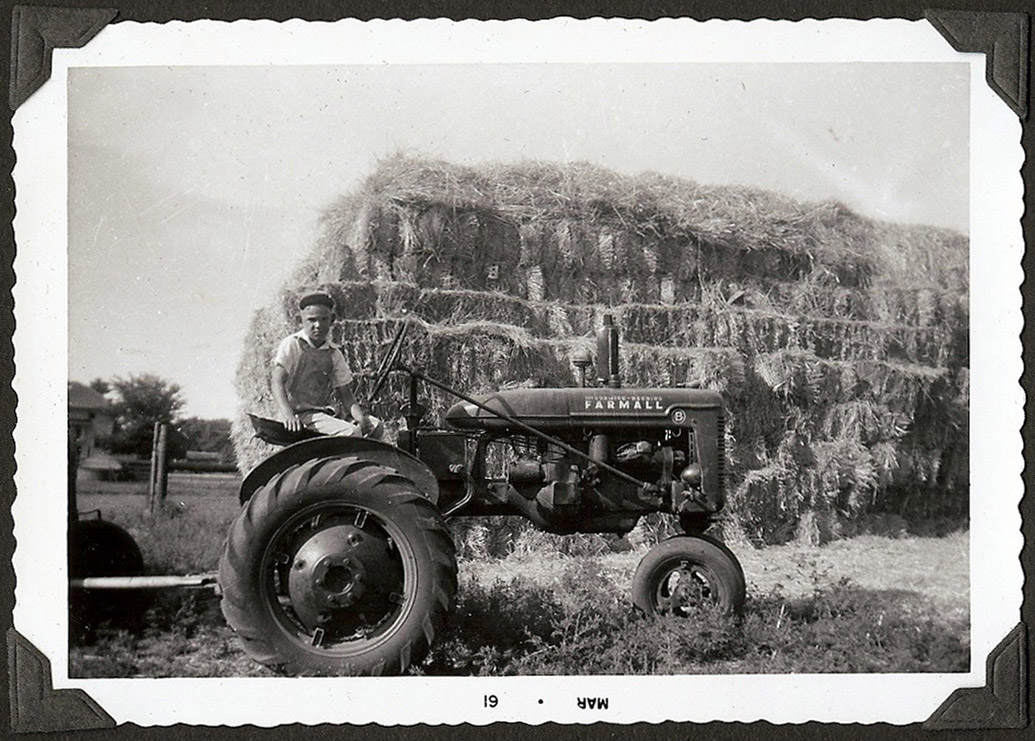
This picture of Loel was taken in 1948, not in 1961 as dated on the white border. He was about 11 years old at the time. The tractor is a Farmall B. The tractor and spreader shown here were owned by Loel's Uncle Frank. (Click on photo to enlarge.)

Manure Hauling Memories of Loel Diggs

I found these pictures* that my Mom took of me when the mid summer (after oat harvest) manure hauling season was going on. I had two uncles** that were involved in raising livestock, as my parents*** were, so a couple weeks in early August were spent removing all the manure piles around the barns and the cattle sheds cleaned out.

I wasn’t old enough to run the tractor with the manure loader, but was old enough to to run a rig back and forth from cattle yard to field. Really felt grown up, (even though I was only about 11 years old when these pictures were taken) that I was trusted with a rig, to drive it, unload it and not tear the spreader up. At the time these pictures were taken the spreaders being used were all recently converted horse drawn spreaders being pulled by tractors. Being that the spreaders were designed to be pulled by horses, the mechanics of the spreaders could be stressed very heavily during manure hauling season, because of the increased speed capable with a tractor over the speed of horses. Even at the age I was, I was reminded that if I broke the unload mechanism (floor conveyor chain) I got to unload the spreader with a pitch fork. I recall in having that honor only once or twice, with help in pitching it off from my Dad, of course!

Relating to the beater reels and bars [referred to in a previous post], if the baler twine was not always taken out of the hay being fed or out of the straw being used for bedding you would spend time cutting the twine off the beater reels and bars with your jackknife. You might say you could get up close and personal with beater bars—— doing that type of cleanup!

* * * * * * * *

*The second photo will be posted in Part II.

**Loel’s two uncles referred to here were Conrad and Franklin Majorowicz.

***Emma and Tom Diggs

(Click here to go to Louise Gunderson Shimon’s blog’s home page.)
Pocahontas, Iowa, in the Summer of 1949 (Part II)

January 23, 2011

To make sense of this post, it would probably help to refer to Part I. While Part I definitely is about the summer of 1949, this Part II post is more of a potpourri about the general location (past and present) of Arlene Brockney’s story of when she was a teenager in 1949. Also, referring to the post titled Pocahontas, Iowa: One Subject Equals Two Paintings will explain about Mother’s (Marion Gunderson) almost identical watercolors of the Pocahontas grain elevator, painted the same year as Arlene’s story…1949.

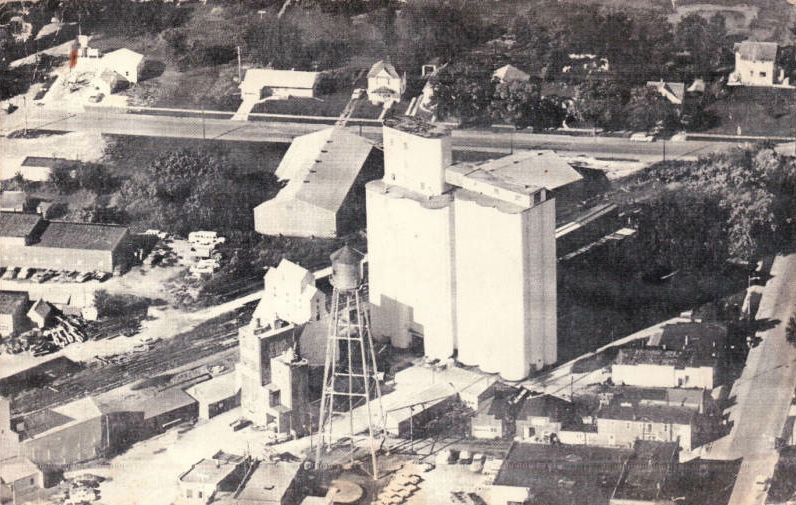
This is an eBay photo of Pocahontas, Iowa. The camera is at the east looking basically to the west. In the upper left corner is just a tad of Highway 3 with what looks like one car on it. Also at the upper left is what I'm thinking is a gas station at the location of the current Pocahontas branch building of the Rolfe State Bank. The water tower in this photo no longer exists. The grain elevator annex (the 2nd tallest large building in this photo) was not present at the time Mother (Marion Gunderson) painted her two Pocahontas grain elevator watercolors. According to the Pocahontas County History (1981) the 200,000 bushel annex was built in 1954. Also according to the history, a new 400,000 bushel silo (not in this photo) was built in 1970. From that, I assume this photo was taken sometime between 1954 and 1970. You can also see the car dealership in the bottom center of the photo. The train tracks in this photo run from southeast (lower left) to northwest (upper right) along the southwest side of the grain elevator. After looking closely at Mother's watercolors of the Pocahontas grain elevator, I see that the railroad cars were between her and the grain elevator. With that in mind, I'm assuming Mother painted her Pocahontas Grain Elevator watercolors at a vantage point south or south-southwest of the grain elevator. (Click on photo to enlarge.)

.

My research about Mother’s vantage point for her two 1949 Pocahontas grain elevator watercolors included my talking with Bob Bellows, Rolfe State Bank Vice-President. Bob works at the branch office in Pocahontas. On my behalf, he conducted research of his own. According to Bob’s source, there had been a double-wide trailer where the Rolfe State Bank branch building now sits. Bob and I are assuming it is the same trailer in which Arlene Brockney lived. (Arlene’s story is in Part I.)

Bob also said there was a DX station (as Arlene also mentioned) closer to Highway 3. The DX station was owned by Jerry Hotovec. The DX station was sold and another building built at the same location in the mid-’60s. This building was the Superior 400, which later became a Gulfstream station, and then was the Pro Coop’s cartrol (i.e., credit card-only station.) The former location of those businesses is now the location of the current bank branch parking lot. It is sandwiched between the Highway 3 and the south side of the branch bank building.

The Rolfe State Bank branch in Pocahontas opened in September of 2001…in a trailer (different than the one Arlene mentioned) which was to the south of the current RSB building. On March 1st of 2004, the Rolfe State Bank moved from the trailer into the present branch building.

* * * * * * * *

* * * * * * * *

(Click on photo to enlarge.)

.

*In case you missed it, here is my oldest sister Clara’s comment from Part I about Mother’s watercolors of the Pocahontas grain elevator.

I remember going with Mother once when she painted the Pocahontas elevator. Although we probably were with other members of the Barr Art Association, I don’t remember if they were there or it was just Mother. Nor do I recall how old I would have been, but if it was this painting, I was probably seven.

One thing that we didn’t discover until recently is that sometimes Mother created more than one painting of the same thing. We think it’s the same, but when we look closely we discover differences. That’s true with this elevator painting. We don’t know if Mother was so intrigued with the painting that she did another, if she was trying to correct a flaw (she always thought of something that could be improved), or if she was creating another painting for someone else.

(Click here to go to Louise Gunderson Shimon’s blog’s home page.)

Pocahontas, Iowa, in the Summer of 1949 (Part I)

January 20, 2011

In November of 2009 the Des Moines Register published an article about Mother’s (Marion Gunderson) work and her watercolors. The timing of the article coincided with the open house at Bill’s and my Perry, Iowa, home. At that open house, prints of Mother’s watercolors were sold with the profits going to the Rolfe Public Library Trust.*

Pocahontas Grain Elevator II Prints are available in three sizes: Medium (Limited Edition, 10" W x ~12.3" H, $25), Grand (~18" W x 22" H, $50), and Largest (20" W x ~24.5" H, same size as the original, $70). (Click photo to enlarge.)

The watercolor featured in the Register article was that of the Pocahontas, Iowa, grain elevator, shown at the left. The article caught the attention of Arlene Brockney of Waukee who lived in Pocahontas in the late 1940s and is the daughter of Viola Jacobson.

Arlene’s recollection of the grain elevator construction is as follows.

* * * * * * * * * *

Pocahontas Elevator, Summer of 1949

My family lived west across the street while it [the grain elevator] was being built. They worked all day and night pouring the cement. For the workers there was a huge night-light that was also great for evening walks.

My mom went to work at the Ideal Cafe at 5 o’clock in the morning. As she would leave the house for work, the construction crew would holler down to her their orders for breakfast. That way, hot food was ready for them when their shift was done.

When the elevator was finished, my mother and two sisters rode to the top and waved at me. Our lot is now in the approximate area of the parking lot for the branch office of the Rolfe State Bank.


The building in the foreground is the Pocahontas, Iowa, branch of the Rolfe State Bank. As a teenager, Arlene Brockney lived in a trailer that, in the 1940s, was in the vicinity -- just north -- of what is now the location of the bank building. The grain elevator that Mother painted is behind the bins in this photo. The street at the far right is Highway 3 running east/west. The camera is pointed primarily east. (Click photo to enlarge.)

* * * * * * * * * *

Arlene said she was 14-years-old and detasseled corn that summer of 1949. She said that the night-light for the construction crew was like a helicopter hovering. Arlene chuckled when she said that the light did not allow for privacy, making her glad that the elevator construction was completed by the time she started dating!

In the midst of the breeze of the summer nights, while on the ground, Arlene could hear the construction workers above talking. Well, actually mumbling with people below not knowing exactly what the workers were talking about.

At that time, Arlene’s family lived in a trailer on the Pocahontas property that is now owned by Rolfe State Bank.

(Click here to view Part II including what I think is a 1950s or ’60s aerial photo of the Pocahontas grain elevator.)

* * * * * * * *

* * * * * * * *

At this link you’ll see information regarding prints of Mother’s watercolor (shown above) as well as where you may purchase them in Rolfe. Prints may also be ordered online. Mother also painted the Rolfe grain elevator and train depot (two watercolors) and Gilmore City grain elevator and depot (one watercolor).

*All profits go to support the digitizing of 101 years of Rolfe newspapers so they will be accessible online. Hopefully they will be online in March.

Click here to go to Louise Gunderson Shimon’s blog’s home page.

I learned, a new definition for a term, that I might, maybe, use sometime.

January 18, 2011

Recently my brother-in-law Jeff revealed to me, via my sister Peggy, the Urban Dictionary meaning for the term “Shatner commas.”

The meaning is at this link: http://www.urbandictionary.com/define.php?term=Shatner%20commas&defid=4307935

If you didn’t already know what “Shatner commas” are, now you do!

* * * * * * * *

I haven’t been working on the blog much recently because I’m catching up just a little on my to-do list. However, I’ve got another manure spreader post coming up soon.

(Click here to go to Louise Gunderson Shimon’s blog’s home page.)

Developing Talents and Strengths — Part II

January 17, 2011

(Part II is continued from Part I. Both posts are about the book Now, Discover your Strengths.)

* * * * * * * *

The chapters are short and segmented into mini-chapters, making a good mix for an easy and light, yet thought-provoking read. Combined, they all point to the authors’ philosophy that our talents, knowledge and skills combine to create our strengths.

One Chapter 5 segment is titled “Why Should I Focus on My Signature Themes?”*  Other segments are titled: “Not all of the phrases in the theme description apply to me. Why?” “Why am I different from other people with whom I share some of the same themes?” “Will I become too narrow if I focus on my signature themes?” “How can I manage around my weaknesses?” “Can my themes reveal whether I am in the right career?”

Fall 1996. Marcy Sparks (Northwest Elementary building principal) and I (media specialist, with the scissors) are pictured celebrating the "ribbon cutting" for Northwest Elementary's (Ankeny, Iowa) first Macintosh computer lab. We are in the lab; the library is on the other side of the pictured door. (Click on photo to enlarge.)

Back to my formal teaching career (mentioned in Part I) … Paula Lee was my first building principal in Ankeny (for years 1 and 2 out of my twelve years there). Marcy Sparks (pictured above) was my principal there for the next eight years (for my years 3-10). Their formal evaluations, notes in my mailbox, and verbal communication including genuine caring about ME (one of the signature themes for both of them just has to be “empathy”), had a way of focusing on my strengths. They made me want to keep on keepin’ on.

Don’t get me wrong. If I or others needed redirection, they gave it. But their overriding focus was on strengths. Although I didn’t realize it then to the degree that I do now, they (especially Marcy because I was on her teaching staff longer than I was on Paula’s) were both empowering influences on my teaching career, and therefore my life.

Am I glad I’m reading the book? Yes. Is everything it reveals news to me? No, but it does blow some dust off my brain and I think will help me (and those around me) get more out of my strengths. Will the book do my thinking for me? No. (Duh! But some people expect a book to do just that.) Do I recommend the book? Yes. However, I’d get the newer publication: Strengths Finder 2.0: A New and Updated Edition of the Online Test from Gallup’s Now, Discover Your Strengths.

*I think of the authors’ meaning for the word “theme” to be similar to the meaning of “strength.”

(Click here to go to Louise Gunderson Shimon’s blog’s home page.)

Developing Talents and Strengths — Part I

January 16, 2011

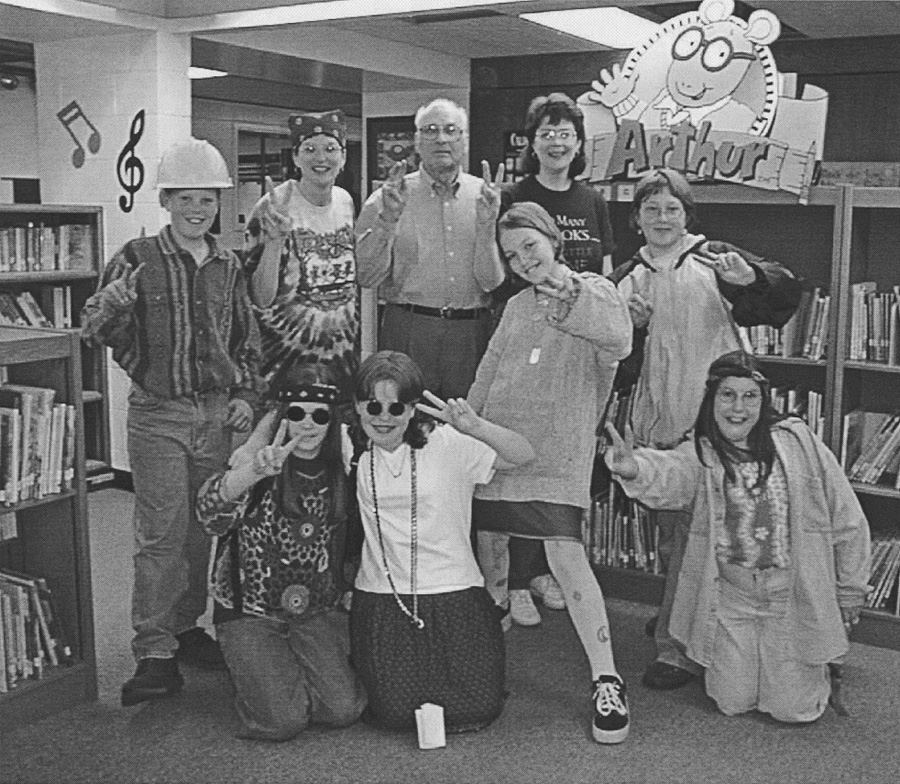
The adults pictured here are (L to R) me, my dad (Deane Gunderson), and my sister Peggy with several students at Northwest Elementary in Ankeny, Iowa. I was the media specialist (now called teacher-librarian) there for twelve years. The photo was taken in the school's library* in 1998 during our "Rock 'n' Read" reading program, hence the 1960s and '70s attire. When NW Elementary was remodeled ~4 years later, including a new library, the room in this photo was enclosed and became a kindergarten classroom. (Click on photo to enlarge.)

Four  years ago my oldest sister, Clara, gave to me the book Now, Discover Your Strengths. I had just left work (retired?) after 12 years with the Ankeny (Iowa) Community School District. At the time, I wasn’t really in the mood for something I perceived as serious … like that book.

Then I got busy spending so much time with Daddy and other family and friends. I had more time to spend at the lake. And, I was able to embark on raising funds for the Rolfe Public Library. These are perks, for which I am grateful, of leaving full-time employment.

With Daddy passing away in July, the cottage being closed for the winter, the holidays passing, and being caught up on most of my appointments, yesterday was an unscheduled day. I had a choice of either organizing my back-burner-to-do list or … read the “strengths” book Clara gave to me. Organize a list or read? I opted for reading the book.

Now, Discover Your Strengths by Marcus Buckingham & Donald O. Clifton, 2001. I recommend this book, but suggest getting the newer version which is Strengths Finder 2.0.

The theme of the book is helping people identify, focus on and capitalize on their strengths. Strengths, strengths, STRENGTHS. According to the book, each strength has at least one underlying talent. The authors of this book have the philosophy that it is a big no-no for us to focus on correcting our and others’ weaknesses. Positive results will not be obtained. When people focus on their strengths, positive results will be obtained.

On page 79 I was instructed to take the Internet-based “StrengthsFinder Profile” which I call the book’s “test” for identifying strengths.

It took about a half hour to complete the online test. (To access and take the test, I had to enter a unique code that accompanied my copy of the book.) Each of the “questions” was actually a pair of statements, of which I had to select the one that fit me most and indicate the degree to which it fit me; or I could just click on “neutral” which I bet I did for more than half of the pairs. One of the pairs of statements included something like, “You like to tell others about your life.” Um, how do you think I answered that!

(I just deleted from this post a long description of my test results. They are interesting to me; probably boring to you. Suffice it to say that I think three of my test-identified themes/strengths are 100% right-on for me. I think two of them are 50-to-75% right-on. Of course, that’s my subjective point of view!)

In Part II I’ll include a little bit about two people in my life who I believe share the philosophy of Now, Discover Your Strengths.

* * * * * * * *

*I believe it was 2002 when we moved into the new library/media center at Northwest Elementary. It was a palace compared to the library pictured, but each had its positive aspects.

(Click here to go to Louise Gunderson Shimon’s blog’s home page.)

A Closer Look at Red Flower

January 14, 2011


(Click image to enlarge.)

It won’t be long before I change the red and green banner at the top of this blog. Before I do, I hope you’ll take a close look at the red rectangle and green rectangle in the banner. They are from portions of Mother’s (Marion Gunderson) Red Flower watercolor, painted in 1969.

Red Flower has been a great seller, with the profits going to the Rolfe (Iowa) Public Library for the online newspaper project. This watercolor is so vibrant and “feels” so alive.

Red Flower is listed online as a print on foam board (or loose in a tube) in three sizes. Also, when purchased directly through me* (with the funds still going to the library) the smallest size is available double-matted in two choices of mat combinations. Either a deep red outer mat and a whitish-cream-colored inner mat. Or, with both mats being the whitish-cream-color. When the small size is matted as such, it will fit in a standard size 11″ x 14″ frame.** The double-matted prints are $29, not including shipping costs.


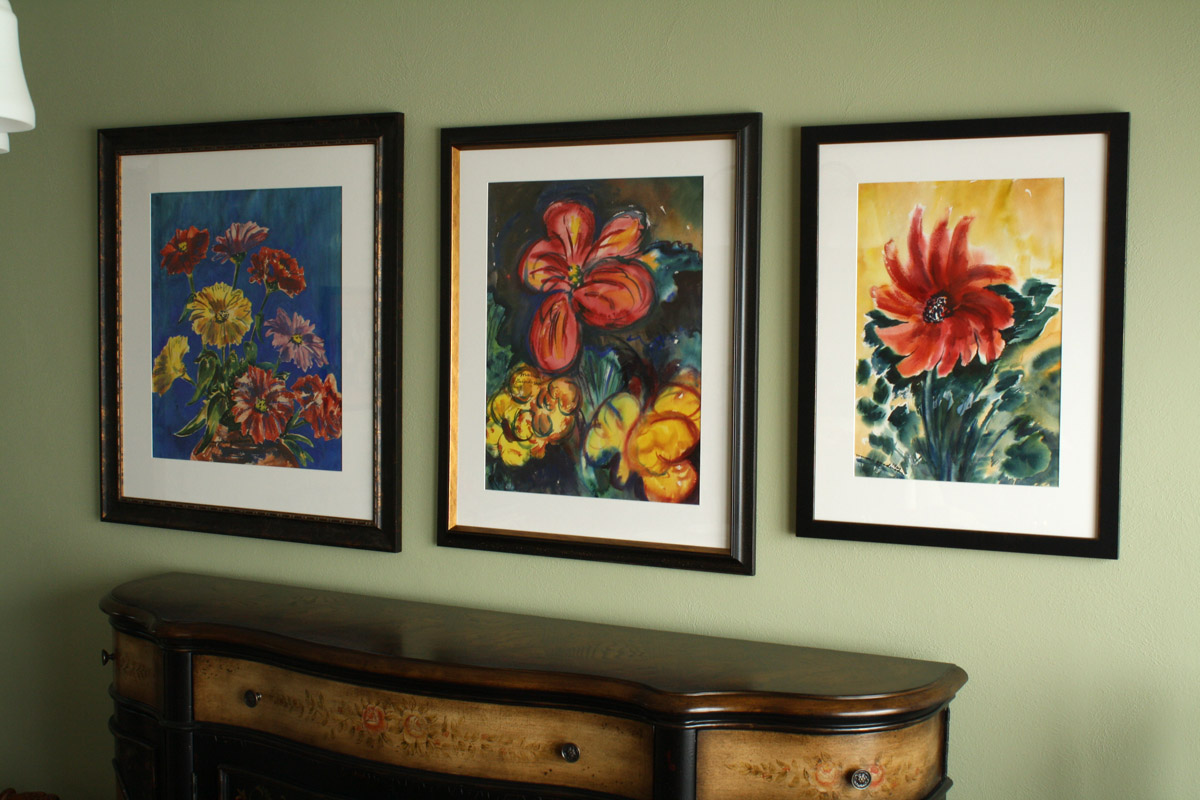
These watercolors were painted by Mother and are now in Bill's and my home. Mother signed the middle watercolor while she was in the nursing home, less than a year before she passed away in 2004. The watercolor had most likely been painted decades prior. (Click photo to enlarge.)

Several people have wanted a print of something painted by Mother, but don’t have wall space to add something large, and/or don’t want to have to take the time to go somewhere to pick out mats and a custom frame. Or, don’t want to have to wait for a custom frame. The pre-matted prints are a win-win-win for all of those reasons.

*Red Flower matted prints are sometimes, but not always, available at the Rolfe (Iowa) Public Library and Wild Faces Gallery in Rolfe. If you prefer to purchase in Rolfe (as to opposed to at the online “store” or through me) anything of the prints offered, and if you let me know your desire, I’ll communicate to make sure what you want is in Rolfe for you. mariongundersonart@gmail.com

**To clarify, the double-matted prints fit in an 11″ x 14″ frame if the frame is cut for those dimensions. I’ve run across one frame that was advertised with those dimensions. However, it was actually a 10 7/8″ (not 11″) frame by 14″ … so the matted print would not fit. Otherwise, the standard size frames have fit just fine.

* * * * * * * *

(Click here to go to Louise Gunderson Shimon’s blog’s home page.)

I Stepped in It (Part II)

January 11, 2011

(Continued from Part I.)

Here is the farmer after I asked him for permission, and just before loading composted chicken manure into the spreader. (Click on photo to enlarge.)

And, he was! I stopped to ask him if I could take photos to post on my blog. When doing so, I walked out into the field. Just a few steps.

And, after those just few steps it dawned on me that even though I was just at the edge of the field, I could still be stepping in manure, even if I avoided the big chunks. Oh well. Too late!

.

A few miles north of Jefferson, Iowa, filling up before the next round (next two photos) in the field. (Click photo to enlarge.)

.

Composted chicken manure (from the pile in the previous photo) being spread by a Chandler litter spreader. (Click on photo to enlarge.)

.

Composted chicken manure. (Click on photo to enlarge.)

The farmer gave his permission; he also said that the manure in the pile he was spreading was “chicken manure mixed with compost.” Well…that shot my connections from the day before (i.e., the nearby cows, and the sign on the back of the guy’s pickup), but, again, oh well!

I realize this might be a little anticlimactic after Part I. I had so many photos I just had to break it into two parts. Maybe to jazz it up a little we can make believe that instead of me being out and about, it was some other woman. Let’s name her Jezebelle. She’s a photographer for National Geographic. And, she drove into the driveway of the field and went out into the field to talk to the farmer. He offered her a cup of ice water from the cab of his end loader, and they developed a relationship Jezebelle would never forget, only because the manure smell stayed on her mind. Bridges of Madison County-esque!

Now, I must go clean my shoes.

* * * * * * * *

* * * * * * * *

(Click here to go to Louise Gunderson Shimon’s blog’s home page.)
I Stepped in It (Part I)

January 10, 2011

My shoes are still in the garage. I had such a heyday (two of them) on Monday and Tuesday of last week, ending with me unwittingly stepping in chicken manure and then getting in the car to drive away (i.e., the car did not smell pretty).

North of Jefferson, Iowa.

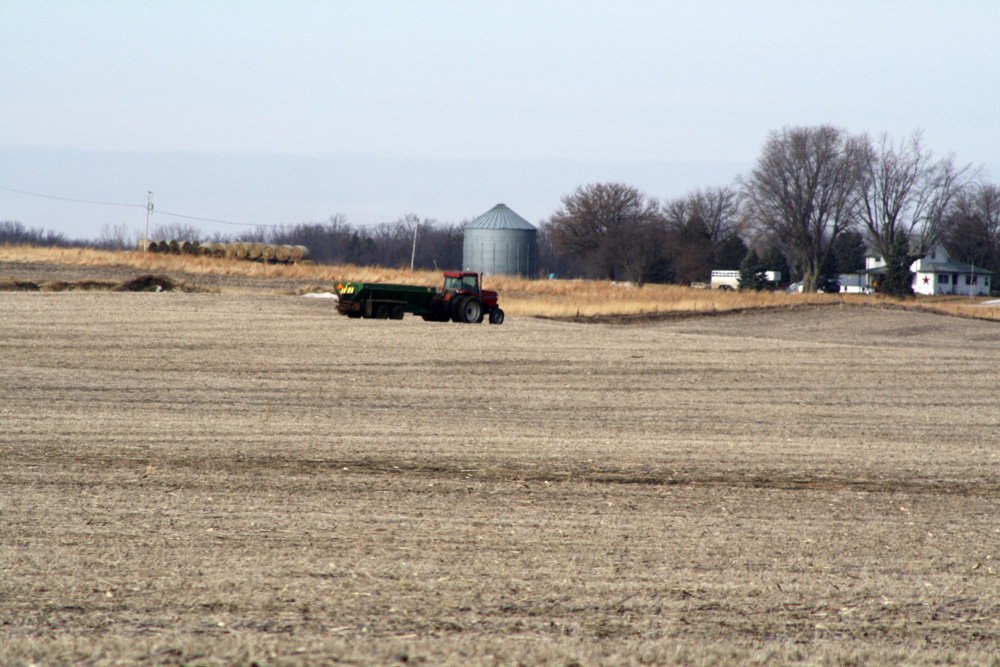
Last Monday, on no certain timetable, I drove to Rolfe for an overnight stay. Just north of Jefferson I looked to the west and saw a beautiful picture: a field with straight east/west rows of stubble and a manure spreader* throwing out chunks of manure. By the time I thought to take a picture, I was too far past the rows of the spreader location. By the time I turned around and came back, the spreader was at the opposite corner of the field. It appeared that the operator was taking a break.

I imagine that any farmer (or maybe just anyone, period!) will roll his/her eyes reading this post. Actually, I’m kind of embarrassed to say I did this because it was just so loosey-goosey. However, one thing I’m learning more after leaving full-time teacher-librarian work four years ago and having melanoma (now being almost five years cancer free) is to smell those flowers. So, here’s what I did.

When the tractor stopped at the edge of the field near the manure pile, I pulled off the highway and started to drive up the gravel road. I wanted to ask the farmer if he’d soon resume spreading manure. Just as I got near the field entrance, he pulled out onto the gravel road. Do I stop him? Or, do I just keep driving?

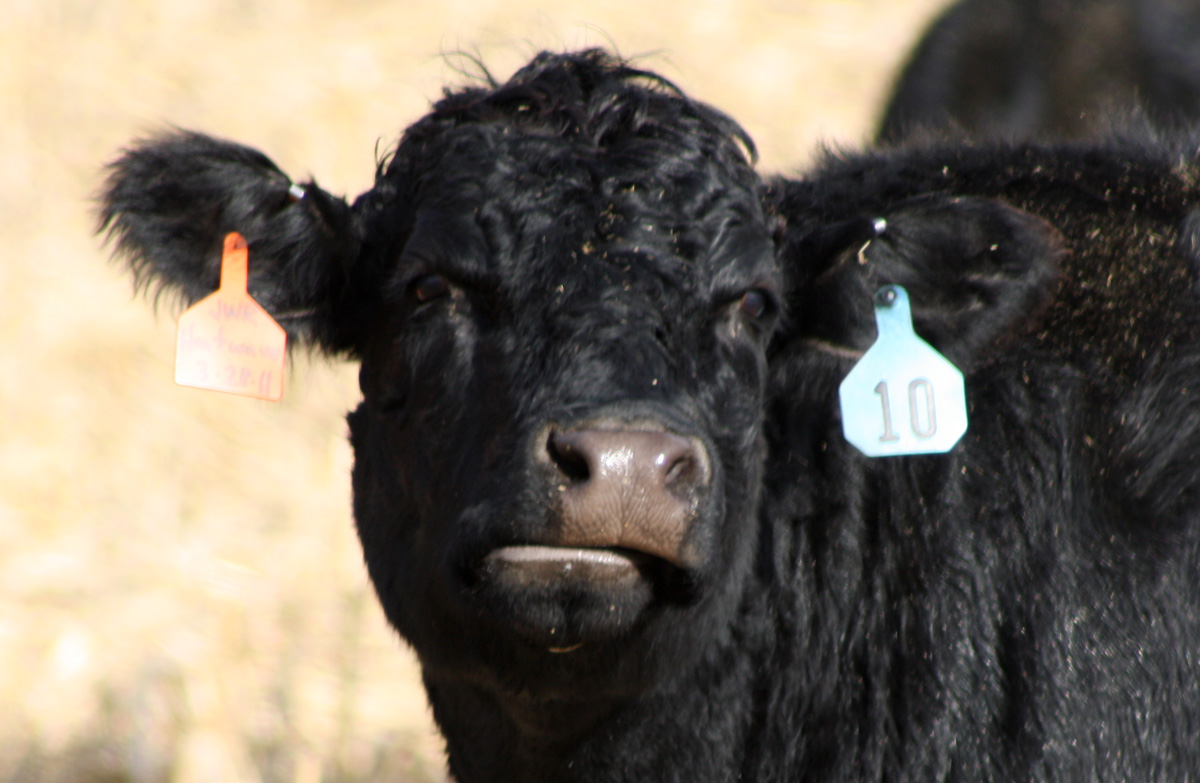
By the time the few seconds passed before we met on the road, I hadn’t developed a game plan. I drove past him and over the hill (so that he wouldn’t think I was stalking him!), planning to turn around. But, there were some cattle just past the hill on the opposite side of the gravel road. Hmmm. Cattle. Manure. I made a connection!

This bovine was over the hill across the gravel road from the spreader/manure pile. (Click on photo to enlarge.)


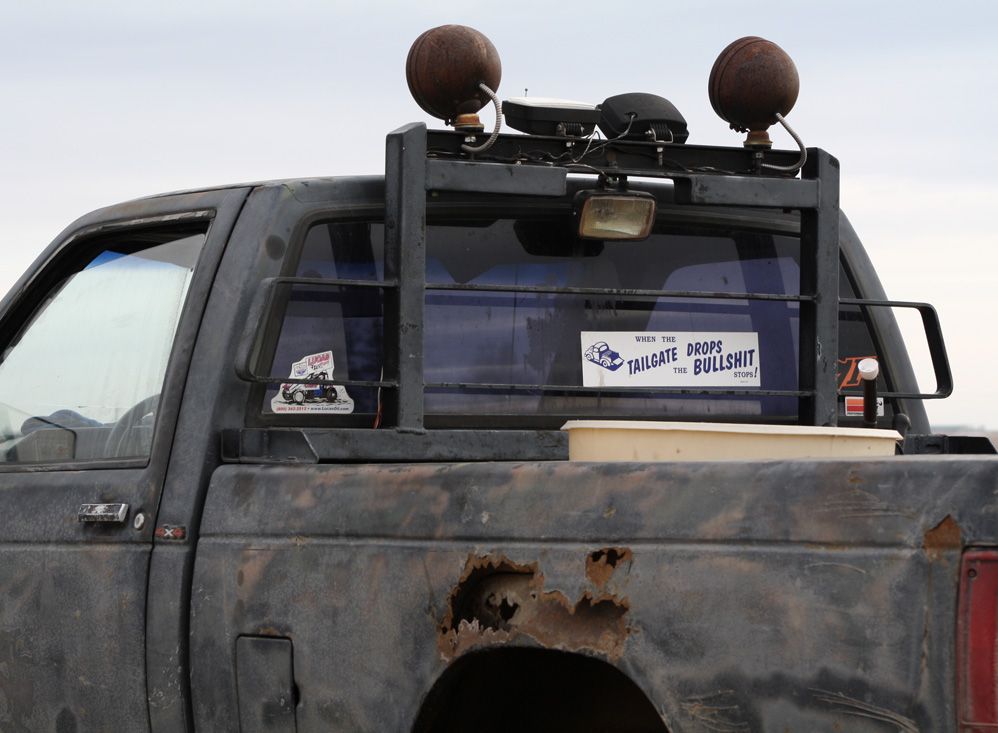
(Click on photo to enlarge the "bleep" text on this sign.)

So, I stopped and took photos of the cattle. Then I drove back to near the manure pile and saw the farmer’s pickup (which was there the first time I went past.) On the rear window of the pickup was a sign, which, if I had seen it in the Target parking lot, or if Jackson was with me and could read it, I’d think it was highly inappropriate. Somehow, seeing it out in this field, it seemed to fit. I made another connection!!! Boy, I’m really learning now!

This pile is the same field as in the first photo. The windmill was not in this field. (Click on photo to enlarge.)

After taking many photos, I drove the rest of the way to Rolfe, scanning the countryside for another operating tractor/manure spreader. I didn’t see any, but from a distance, took photos of anything that might have been a stationary manure spreader. (When I got home, at closer inspection, I realized that almost all of the maybe-a-manure-spreader photos were of something else.)

Once in Rolfe I ran several errands and did some work at Gunderland, all the while hoping that on my drive back to Perry the next day, the same guy would be out spreading manure north of Jefferson.

Since this is such a cliff-hanger, I’ll post Part II mid-week.

* * * * * * * *

After I post Part II, I’ll stay out of the manure talk and probably move on to a post about Mother’s watercolors of the Pocahontas grain elevator. Or, something else!

*I later learned it was a Chandler litter spreader.

(Click here to go to Louise Gunderson Shimon’s blog’s home page.)

The Cattle Chute at Gunderland

January 8, 2011

Gunderland, about 1969 or 1970. (Click on photo to enlarge.)

Almost always at this blog I include things that I hope will appeal to people outside of my family, as well as my family. However, sometimes I post something more with the narrowed intended audience being my own family…to keep our heritage fresh in our minds. I figure this is probably one of those posts.

In the last post I mentioned Charles’ (my brother) recollection that Daddy fed cattle one year in the 1950s. That made me wonder what photos my family might have related to those cattle.

Hmmm … Below are two photos of my five siblings and me on/in front of the cattle chute at Gunderland. On both photos my notation says “Christmas 1977.” In these photos, I was a shade over five months pregnant with Abby.

The cattle chute and we were on the west side of the barn (toward the north end) that stood at Gunderland. In the thumbnail photo (above left), the camara is “looking” south-southeast. The right-hand side of the barn is the west side of the barn.

December 1977. L to R: Helen, me (Louise), Clara, Marti, Charles and Peg. The wood pole in the background at the left is in the vicinity of the house. (Click on photo to enlarge.)

The photo above shows more of the roof and chute. The photo immediately below shows more of the west side of the barn. Later the roof of the barn was damaged. Neither the barn nor the chute stands any longer. Sometime I’ll post more about that.

December 1977. L to R: Helen, me (Louise), Clara, Charles, Marti and Peg. (Click on photo to enlarge.)


This photo of Gunderland was developed in 1965. The barn and cattle chute are toward the left side of the photo. The cattle shed is between the barn and corn crib; none of these three buildings is still standing. (Click on photo to enlarge.)

* * * * * * * *

(Click here to go to Louise Gunderson Shimon’s blog’s home page.)