2011 Soybean Harvest (Pocahontas County, Iowa)

October 7, 2011 by

Except for this post’s last photo, these photos and video are of Section 24, Roosevelt Township, Pocahontas County, Iowa. This section is about halfway between Rolfe and Pocahontas.

Click on any of the photos to enlarge them, and/or view the video in full screen mode.

In this photo I'm in the cab of the John Deere 9660 combine. I'm looking down on the bean head as it draws in the mature soybean plants. Video of this process is at the end of this post.

.

From this combine auger, soybeans are transferred to a wagon moving alongside the combine, i.e., dumping on-the-go. (This on-the-go dumping in Section 24 is shown in the video below.) Again, I took the photo from inside the combine cab.

.
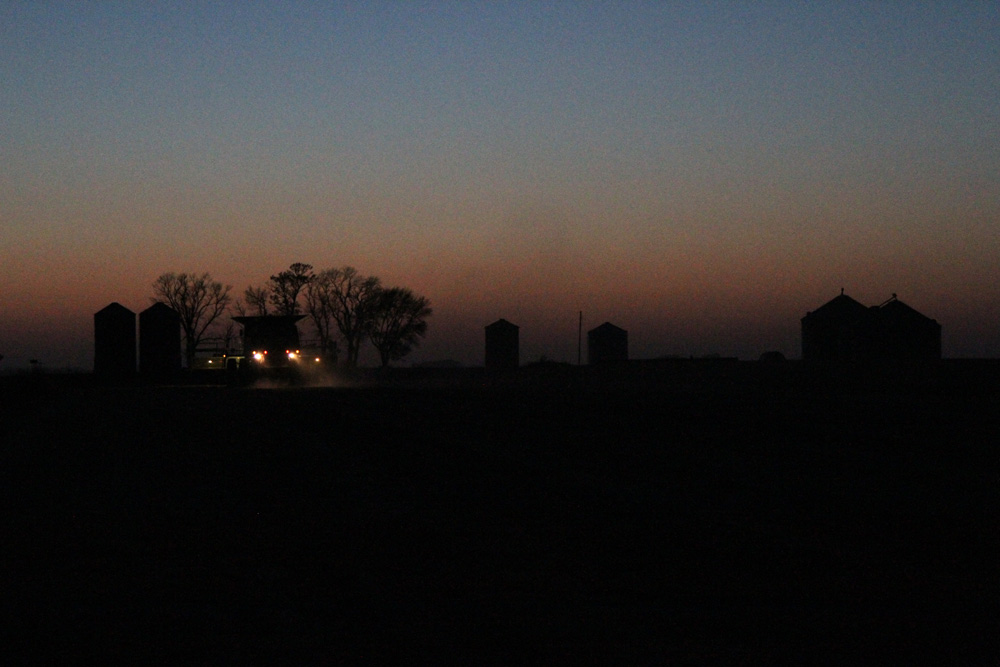
This photo including farmstead and lighted combine was taken two or three hours after the previous photos. At this point, I wanted to get from here (Section 24) to Gunderland (now the only farmstead in Section 13, which is where I was raised) quickly before they started dumping soybeans there to be stored in grain bins. (Until this point in the evening, the soybeans had been dumped at a farm 1/2 mile away where my dad was raised.) Here, I had just gotten out of the combine so I could drive to Gunderland, a little over two miles away. Where you see the silhouettes of the grain bins is the same farmstead where my dad (Deane Gunderson) was born in an upstairs room in 1918. (The house is no longer there.) This farmstead is also the former location of the "Bud Barn" which is now in Rolfe and owned by Roger and Dan Allen who are operating the tractor and combine seen in this post.

.

I love the hum of the grain drier and the hubbub when grain is dumped at this farmstead where I was raised in Section 13. Almost obstructed from view, on the far side of the larger wagon is a tractor. This tractor and wagon just arrived from Section 24 (the location of the photos above) about 2 1/2 miles away. If you click on the photo and look closely you'll can see the soybeans spewing from the auger (attached to the larger wagon) into the smaller wagon. From the smaller wagon they are transferred to a long auger which transports them to the top of the grain bin in which they will be stored. (The tractor at the far left is used to power the long auger.)

.

The following video was taken from inside the combine cab, with dust flying around outside. The location is the southwest field in Section 24, Roosevelt Township, Pocahontas County, Iowa. The video includes dumping on–the-go. It was so dusty and bumpy, and the video reflects that. Still, I’m glad to have it, if for no one reason than for grandson Jackson to see it. He loves combines and harvest, and he is fond of Rog and Dan Allen, the two guys running this operation. Rog and Dan were very close to my dad; they were integral in making it possible for my dad to continue living on the farm until just before he passed away in mid-2010.

If the video play is jerky at all, let it play through once while you do something else. Then watch it when it plays a second time. That might allow it to play more smoothly. Also, to view it in full screen mode, after starting the video click on the lower right corner of the video rectangle.

.

* * * * * * * *

(Click here to go to Louise Gunderson Shimon’s blog’s home page.)

Art Education — Part II

October 5, 2011 by

Written by Clara Gunderson Hoover

(To view Part I, also written by Clara, click here.)

Clara in 1966 with a painting she created. (Click on image to enlarge.)

I was in 4-H for nine years.  The focus changed every year: food and nutrition, clothing, and home furnishings, and then the cycle repeated.  The home furnishings year included a picture study.  In 1952/53, I scored 70% in the picture study contest.  In 1955/56 I gave a picture study on Pileated Woodpecker, by John James Audubon, participated in the picture study contest and wrote that my favorite picture was The Dancers (painting and artist unknown to me now).  My  4-H Record Book contains a certificate for having participated in the 1959 Picture Memory Contest.  Clippings in my Record Book report the Garfield Gleaners visiting art museums in Cherokee and Des Moines. In addition, I wrote that my favorite paintings were Blue Boy (Thomas Gainsborough) and Pinkie (Thomas Lawrence).  I have no idea if they were part of that year’s picture study but recall seeing them at the Huntington Art Gallery in San Marino, California, when we went to the 1959 Rose Bowl.  One year we studied Grant Wood’s Stone City.  What a treat to see the original at the Joslyn Art Museum after my husband and I moved to Omaha.  I believe Grandpa’s (John Gunderson) favorite, The Horse Fair, by Rosa Bonheur, was also one of the 4-H paintings.

For many years, the Rolfe Public Library had a collection of art reproductions people could check out to display in their homes.  Mother took us to the Blanden Art Museum in Fort Dodge.  She exhibited there and participated in some of the museum’s activities.  Later Mother attended art exhibits in cities throughout the country, sometimes with Rolfe friends and other times with her life-long friend, Betty Dix Kirley.  During a 1991 trip to Minneapolis, Mother, Betty Dix and I visited the Walker Art Gallery and the Minneapolis Institute of Arts.

.

On the left side of this 1953 Rolfe Arrow page is a write-up about one of the art exhibits in which Mother (Marion Gunderson) participated. (Click once or twice to magnify the image/text.)

.

Mother had taken classes from Richard Leet, then director of the MacNider Art Museum in Mason City.  During summer 1967, my husband and I lived in Charles City, so I drove the 30 miles to Mason City to take painting lessons from Richard Leet.  I learned the importance of white in paintings.  In summer 1973, I was required to take two courses to obtain a Nebraska teaching certificate.  I chose an art history course and absolutely loved it.

.

Pictured here is Mother's framed print of Flower Vendor by Diego Rivera. If you click on this image, you'll see Mother's handwriting explaining that this painting was her lasting favorite and why. Her note is not dated.

.

Throughout her life, Mother introduced us to art and artists, including Christian Petersen, the Iowa State sculptor who had been one of her instructors at Iowa State; Diego Rivera, whose The Flower Vendor was one of Mother’s all-time favorites; Dale Chihuly and his colorful blown glass sculptures (even at the Joslyn in Omaha); and R.C. Gorman, whose Su-Sho-Ba hung above the dining table in our farm house for as long as I can remember.  How thrilled I was to suddenly see Picasso’s powerful Guernica at the top of the stairs in the Museum of Modern Art in New York City.  What fun to see real Calder mobiles in downtown Chicago and at the National Gallery of Art in Washington, D.C.  One of my most memorable art experiences with Mother was in spring 1988 when we met in Chicago to see the huge, retrospective exhibit of Georgia O’Keeffe’s paintings at the Art Institute of Chicago.  O’Keeffe had long been one of Mother’s favorite artists.  When I discovered the O’Keeffe exhibit was going to be in Chicago, I called Mother to ask if she’d like to meet me there.  The paintings were truly amazing.

Indeed, although I had no art classes in grades K-12, we had many opportunities to learn about art (at least art appreciation, if not production) in a variety of ways and from several people.  It’s been fun to recall those experiences.

Thanks to my siblings for sharing their recollections.  Thank you, also, to Penny Tilden, Rolfe Public Library librarian, and Lola DeWall, Pocahontas Public Library librarian, for their research.

* * * * * * * *

(Click here to go to Louise Gunderson Shimon’s blog’s home page.)
Good Morning, October

October 1, 2011 by

.

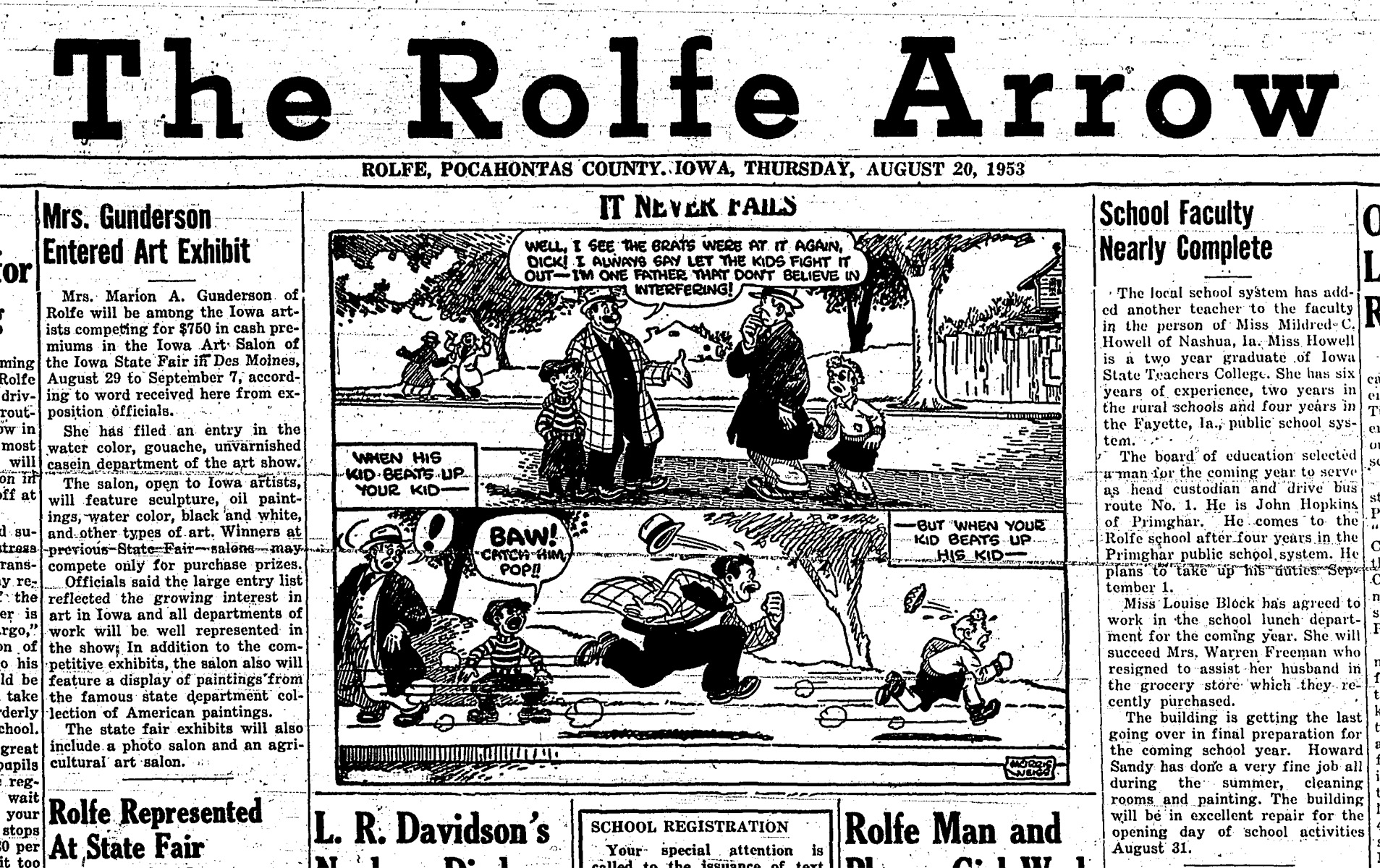
This was my vantage point every morning growing up at Gunderland (near Rolfe, Iowa), as it was this morning. Until several years ago, this view included a large red corn crib, a tiny red chicken house, and fewer round grain bins.

Later this morning, soybean harvest will resume here.

(Click here to go to Louise Gunderson Shimon’s blog’s home page.)

Soybean Harvest — or — Good-night, September

September 30, 2011 by

.

I feel I shouldn’t interrupt Clara’s “Art Education” article. I also so enjoyed riding in the combine tonight in Section 13, Roosevelt Township, Pocahontas County, Iowa. So, interruption, it is. Pictured is the field that nearly surrounds the farmstead where I was raised.

I hope you’ll click on the photo to enlarge it.

Soybean harvest today, Iowa State football tomorrow, and then I’ll follow up with Part II to Clara’s “Art Education” article.

(Click here to go to Louise Gunderson Shimon’s blog’s home page.)
Art Education — Part I

September 27, 2011 by

Written by Clara Gunderson Hoover

.
.

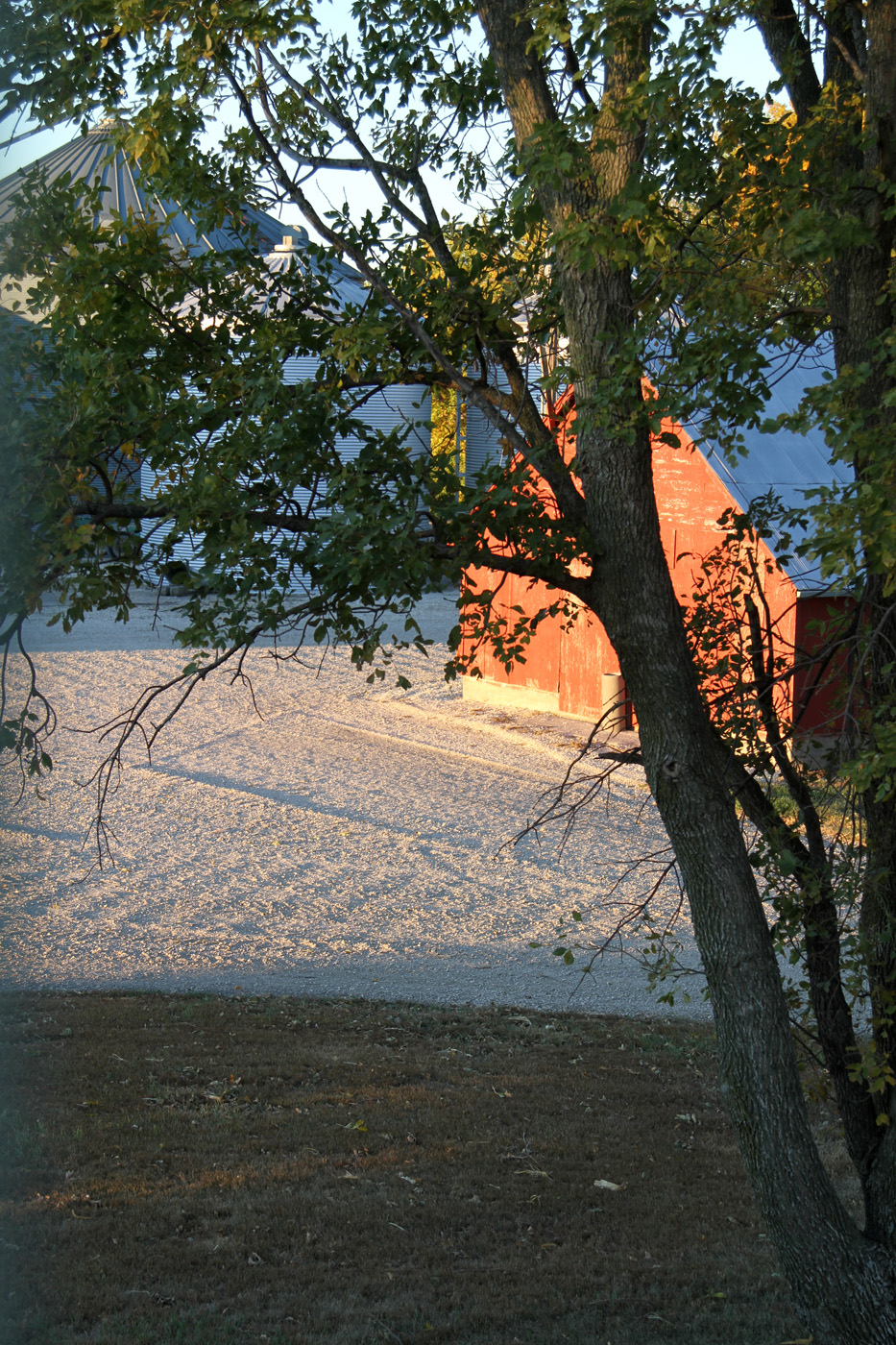
Mother (Marion Gunderson) was disappointed that the Rolfe Consolidated School did not offer art in any grades.  We had music in elementary grades and listened to the different instruments in Peter and the Wolf but had no art production or appreciation during the time I was in school (1947-1960).
.

Carla Jones, as pictured in the 1965 Rolfe Ram yearbook.

In the early sixties, Carla Jones began teaching art in Rolfe.  During her at least ten years in Rolfe, she taught high school art, junior high social studies and, sometimes, elementary art.  My sisters Martha, Louise and Peggy remember Carla as encouraging students and giving them a great deal of latitude in choosing projects.  Martha recalls, “Carla was my first formal art instructor who had me really ‘look’ at something, to see its shape, the lines, the texture, their relationships, and had me do exercises related to those topics on newsprint.  Her lessons were an important foundation for me and very relevant to [art] classes at Iowa State.”

Recently I’ve reflected on things Mother and others did to help us not only learn about art, but also create art.  Arts and crafts were part of vacation Bible school (VBS).  Steven Graeber is an accomplished potter who grew up in Rolfe and later moved with his family to a farm near West Bend.  He now lives in Evergreen, Colorado, and said his first experience with clay was as an elementary student in VBS.  My brother, Charles, was in the same class, and Mother was their teacher.  They worked with slabs, coils, free forms and pinch pots.  Arts and crafts were the primary motivation for my sister Martha to attend VBS where she made plaster of Paris handprints, loom-woven potholders and small items formed from Popsicle sticks.
.

Vera Fisher invited the girls in her high school Sunday school class to her home after school to glaze ceramics and fire them in her kiln.  While few of these projects were original creations, we enjoyed making them and learning about the ceramics process.

From the February 5, 1953, Pocahontas Record-Democrat.

.
At least one summer, Mother drove me and some of my siblings to Pocahontas for lessons with Grace Pearl Walters in her Art and Hobby Shop, which at that time was located on the west side of Main Street across from the Rialto Theatre.  Grace was known as the “Bird Lady,” perhaps because her store also sold pets, and traveled to shows and fairs with her items.  I have only a vague memory of being in her classes and suspect I made enameled copper jewelry and created something with beads.

.

Pictured is Clara painting at the kitchen table with one of Sharon (Wickre) and Jerry Rickard's sons. (Sharon and Clara are classmates from Rolfe's class of 1960.)

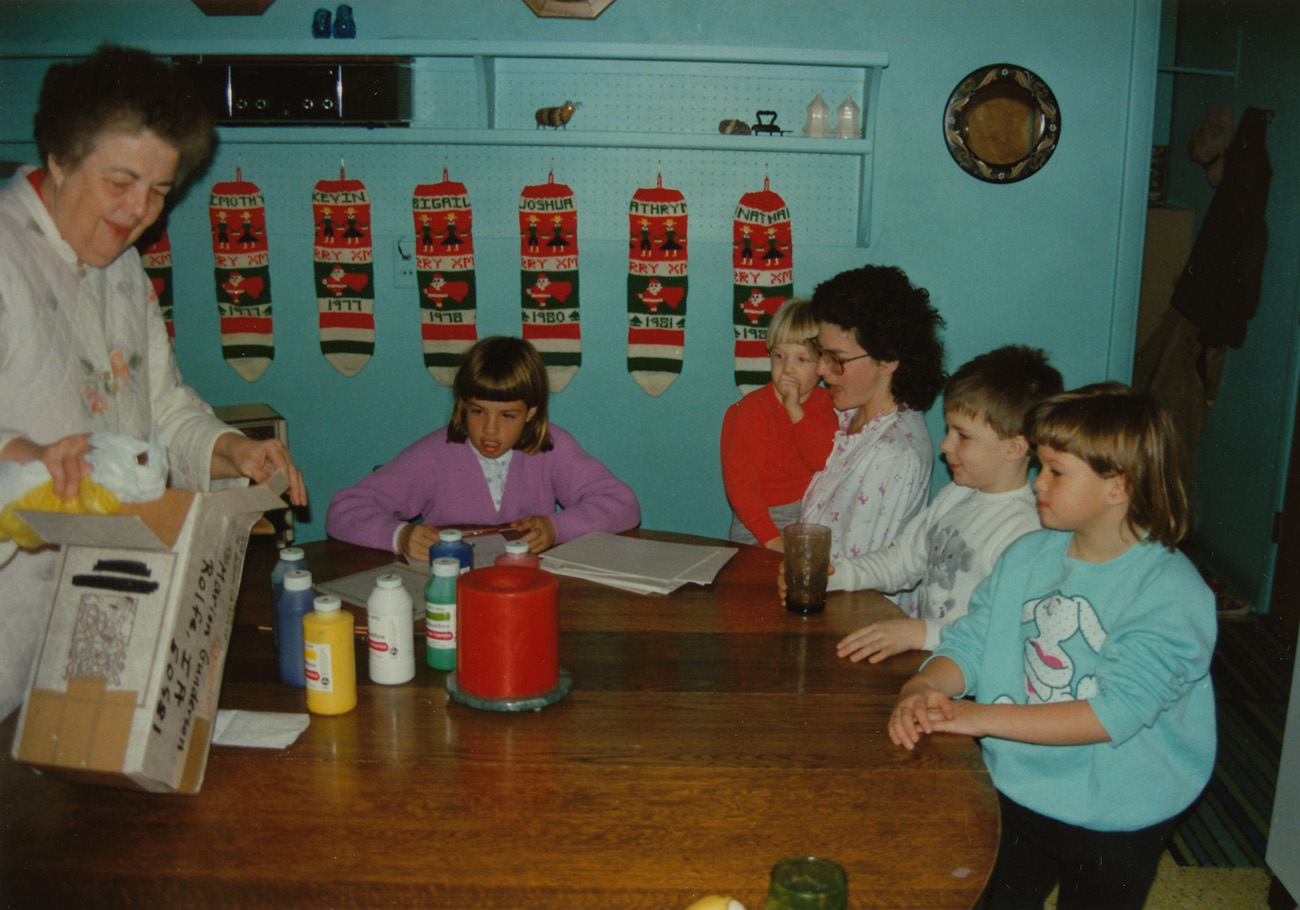
In the summers when I was young, I occasionally accompanied Mother when she painted on location with members of the Barr Art Association.  Once we went to the gypsum plant near Otho; another time we went to either the Pocahontas or Gilmore City elevator.  I took my own small stool, paints, watercolor paper and coffee can of water for rinsing paintbrushes.  Getting to paint with the adults was a treat.  As children, we sometimes watched Mother paint at home and enjoyed seeing her paintings propped up in the kitchen or dining room.  Later, as adults, we smiled as Mother and her grandchildren* (or children of our friends) painted on papers spread across the kitchen table.

City Hall, Gunnison, Colorado, watercolor by Marion A. Gunderson, 1964. (Click on image to enlarge.)

The summer after her sophomore year in high school, Martha traveled with Mother to a watercolor course in Gunnison, Colorado.  Martha went on some of the painting outings and enjoyed the scenery and peacefulness of the surroundings but doesn’t remember doing much painting herself.  Martha said she was always interested in art and was influenced by Mother as a 4-H leader and by her artistic background, use of color and way of arranging things.  Influenced by both Mother and Carla Jones, Martha majored in applied art at Iowa State.

.

.

* * * * * * * *

* * * * * * * *

*Mother had seven grandchildren. Four of them are pictured here.

“Art Education — Part II” will be posted later this week.

Mother was born 92 years-ago today. Happy Birthday, Doll!  :  )

(Click here to go to Louise Gunderson Shimon’s blog’s home page.)

Before Soybean Harvest: Adjusting for Hail Damage

September 24, 2011 by

Pictured is Bill Shimon with Jerry Kleymann. Bill is my husband. Jerry is a crop adjuster for Rain and Hail Insurance. Date: September 23, 2011. Location: Section 13, Roosevelt Township, Pocahontas County, Iowa. What's going on?: Analyzing extent of June hail damage to soybean crop. Why now?: Jerry and Bill inspected this field once last summer --- a couple of weeks after the June hail storm --- to do an initial analysis. Yesterday they returned for a final analysis, intentionally waiting until harvest is imminent, which it now is.* (Click on photo to enlarge.)

.

I like this photo for many reasons. 1.) This field nearly surrounds the farmstead where I was raised and where my dad lived until mid-2010. 2.) I love harvest. 3.) The photo lets me see one facet of Bill’s work. 4.) From a photographic standpoint, I like how the focus is on Bill and Jerry, but the soybean plants in front of and behind them are out of focus. (To see #4 for yourself, click on the photo to enlarge it.)

.

The photo above is a cropping of the photo at left (i.e., at left is the original). I took this photo with the combination of my Canon 135 mm lens and a Canon Extender EF 1.4X III. The combination offered a focal length of 189 mm. I was about twice (maybe three times?) as far from Bill and Jerry than appears in this photo. Shutter: 1/800; Aperture: f/5.0; ISO: 100; Exposure Bias: 0.00.

.

*Depending upon a variety of conditions (especially weather and seed variety), harvest has already started in some fields in northwest Iowa.

(Click here to go to Louise Gunderson Shimon’s blog’s home page.)

Threshing, Horses, Haystacking, Etc. (and Happy Birthday)

September 16, 2011 by

Ninety-three years ago today, my dad, Deane Gunderson, was born in an upstairs room of a farmhouse that was located at the southwest corner of Section 24, Roosevelt Township, Pocahontas County, Iowa. Daddy made it to 91 years of age before passing away on July 1, 2010. In honor of his birthday, a Miller High Life (Daddy’s beer of choice) showed up today in Rolfe at his gravesite.

This post includes two audio clips of my dad speaking thirty years ago…1981. They are excerpts from one of his oral history tapes. In the clips he talked about work on the farm during his growing-up years, including his memories about threshing.

In the first audio clip (3 1/2 minutes) my dad referred to his Uncle Art (a brother to my Grandpa John Gunderson and pictured below), farming responsibilities (including driving cattle and sometimes hogs to town with the aid of horses) when my dad was a boy in the 1920s and/or 1930s, and his horse named Chance. He also talked about the use of a haystacker (a rope and pulley mechanism, see image immediately below).

.

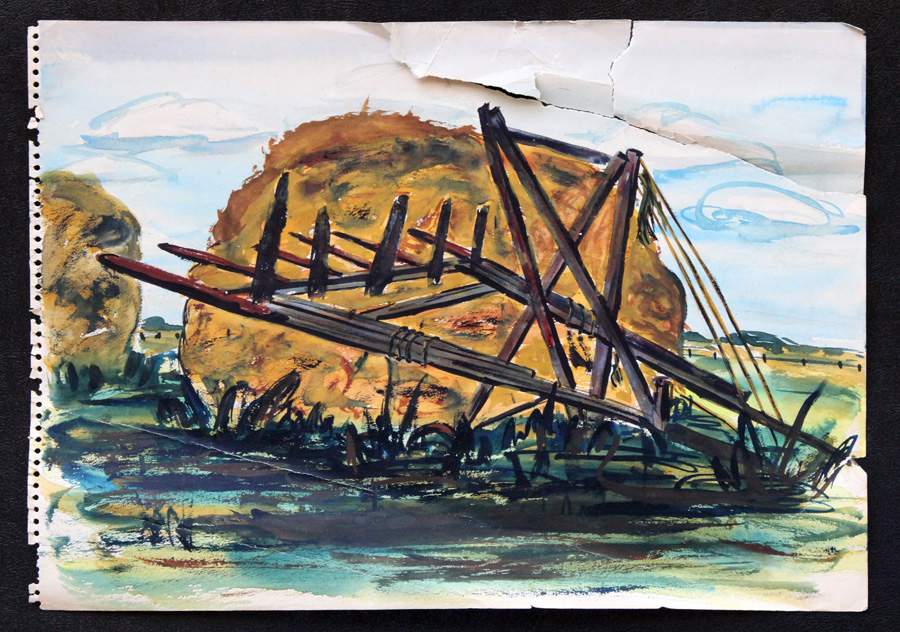
This watercolor is of a haystacker, referred to by my dad in this post's first audio clip. The watercolor was painted by my mom. She and my dad were married in 1941 and in 1945 moved to the farm southwest of Rolfe, Iowa. I assume Mother painted this in the 1940s or soon thereafter, but I'm not sure. (Click on image to enlarge.)

.

In the second audio clip (5 minutes) my dad spoke about oat harvest/threshing, his family moving into the tractor era, his Uncle Art, area farmers (including the Brinkmans, Wiegmans and A.V. Graeber) and threshing rings. In this clip my dad made reference to an “18-36” McCormick Deering. At first I thought he meant the year 1836 and wondered how that could be. After doing research on the web, I realize he meant “18-36” and not “1836.”

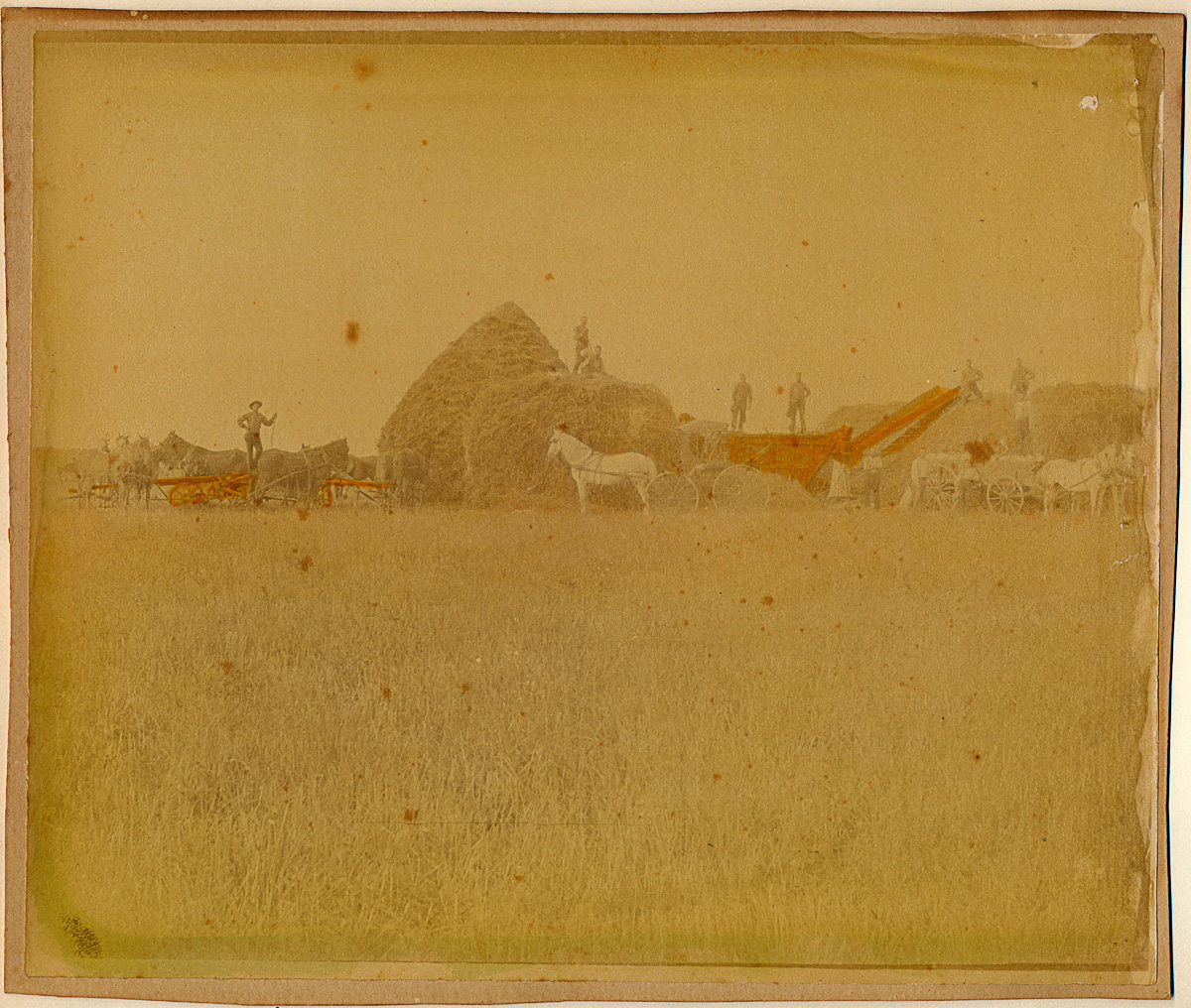
In the photo immediately below is a threshing operation and what Josh Lindgren* thinks is an 8 horse power. I found this photo in a scrapbook that my mom, Marion Gunderson, put together. In the scrapbook, next to this threshing photo, is this post’s second photo (scroll down) of eight horses. I have no idea if these horses operated an 8 horse power or not. I like to think they did and that it was why my mom put the two photos adjacent to each other.

If you didn’t watch the video yet (about threshing oats with a 12 horse sweep) from the previous post, you might want to watch it to better understand this next photo.

To really understand this photo, click on it once or even twice to enlarge it. This photo is from a scrapbook organized by my mom. At the far left is what Josh Lindgren* said is likely an 8 horse power. In the middle are two stacks, I assume of straw and chaff. Somewhere in the middle is likely a tumbling rod(s) similar to that in the video linked to in the previous paragraph. To the right of center in this photo is the threshing machine. A sack is at the right end of the thresher. The grain settled toward the bottom of the thresher and was moved along into this bag. The wagon at the far right holds bags of grain ready to be hauled away. Also at the far right, the oats are being loaded onto the thresher conveyor at the beginning of the threshing process. I assume this photo was taken in the 1920s or before.

.

This photo of eight horses was on the same scrapbook page and next to the threshing photo (above). I don't know if these horses were involved with the threshing my dad spoke of or when driving cattle to town and/or in the yellowed threshing photo. I like to think they are. (Click on photo to enlarge.)

.

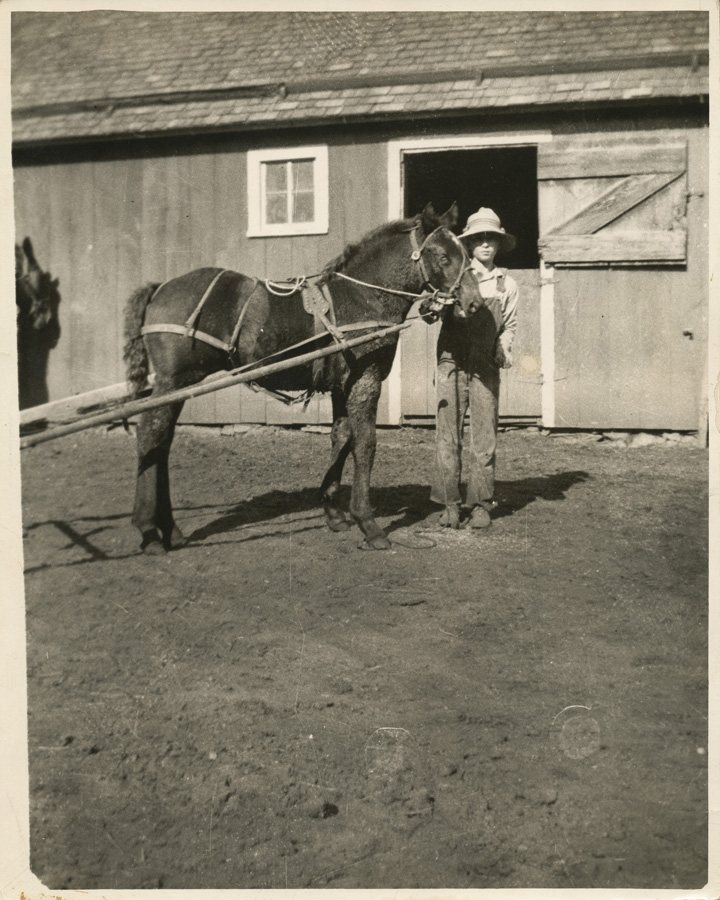
Pictured here is my dad when he was 12 years 2 months old. (Click on photo to enlarge.)

.

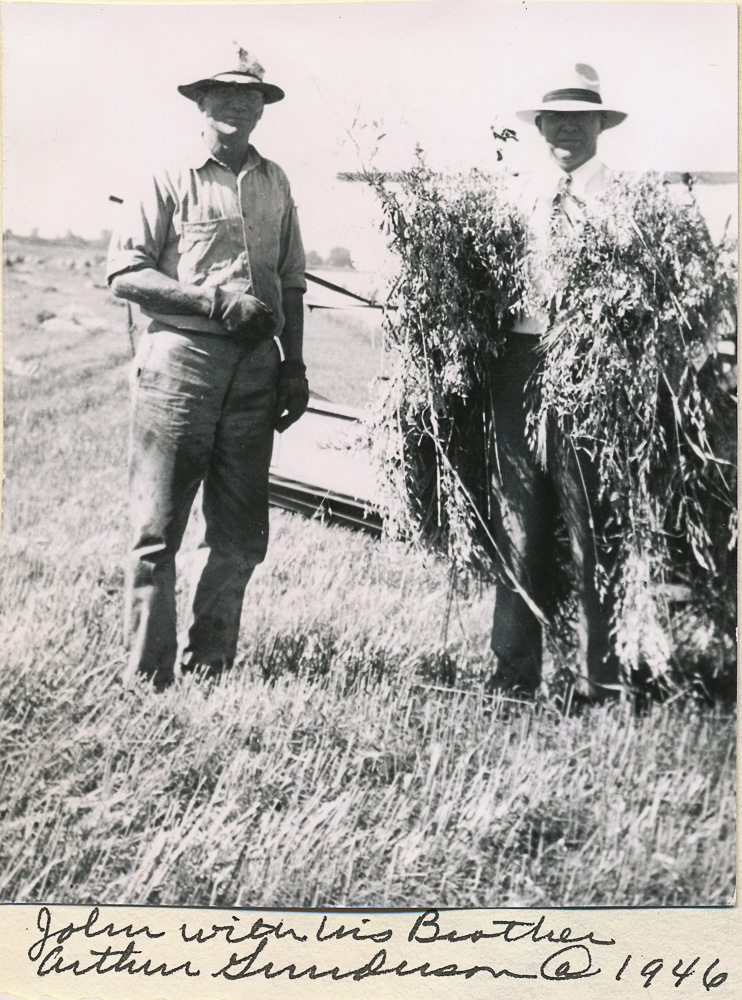
At right, holding the oats, is my Great-Uncle Art, to whom my dad referred in both audio clips in this post. Grandpa John is at the left. (Click on image to enlarge.)

.

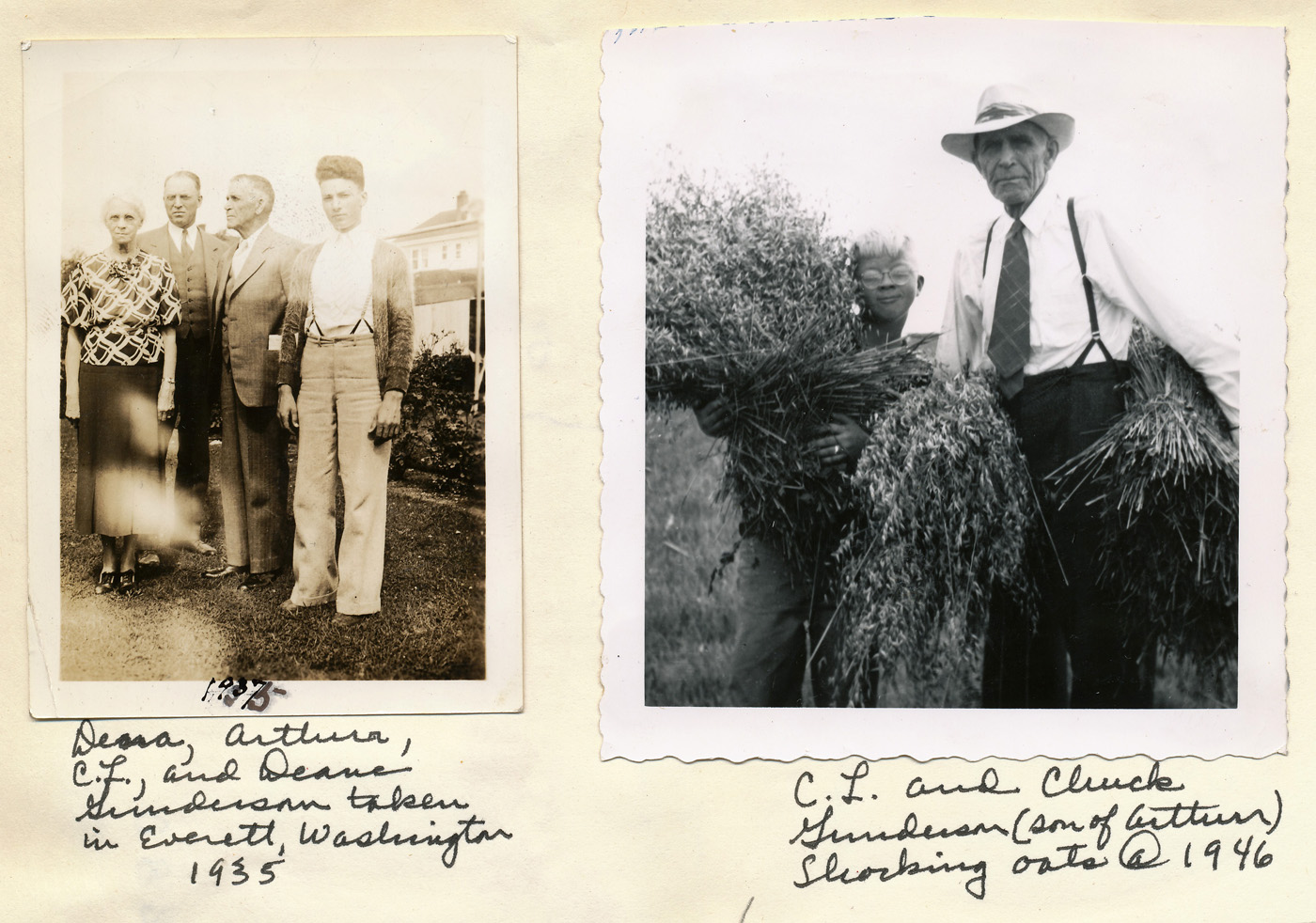
I included these two photos together because my Great-Uncle Arthur (in the left photo) was the son of C. L. (in both photos) and father of Chuck (in the right photo). C.L. (Charles Lewis) was my great-grandfather and was married to Dena, my great-grandmother (also pictured here). In the photo at left, my dad was 17-years-old. (Click on image to enlarge.)

.

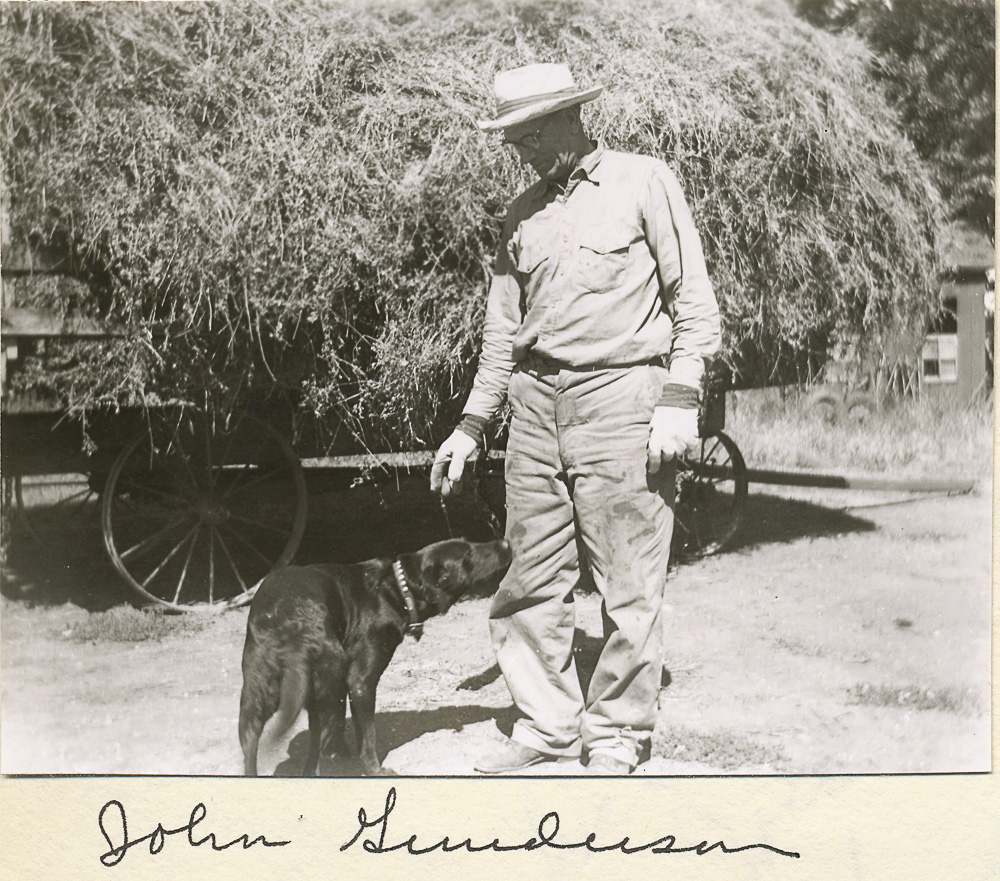
Pictured is my dad's dad/my grandfather with a load of what I assume was oats. (Click on image to enlarge.)

.

*Josh Lindgren is from Marathon, Iowa. A photo and video of Josh and two of his horses is included in this post.

(Click here to go to Louise Gunderson Shimon’s blog’s home page.)
“12 Horse Sweep” or “12 Horse Power” Threshing

September 14, 2011 by

I’ve got a variety of things — with a variety of content related to threshing — that I want to post. The items are interrelated, but also random. So, I’ll post a chunk at a time.

In the previous post, I included video of horse power involving two horses. That horse power was used to elevate grain into a wagon. This was not as taxing a process as threshing. So…two horses (as opposed to many horses) handled it just fine.

In the following YouTube video, oats were threshed with what is called (in the YouTube video) a “12 horse sweep.” This horse power/sweep is similar in concept to the horse power involving two horses, but, in my opinion, much more complex. And…powering a much more taxing process, therefore requiring more than just two horses.

Watching the YouTube video will help explain part of my next post, which will be about threshing in general, but will touch on horse power. There won’t be a test, but to better understand the next post, I hope you’ll watch this video.

.

(Click here to go to Louise Gunderson Shimon’s blog’s home page.)

Horse Power

September 11, 2011 by

This horse power was demonstrated at the 2011 Albert City, Iowa, Threshermen and Collectors Show. (Click on photo to enlarge it.)

.

The horses pictured above belong to Josh Lindgren of Marathon, Iowa. Josh is operating the horse power in these two photos and also in the video below.

Wikipedia offers one explanation of horse power. The explanation refers to horses walking on a treadmill. Obviously Josh’s horses are not walking on a treadmill, but instead in a circular sweep. Another explanation is here.

..

Josh Lindgren of Marathon, Iowa, walks behind his horses during this demonstration of horse power. (Click on photo to enlarge.)

.

This 1-minute video was taken at the 2011 Albert City Threshermen and Collectors Show. Just two horses were involved in this video. In a subsequent post I’ll include a photo of what Josh thinks is an 8 horse power (i.e., 8 horses).

.

.

I’m not sure if the term is technically two words (horse power) or one word (horsepower). The most common spelling I found on the web has it as two words.

(Click here to go to Louise Gunderson Shimon’s blog’s home page.)

Steam Engine Powered Wheat Threshing

September 8, 2011 by

.

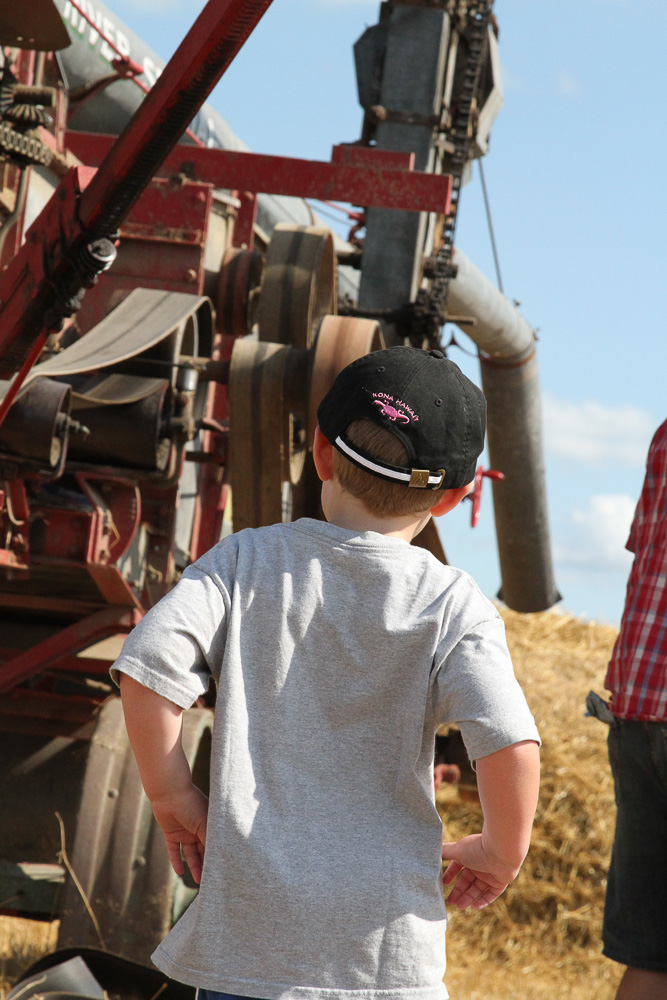
On August 11, 2011, I posted about pre-1940 steam engine powered oat threshing. On August 12, Bill, Jackson (Bill’s and my grandson, pictured above) and I attended the Albert City, Iowa, Threshermen and Collectors Show. Threshing of wheat — not oats — was demonstrated there. All three of us enjoyed the demonstrations involving machinery and horses, talking with those demonstrating, the parade of implements, and the ice cream.

The 5-minute video below is from one of the August 12 demonstrations. It is of shocked wheat and a threshing machine powered by a steam engine, similar to my Great-Uncle Art’s oat threshing rig.

In a subsequent post, I’ll include a short video of horsepower driven (as opposed to steam engine driven) threshing.

.

.

(Click here to go to Louise Gunderson Shimon’s blog’s home page.)