Archive for the ‘Uncategorized’ Category

2011 Soybean Harvest (Pocahontas County, Iowa)

October 7, 2011

Except for this post’s last photo, these photos and video are of Section 24, Roosevelt Township, Pocahontas County, Iowa. This section is about halfway between Rolfe and Pocahontas.

Click on any of the photos to enlarge them, and/or view the video in full screen mode.

In this photo I'm in the cab of the John Deere 9660 combine. I'm looking down on the bean head as it draws in the mature soybean plants. Video of this process is at the end of this post.

.

From this combine auger, soybeans are transferred to a wagon moving alongside the combine, i.e., dumping on-the-go. (This on-the-go dumping in Section 24 is shown in the video below.) Again, I took the photo from inside the combine cab.

.
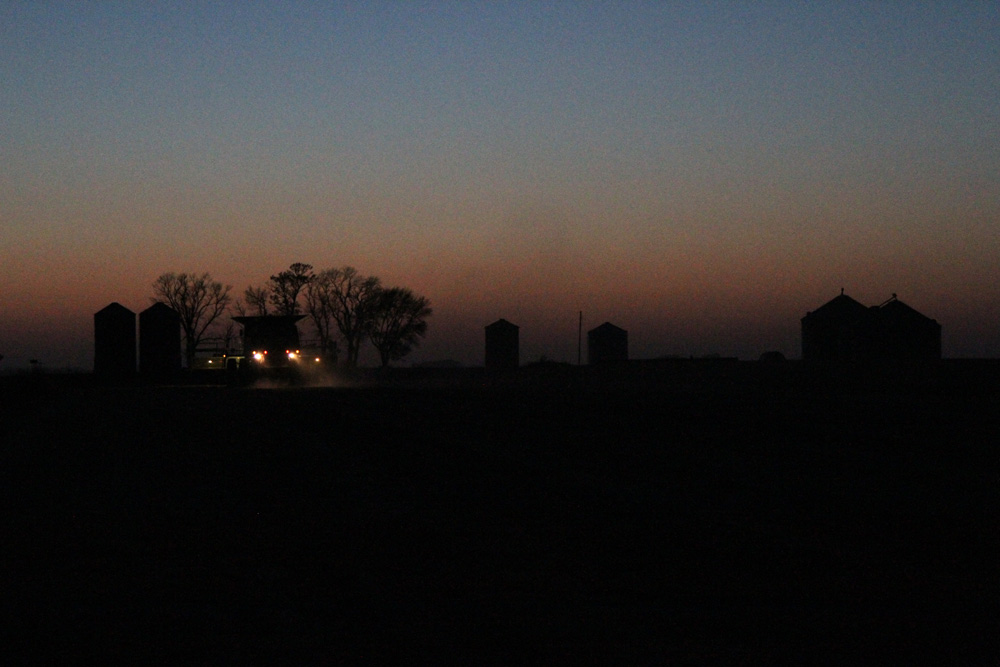
This photo including farmstead and lighted combine was taken two or three hours after the previous photos. At this point, I wanted to get from here (Section 24) to Gunderland (now the only farmstead in Section 13, which is where I was raised) quickly before they started dumping soybeans there to be stored in grain bins. (Until this point in the evening, the soybeans had been dumped at a farm 1/2 mile away where my dad was raised.) Here, I had just gotten out of the combine so I could drive to Gunderland, a little over two miles away. Where you see the silhouettes of the grain bins is the same farmstead where my dad (Deane Gunderson) was born in an upstairs room in 1918. (The house is no longer there.) This farmstead is also the former location of the "Bud Barn" which is now in Rolfe and owned by Roger and Dan Allen who are operating the tractor and combine seen in this post.

.

I love the hum of the grain drier and the hubbub when grain is dumped at this farmstead where I was raised in Section 13. Almost obstructed from view, on the far side of the larger wagon is a tractor. This tractor and wagon just arrived from Section 24 (the location of the photos above) about 2 1/2 miles away. If you click on the photo and look closely you'll can see the soybeans spewing from the auger (attached to the larger wagon) into the smaller wagon. From the smaller wagon they are transferred to a long auger which transports them to the top of the grain bin in which they will be stored. (The tractor at the far left is used to power the long auger.)

.

The following video was taken from inside the combine cab, with dust flying around outside. The location is the southwest field in Section 24, Roosevelt Township, Pocahontas County, Iowa. The video includes dumping on–the-go. It was so dusty and bumpy, and the video reflects that. Still, I’m glad to have it, if for no one reason than for grandson Jackson to see it. He loves combines and harvest, and he is fond of Rog and Dan Allen, the two guys running this operation. Rog and Dan were very close to my dad; they were integral in making it possible for my dad to continue living on the farm until just before he passed away in mid-2010.

If the video play is jerky at all, let it play through once while you do something else. Then watch it when it plays a second time. That might allow it to play more smoothly. Also, to view it in full screen mode, after starting the video click on the lower right corner of the video rectangle.

.

* * * * * * * *

(Click here to go to Louise Gunderson Shimon’s blog’s home page.)
Good Morning, October

October 1, 2011

.

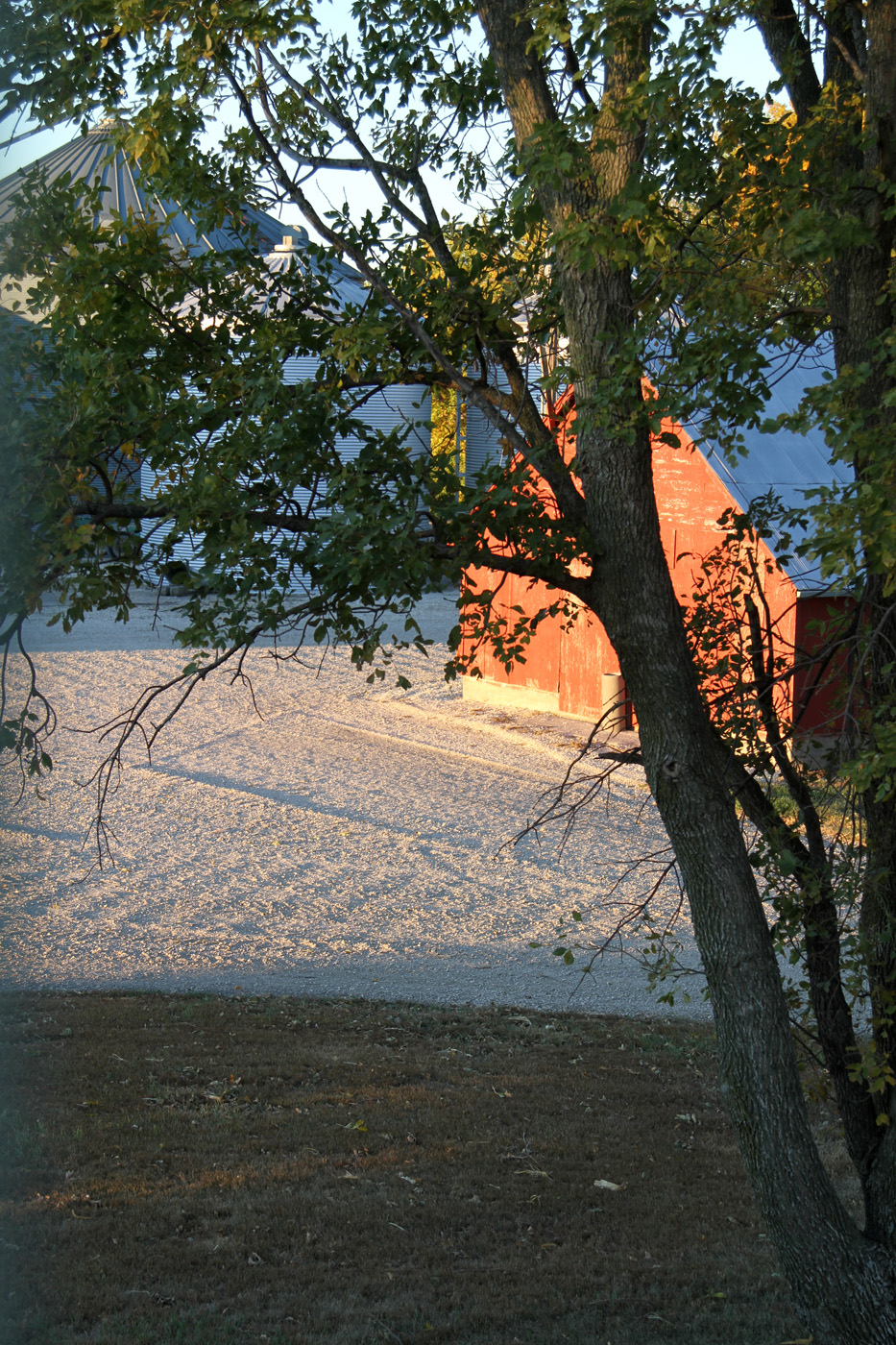
This was my vantage point every morning growing up at Gunderland (near Rolfe, Iowa), as it was this morning. Until several years ago, this view included a large red corn crib, a tiny red chicken house, and fewer round grain bins.

Later this morning, soybean harvest will resume here.

(Click here to go to Louise Gunderson Shimon’s blog’s home page.)

Soybean Harvest — or — Good-night, September

September 30, 2011

.

I feel I shouldn’t interrupt Clara’s “Art Education” article. I also so enjoyed riding in the combine tonight in Section 13, Roosevelt Township, Pocahontas County, Iowa. So, interruption, it is. Pictured is the field that nearly surrounds the farmstead where I was raised.

I hope you’ll click on the photo to enlarge it.

Soybean harvest today, Iowa State football tomorrow, and then I’ll follow up with Part II to Clara’s “Art Education” article.

(Click here to go to Louise Gunderson Shimon’s blog’s home page.)

Before Soybean Harvest: Adjusting for Hail Damage

September 24, 2011

Pictured is Bill Shimon with Jerry Kleymann. Bill is my husband. Jerry is a crop adjuster for Rain and Hail Insurance. Date: September 23, 2011. Location: Section 13, Roosevelt Township, Pocahontas County, Iowa. What's going on?: Analyzing extent of June hail damage to soybean crop. Why now?: Jerry and Bill inspected this field once last summer --- a couple of weeks after the June hail storm --- to do an initial analysis. Yesterday they returned for a final analysis, intentionally waiting until harvest is imminent, which it now is.* (Click on photo to enlarge.)

.

I like this photo for many reasons. 1.) This field nearly surrounds the farmstead where I was raised and where my dad lived until mid-2010. 2.) I love harvest. 3.) The photo lets me see one facet of Bill’s work. 4.) From a photographic standpoint, I like how the focus is on Bill and Jerry, but the soybean plants in front of and behind them are out of focus. (To see #4 for yourself, click on the photo to enlarge it.)

.

The photo above is a cropping of the photo at left (i.e., at left is the original). I took this photo with the combination of my Canon 135 mm lens and a Canon Extender EF 1.4X III. The combination offered a focal length of 189 mm. I was about twice (maybe three times?) as far from Bill and Jerry than appears in this photo. Shutter: 1/800; Aperture: f/5.0; ISO: 100; Exposure Bias: 0.00.

.

*Depending upon a variety of conditions (especially weather and seed variety), harvest has already started in some fields in northwest Iowa.

(Click here to go to Louise Gunderson Shimon’s blog’s home page.)

Threshing, Horses, Haystacking, Etc. (and Happy Birthday)

September 16, 2011

Ninety-three years ago today, my dad, Deane Gunderson, was born in an upstairs room of a farmhouse that was located at the southwest corner of Section 24, Roosevelt Township, Pocahontas County, Iowa. Daddy made it to 91 years of age before passing away on July 1, 2010. In honor of his birthday, a Miller High Life (Daddy’s beer of choice) showed up today in Rolfe at his gravesite.

This post includes two audio clips of my dad speaking thirty years ago…1981. They are excerpts from one of his oral history tapes. In the clips he talked about work on the farm during his growing-up years, including his memories about threshing.

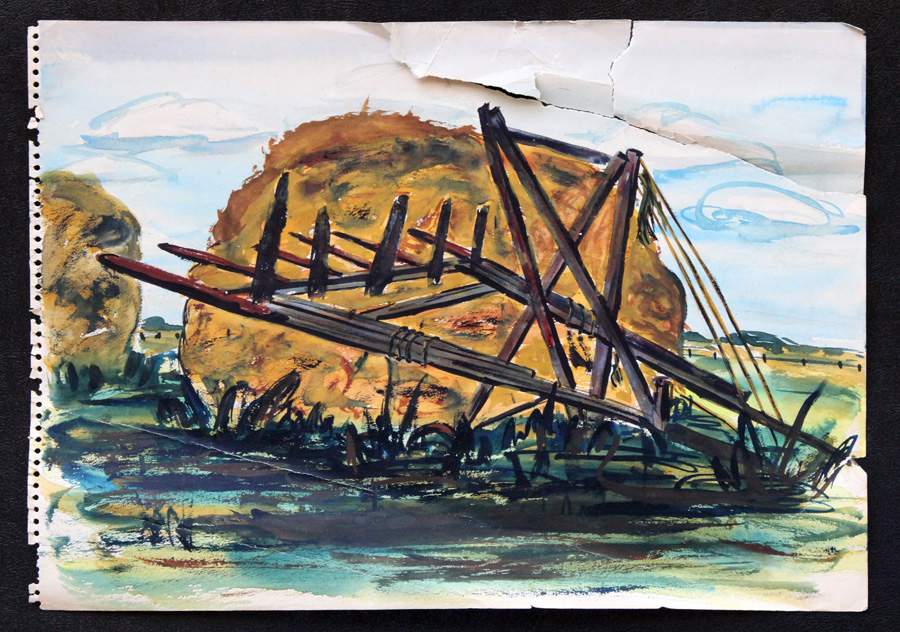
In the first audio clip (3 1/2 minutes) my dad referred to his Uncle Art (a brother to my Grandpa John Gunderson and pictured below), farming responsibilities (including driving cattle and sometimes hogs to town with the aid of horses) when my dad was a boy in the 1920s and/or 1930s, and his horse named Chance. He also talked about the use of a haystacker (a rope and pulley mechanism, see image immediately below).

.

This watercolor is of a haystacker, referred to by my dad in this post's first audio clip. The watercolor was painted by my mom. She and my dad were married in 1941 and in 1945 moved to the farm southwest of Rolfe, Iowa. I assume Mother painted this in the 1940s or soon thereafter, but I'm not sure. (Click on image to enlarge.)

.

In the second audio clip (5 minutes) my dad spoke about oat harvest/threshing, his family moving into the tractor era, his Uncle Art, area farmers (including the Brinkmans, Wiegmans and A.V. Graeber) and threshing rings. In this clip my dad made reference to an “18-36” McCormick Deering. At first I thought he meant the year 1836 and wondered how that could be. After doing research on the web, I realize he meant “18-36” and not “1836.”

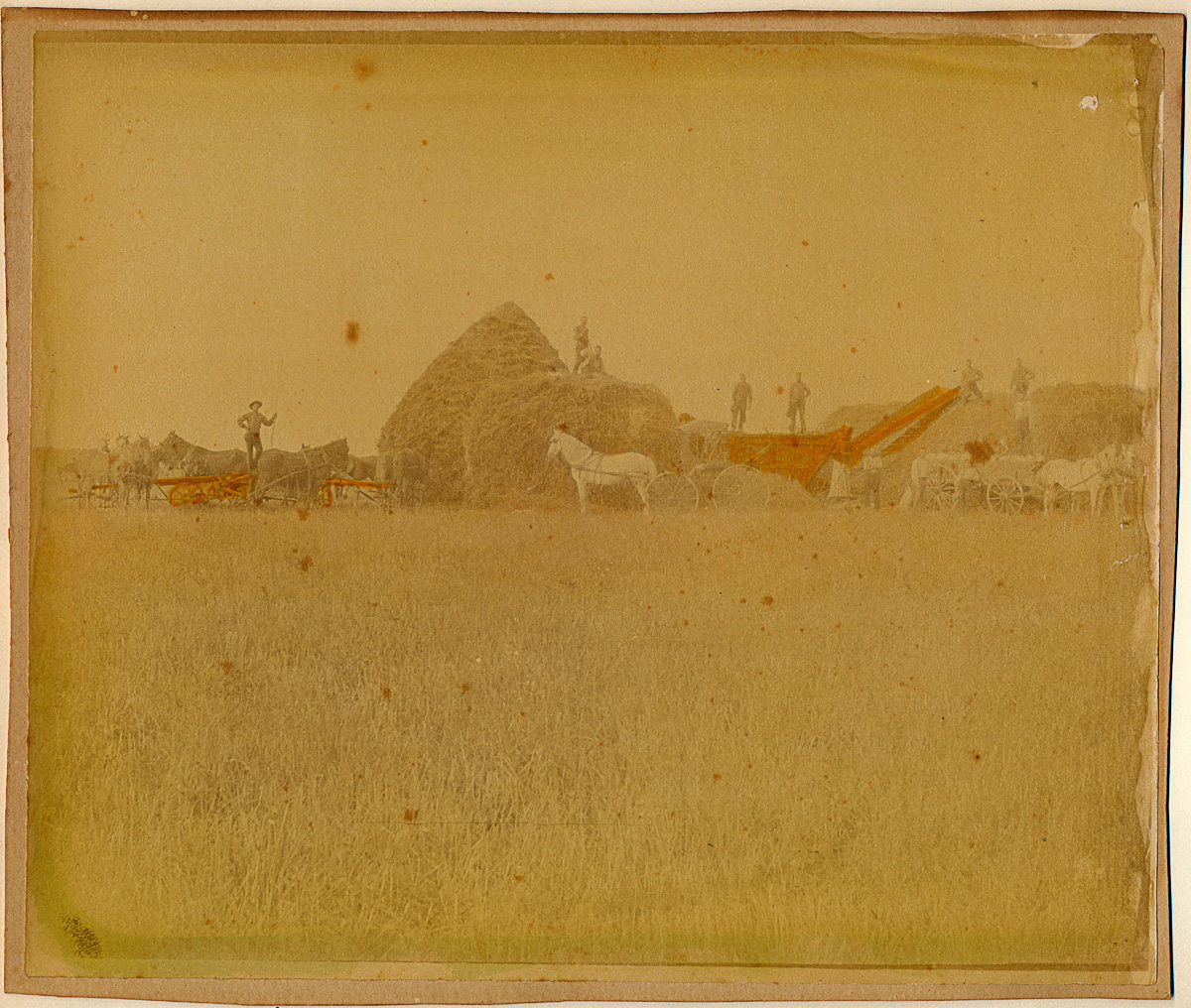
In the photo immediately below is a threshing operation and what Josh Lindgren* thinks is an 8 horse power. I found this photo in a scrapbook that my mom, Marion Gunderson, put together. In the scrapbook, next to this threshing photo, is this post’s second photo (scroll down) of eight horses. I have no idea if these horses operated an 8 horse power or not. I like to think they did and that it was why my mom put the two photos adjacent to each other.

If you didn’t watch the video yet (about threshing oats with a 12 horse sweep) from the previous post, you might want to watch it to better understand this next photo.

To really understand this photo, click on it once or even twice to enlarge it. This photo is from a scrapbook organized by my mom. At the far left is what Josh Lindgren* said is likely an 8 horse power. In the middle are two stacks, I assume of straw and chaff. Somewhere in the middle is likely a tumbling rod(s) similar to that in the video linked to in the previous paragraph. To the right of center in this photo is the threshing machine. A sack is at the right end of the thresher. The grain settled toward the bottom of the thresher and was moved along into this bag. The wagon at the far right holds bags of grain ready to be hauled away. Also at the far right, the oats are being loaded onto the thresher conveyor at the beginning of the threshing process. I assume this photo was taken in the 1920s or before.

.

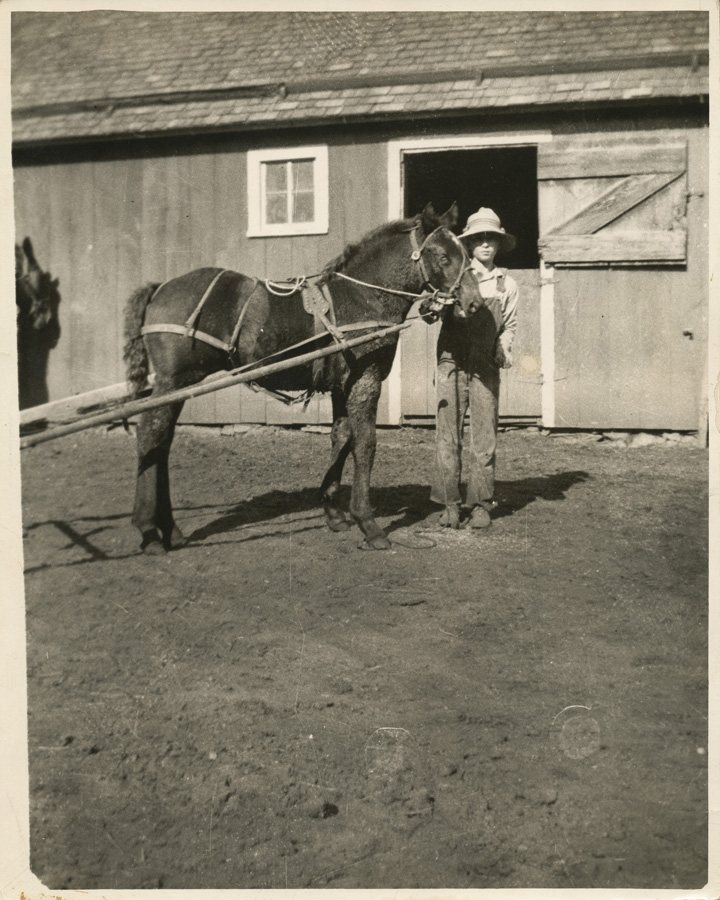
This photo of eight horses was on the same scrapbook page and next to the threshing photo (above). I don't know if these horses were involved with the threshing my dad spoke of or when driving cattle to town and/or in the yellowed threshing photo. I like to think they are. (Click on photo to enlarge.)

.

Pictured here is my dad when he was 12 years 2 months old. (Click on photo to enlarge.)

.

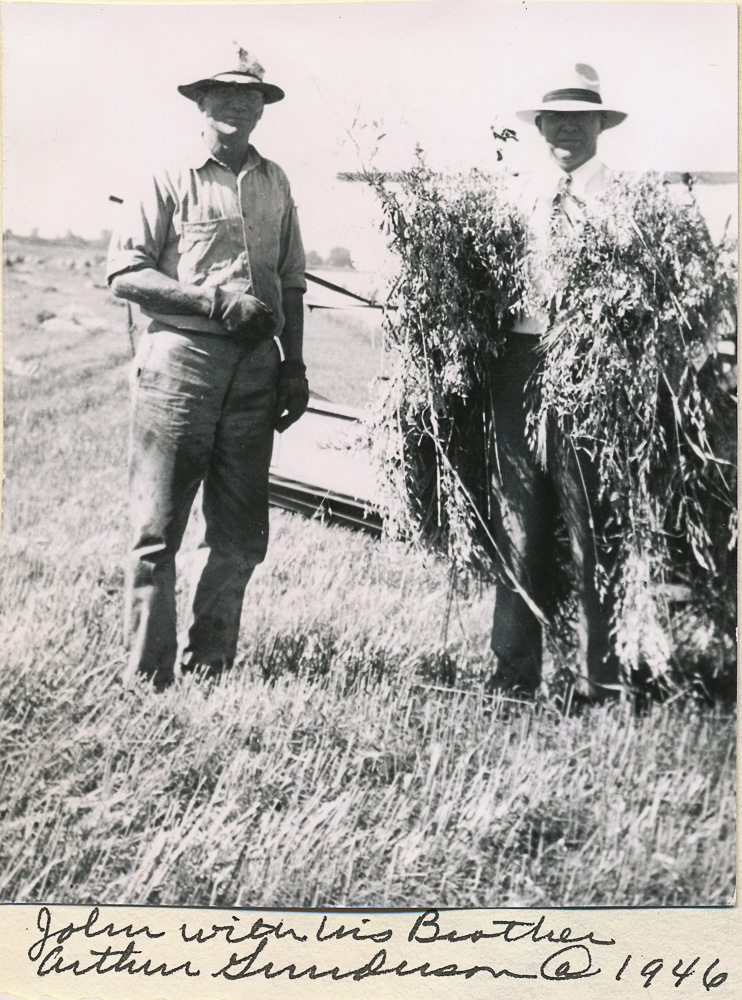
At right, holding the oats, is my Great-Uncle Art, to whom my dad referred in both audio clips in this post. Grandpa John is at the left. (Click on image to enlarge.)

.

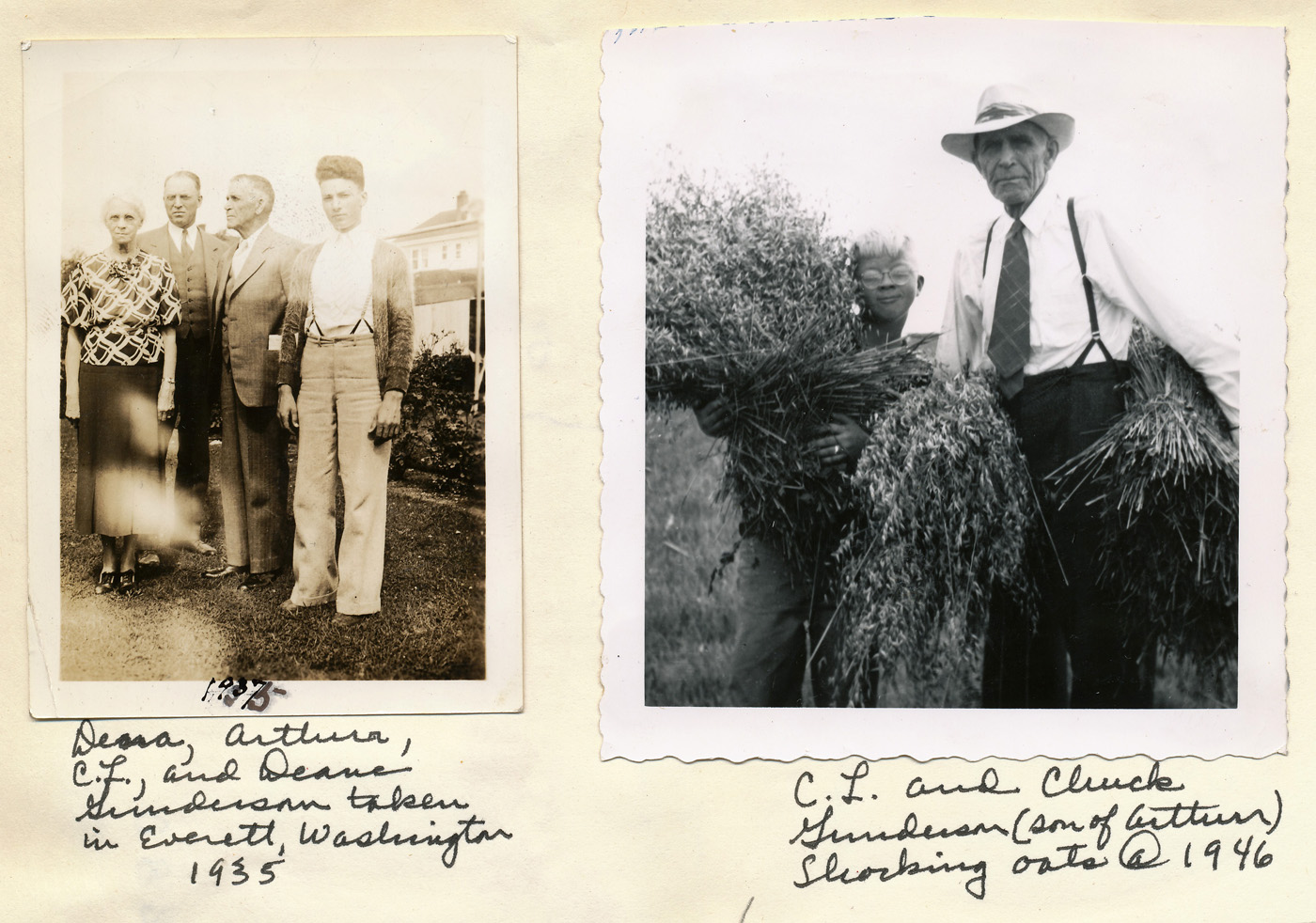
I included these two photos together because my Great-Uncle Arthur (in the left photo) was the son of C. L. (in both photos) and father of Chuck (in the right photo). C.L. (Charles Lewis) was my great-grandfather and was married to Dena, my great-grandmother (also pictured here). In the photo at left, my dad was 17-years-old. (Click on image to enlarge.)

.

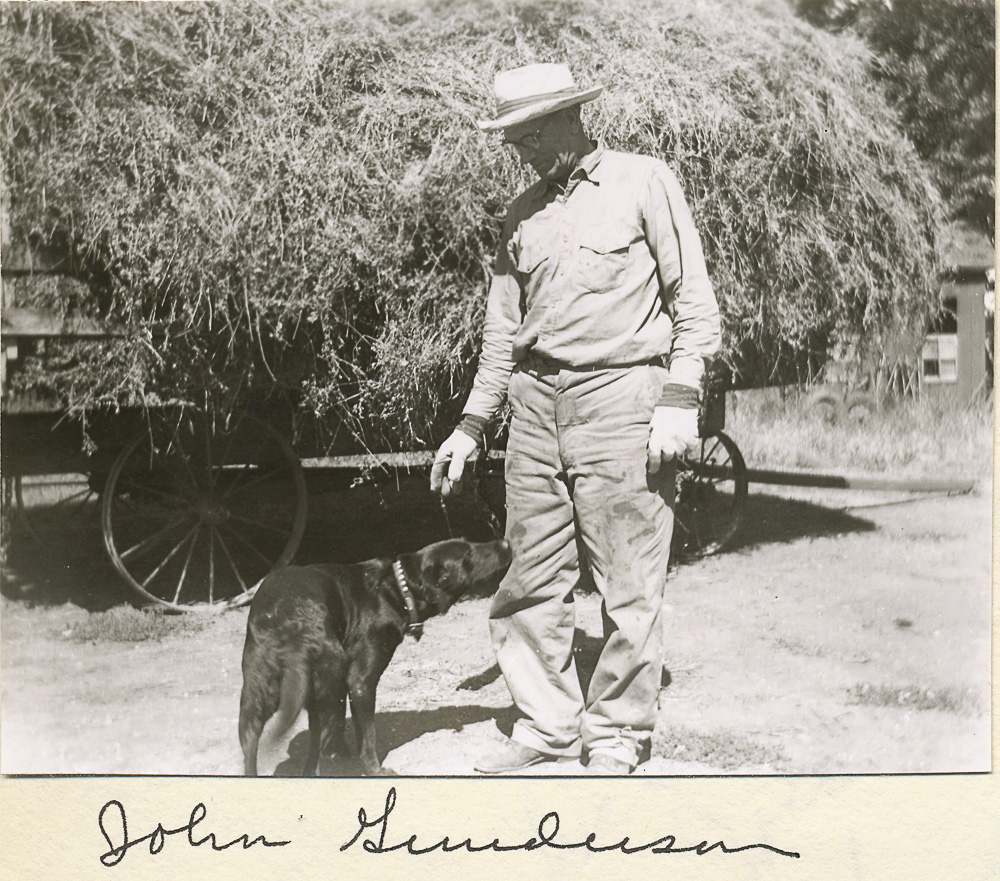
Pictured is my dad's dad/my grandfather with a load of what I assume was oats. (Click on image to enlarge.)

.

*Josh Lindgren is from Marathon, Iowa. A photo and video of Josh and two of his horses is included in this post.

(Click here to go to Louise Gunderson Shimon’s blog’s home page.)
“12 Horse Sweep” or “12 Horse Power” Threshing

September 14, 2011

I’ve got a variety of things — with a variety of content related to threshing — that I want to post. The items are interrelated, but also random. So, I’ll post a chunk at a time.

In the previous post, I included video of horse power involving two horses. That horse power was used to elevate grain into a wagon. This was not as taxing a process as threshing. So…two horses (as opposed to many horses) handled it just fine.

In the following YouTube video, oats were threshed with what is called (in the YouTube video) a “12 horse sweep.” This horse power/sweep is similar in concept to the horse power involving two horses, but, in my opinion, much more complex. And…powering a much more taxing process, therefore requiring more than just two horses.

Watching the YouTube video will help explain part of my next post, which will be about threshing in general, but will touch on horse power. There won’t be a test, but to better understand the next post, I hope you’ll watch this video.

.

(Click here to go to Louise Gunderson Shimon’s blog’s home page.)
Horse Power

September 11, 2011

This horse power was demonstrated at the 2011 Albert City, Iowa, Threshermen and Collectors Show. (Click on photo to enlarge it.)

.

The horses pictured above belong to Josh Lindgren of Marathon, Iowa. Josh is operating the horse power in these two photos and also in the video below.

Wikipedia offers one explanation of horse power. The explanation refers to horses walking on a treadmill. Obviously Josh’s horses are not walking on a treadmill, but instead in a circular sweep. Another explanation is here.

..

Josh Lindgren of Marathon, Iowa, walks behind his horses during this demonstration of horse power. (Click on photo to enlarge.)

.

This 1-minute video was taken at the 2011 Albert City Threshermen and Collectors Show. Just two horses were involved in this video. In a subsequent post I’ll include a photo of what Josh thinks is an 8 horse power (i.e., 8 horses).

.

.

I’m not sure if the term is technically two words (horse power) or one word (horsepower). The most common spelling I found on the web has it as two words.

(Click here to go to Louise Gunderson Shimon’s blog’s home page.)

Steam Engine Powered Wheat Threshing

September 8, 2011

.

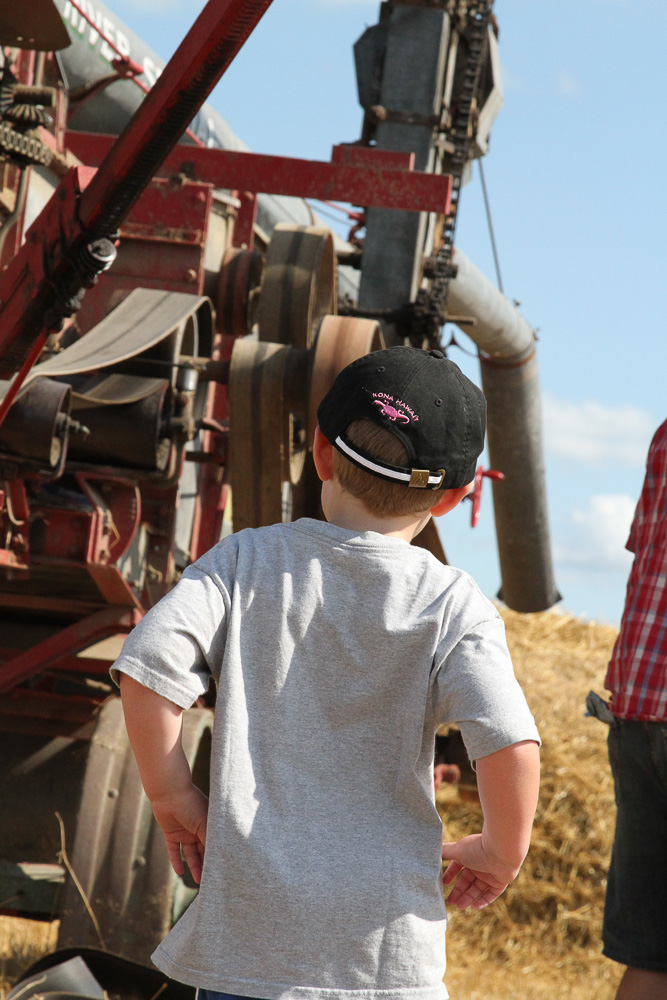
On August 11, 2011, I posted about pre-1940 steam engine powered oat threshing. On August 12, Bill, Jackson (Bill’s and my grandson, pictured above) and I attended the Albert City, Iowa, Threshermen and Collectors Show. Threshing of wheat — not oats — was demonstrated there. All three of us enjoyed the demonstrations involving machinery and horses, talking with those demonstrating, the parade of implements, and the ice cream.

The 5-minute video below is from one of the August 12 demonstrations. It is of shocked wheat and a threshing machine powered by a steam engine, similar to my Great-Uncle Art’s oat threshing rig.

In a subsequent post, I’ll include a short video of horsepower driven (as opposed to steam engine driven) threshing.

.

.

(Click here to go to Louise Gunderson Shimon’s blog’s home page.)
From Threshing to Teddy Bear Parade

September 3, 2011

I’m working on a post (or two or three) that will include a combination of photos and video from when Bill, Jackson (Bill’s and my grandson), and I went to the Albert City, Iowa, Threshermen and Collectors Show in August. Also, I’ve been scanning a couple more Rolfe school yearbooks. And, I’m looking for images to accompany an article that Clara (my oldest sister) wrote for posting here. All that plus I’ve been working on some other non-blog-related things. Oh, and this month I get to be at Jackson’s school when his class has its Teddy Bear Parade!

I’ll “see” you soon via another blog post.

Rolfe Newspapers Project: I’ll tell you the good news last.

August 30, 2011

As you may already know, in 2010 the Rolfe Public Library board endorsed the project of having 101 years of Rolfe, Iowa, newspapers digitized by Heritage Microfilm (HM) of Cedar Rapids, Iowa. In a sense, we had vetted this company, including knowing that HM handled all the newspaper microfilming for the State Historical Society of Iowa (SHSI).

In early December 2010, the Rolfe Public Library paid to HM one-half of the Rolfe newspaper project cost. The plan was that the images (pages) — from 101 years of Rolfe newspapers — would be online and keyword-searchable.* This project was to be completed by March 2011.

In late February 2011 the library board received a letter from HM stating that HM had moved much of its operation to Mexico. Ok…not great…but there wasn’t anything we could do about “our” newspaper project being worked on outside of the United States.

We (the library board and I) still believed the project would be completed in a timely manner. However, after the company kept defaulting on deadline after deadline, with persistence on our end, the company refunded all that the library had paid (again, one-half of the total project cost).

We remained in good faith that the project would be completed and be a quality product…until up popped many, many red flags. For example, online there is a letter issued in June by SHSI saying that SHSI was transferring all of its microfilm from HM to Advantage Information Management Solutions in Cedar Rapids. Also, umpteen other libraries were having problems with HM. And, complaints were being filed with the Better Business Bureau and with the Iowa Attorney General’s office.

Fortunately the library board had its refund, so was not out any money. (To my knowledge, none of the other libraries in the same boat have received a refund.) After more vetting, including knowing that SHSI had transferred to Advantage, the library board voted to terminate its relationship with HM and, following in the footsteps of SHSI, transfer its project to Advantage.

How soon will this project be completed?

By two months from now (so, around November 1, 2011) the Rolfe Public Library should have a searchable hard drive that contains images of all the Rolfe newspaper issues that are on microfilm.**

Until sometime in January 2012, these digitial files may be browsed/searched only within the walls of the Rolfe Public Library and not online. The files will be accessible to patrons and to library staff.

When will the newspapers be online?

Sometime in January, the files will be online and accessible throughout the world.

Yes, we are having to wait months longer than originally planned. But, it will be worth it!

What is the bonus?

A bonus is that the book Centennial History, Rolfe, Iowa, 1863-1963 will be included in this project. In other words, you’ll be able to browse/search the contents of this book online.

All is well that ends well! When there’s more to report, including completion of the project, I’ll post about it. Upon project completion, there will also be information on the Rolfe Public Library web site regarding how to access the newspaper files online.

May a person still contribute?

*Thank you to those of you who contributed to the project via a cash donation or by purchasing one or more prints of Mother’s (Marion Gunderson) watercolors. If you still want to contribute, you may do so by 1. writing a check payable to “Rolfe Public Library Trust” 2.) on the memo line write “newspaper project” and 3.) mail your check to Rolfe Public Library, 319 Garfield St., Rolfe, Iowa 50581. Contributions so far have ranged from $10 to $115 and all are greatly appreciated.

* * * * * * * *

**There can’t be a scan of any issue or page that isn’t already on microfilm, unless the hard copy of the newspaper is provided to Advantage.

Heritage Microfilm is associated with NewspaperArchive.com.

(Click here to go to Louise Gunderson Shimon’s blog’s home page.)