I’m curious to know if you know what the item in this photograph is, and how it was used. I do know, but only because my father, Deane Gunderson, told me.
If you prefer to not comment below, but would like to email to tell me your guess, or your in-the-know answer, feel free to do so. mariongundersonart@gmail.com
Clicking on this photo will magnify detail.
.
(Click here to go to Louise Gunderson Shimon’s blog’s home page.)
Tonight I was going through some super8/8mm movies that I don’t know if I’d ever even seen. I ran across this shorty (21 seconds) from my days of teaching home economics at Mallard, Iowa. The video is of the students in the senior Home Arts class as they were escorted into the home ec. room for their mock weddings.
The Home Arts curriculum was set before I started teaching at Mallard. It was geared 100% to getting married. The administration’s expectation was that I follow the curriculum of the previous home ec. teacher…probably because it had always been a popular class, and, face it, at that time, there was more focus in society on being married as opposed to not.
If I were teaching a similar class today, I’d have the students concentrate more on things like family finance, compatibility, and commitment than on choosing a wedding cake or the four Cs when shopping for a diamond.
When I started teaching at Mallard I was 20 years old; some of the seniors were just a year younger than I at the time. I might have had more growing up yet to do than many of them did!
Oh, yes…I remember the “boys” class when they cooked a turkey for Thanksgiving. They got their clean-up done awfully quickly. Sort of. I didn’t discover until the end of the year that those boys put the turkey bones way back in the corner of the lower cabinets! (How I didn’t discover those turkey bones before then, I’ll never know!)
Those same boys had a home ec. lesson in mending/patching jeans. But, the laugh was on me…or rather on Bill. The boys practiced their mending on Bill’s jeans. After I took the jeans home to Bill and he went to step into a pair, he discovered that those boys had sewn his pant legs closed!
Back to the video. After the Home Arts students graduated in the spring of ’77, Bill and I had a get-together for them at our home. (I.e., all or almost all of the students in the video showed up at our house.) We had no idea what to expect, but to cover our fannies, we made sure that the students were of legal age. (All were except for one girl.) There did end up being some “adult” beverages brought by at least one student, which made me quite nervous. But, in talking with the parents afterward, they were just glad their daughters and sons were with us instead of who knows where.
Fond memories of the days that were. Just like yesterday, today and tomorrow will one day turn into the fond memories for our futures.
(Click here to go to Louise Gunderson Shimon’s blog’s home page.)
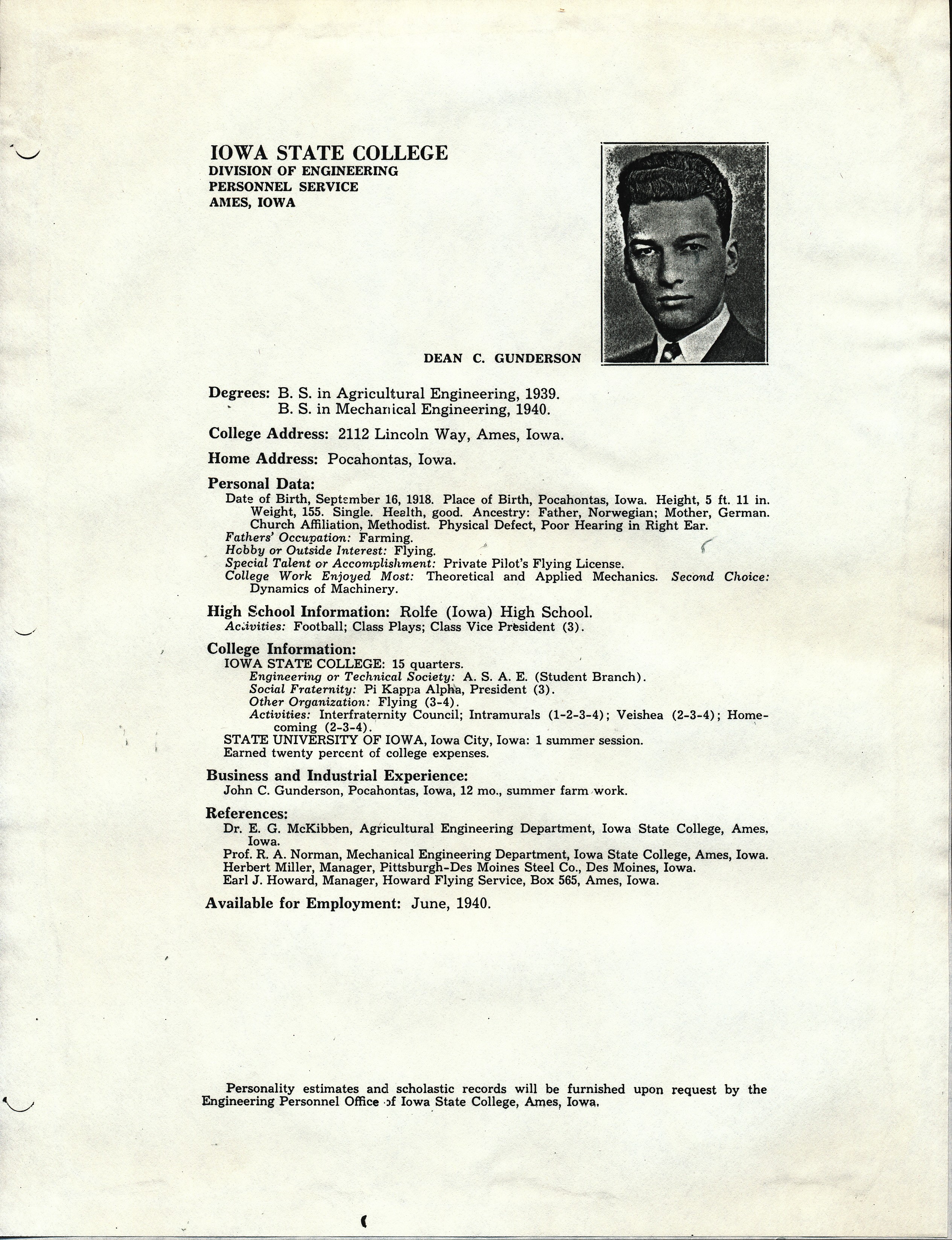
To enlarge the résumé text, click once on the image. Twice for further magnification.
.
The year: 1940. My father’s (Deane* Gunderson) résumé most likely played at least a small part in his landing a job with the John Deere Tractor Company in Waterloo, Iowa. He was an engineer for John Deere from 1940-1945.
Can you imagine the looks on the faces of human resources personnel if this résumé came across their desks in this day and age? Forget the looks. What about the potential law suits if in 2011 they did hire him…or if they didn’t?!!!
* * * * * * * *
*My father’s legal first name is “Deane.” For a while he dropped the last letter and went by “Dean.”
(Click here to go to Louise Gunderson Shimon’s blog’s home page.)
The red background in the above banner is a cropping from the photo of strawberry pretzel salad in this post. The post includes a link to the salad recipe, as well. If you’re looking for a yummy salad for Valentine’s Day, or anytime, I hope you’ll try the recipe.
(Click here to go to Louise Gunderson Shimon’s blog’s home page.)
When I awakened this morning the thermometer read -12º F. While I know that is a heat wave for some of you, I’m staying in the house and thinking S-P-R-I-N-G!
Last April I photographed this Willis Avenue (Perry, Iowa) tulip (above). It caught my eye because it is similar to tulips in Mother’s (Marion Gunderson) Bright Tulips 1968 watercolor shown below.
.
The Bright Tulips original is owned by Kim Webb Toth-Tevel of California. Kim, a granddaughter of the late Jane Webb (formerly of Rolfe, Iowa, and dear friend of Mother’s), was generous to ship her painting to me so prints of it could be made.
Bright Tulips prints in three sizes* are available by contacting me directly at mariongundersonart@gmail.com or by ordering online. A limited supply of Bright Tulips is available at Wild Faces Gallery (712-848-3399) in Rolfe, and the Rolfe Public Library (712-848-3143). The profits go to the Rolfe Public Library where Mother worked for thirty-five years.
*The three sizes are as follows: 10″ H x 13.3″ W (Medium $25), 13.25″ H x 17.6″ W (Standard $35…when matted, fits in standard 20″ x 24″ frame) and 16.4″ H x 22″ W (Grand $50). Larger sizes may be special ordered by contacting me or the gallery.
(Click here to go to Louise Gunderson Shimon’s blog’s home page.)
While watching Super Bowl commercials or any other ads (whether moving video or still photo) an interesting concept to keep in mind is the content of the following YouTube video. The narrator explains the Fibonacci Series and how it relates to the Rule of Thirds in composition.*
The video is 5 1/2 minutes in length. The first 2 minutes are about mathematical theory, including referring to The Da Vinci Code. The last 3 1/2 minutes are specifically about the Rule of Thirds.
Also interesting is analyzing how Mother (Marion Gunderson) applied the Rule of Thirds in her watercolors. At this link which of Mother’s watercolors catch your eye the most? And, do you think your preferences regarding Mother’s watercolors, or any other artwork, have anything to do with the Rule of Thirds? Is there artwork in your home that over time still keeps your interest, but other artwork you own seems blah? Do you think the Rule of Thirds has anything to do with your continued interest, or declining interest? Even if you prefer to remain private with your response, the concept is certainly interesting to ponder.
*I understand the Fibonacci Series and I understand the Rule of Thirds. For me to understand more thoroughly how the two theories connect is going to require further study.
(Click here to go to Louise Gunderson Shimon’s blog’s home page.)
The aircraft in the distance is being deiced at the Dallas/Ft. Worth International Airport Thursday morning. You can see the part-glycol fluid somewhat pooled on the aircraft. I took this photo from inside the aircraft that was next in line to be deiced. (Click on image to enlarge.)
Yesterday I flew from Dallas to Minneapolis to Des Moines. After boarding Delta’s Embraer 175 (twin-jet) at DFW, passengers were told that our aircraft needed to be deiced. It had picked up ice en route from Detroit to Dallas earlier yesterday.
The following is a video* of one wing being deiced. I’m wondering how many gallons of deicing fluid were needed for just this one wing, and how much fluid in total for this aircraft.
A pilot friend told me tonight that in 2001 he had a Beach King Air deiced. The King Air was an approximately 10-seat plane with a wingspan of approximately 50 feet. It had severe icing about 1/2 inch thick. In 2001 the cost for deicing the thick ice on his small aircraft was $3,000…300 gallons of deicing fluid at $10/gallon. If there had been just frost on the wings, the deicing cost would have been much less.
So…that was $3,000 in 2001 to deice a small aircraft. With deicing fluid prices being higher** a decade later in 2011, just think how astounding the cost of deicing must be on aircraft with much larger surface areas (i.e., huge jets) than the Beach King Air.
I want to get this posted tonight, so am not taking the time to research about different types of deicing fluid. However, some basic information about different types of fluids is included in this 2001 article.
*I am wondering if the drain-looking circle in the concrete at the lower right of the video is part of some sort of deicing fluid recapture system. DFW has dedicated deicing pads. The aircraft I was in departed the terminal and was deiced at one of these pads before taking off.
**according to a few online forums
(Click here to go to Louise Gunderson Shimon’s blog’s home page.)
I am in Texas. During my flight from Iowa, with my point and shoot camera I took photos of the landscapes/cloudscapes, including the static wicks at several points along this wing. Within the confines of the recessed window opening, when taking the photos I tried to keep in mind the rule of thirds.
Clicking on the photos will magnify the static wicks.
.
By the way, after midnight tonight before I say anything tomorrow (the first day of the month), with Jackson I’ll get to say Rabbit, Rabbit, Rabbit!
(Click here to go to Louise Gunderson Shimon’s blog’s home page.)
On New Year's Eve Jackson and I went to the Perry (Iowa) Public Library. Curious George got our attention. If you click on the photo to enlarge it, you'll see that H.A. Rey's name is on the front cover of the book. Margret Rey's name is not.
Do the names Margret and H.A. Rey ring a bell? How about the Curious George books that for decades have endeared children of all ages? While I’ve “known” Curious George for what seems like forever, I didn’t realize that the creators (the Reys) were German Jews who fled Paris in June of 1940 just before German troops marched into that city. A manuscript and sketches of what later became known as the monkey Curious George literally saved the Reys as they escaped before arriving in the United States in 1940.
In December my brother-in-law Jeff sent this link that includes the harrowing story of how Margret and H.A. Rey escaped the Nazis. The article also includes a link for the Margret and H.A. Rey Center in Waterville Valley, New Hampshire. (Sounds like a great New England vacation stop!)
A Houghton Mifflin site provides photos of and additional information about Margret and H.A. Rey.
As evidenced in the above photo, the front cover of Curious George includes “H.A. Rey” but not Margret’s name. This made me curious as to why Margret’s name isn’t on the cover. After all, wasn’t she an author, too? At the Houghton Mifflin site (linked to in the previous paragraph) is an FAQ section. One of the FAQ answers gives a brief explanation of how the Reys worked together on their books.
Curious George was first copyrighted in 1941, the year after Margret and H.A. Rey arrived in the United States. This scan is taken from a copy from the 74th printing. (Click on photo to enlarge.)
Reading about the Reys’ escape from the Nazis provided the impetus for Jackson, my almost-five-year-old grandson, and me to go to the Perry library to check out Curious George. Jackson was fascinated — curious — as was I. When I looked at the illustrations I remembered that if the Reys did not have those illustrations with them as they escaped, they may have never made it to the United States in 1940. And therefore, there may have never been Curious George books as we know them today.
(Click here to go to Louise Gunderson Shimon’s blog’s home page.)
After Loel Diggs* sent his comments about manure hauling (that I posted in Part I), I asked him how long it had been since his family raised oats. In response, he sent the following comments.
Pictured is Loel Diggs (11 years old in this 1948 photo) manure hauling with his Uncle Frank's rig: a Farmall B tractor and Oliver Superior No. 7** manure spreader. (Click on photo to enlarge.)***
Memories of Loel Diggs
Regarding Raising Oats and Trading Labor
Oats haven’t been grown on the farm since back in the mid to late ’50s, once Dad decided to get completely out of livestock. Not only were oats used for a grain crop for livestock and straw for bedding, oats were also used as a cover crop for crops such as Alfalfa, Timothy, Brome, and Sweet Clover when grown for next year’s Hay or Pasture land. The Farm was on a 3 year rotation growing Corn, Soybeans and Oats, so hay ground and pastures would not be changed for three years or more.
Your spreader series just reminded me of the way labor would be traded between farmers when harvest and other such jobs needed to be done, and all parties involved did not have all the mechanized equipment to get the job done quickly. Dad and two of my Uncles (two of my Mother’s 4 brothers) traded a lot of labor when harvest, haying and manure hauling was done between the three Farmsteads.
The uncles that my Dad traded labor with the most were: Conrad and Franklin Majorowicz. All the farmsteads were within a 6 mile radius of each other.
* * * * * * * *
* * * * * * * *
*Loel grew up on his family’s farm northeast of Rolfe, Iowa, 1/2 mile west of Des Moines Township School (D.M.T.) where he graduated from high school in 1956.
In 1939 Oliver introduced the Oliver Superior No. 7 spreader. This was the first spreader designed specifically for use with rubber tires. This was the Cadillac of all spreaders. With rubber tires, a smooth ride and a wide non-slip footboard for the operator, hauling manure was no longer a painful chore (unless you filled the box with a pitchfork.) The farmer now had a handy pedal clutch to start and stop the spreading. The tractor user could operate the spreader with a rope. The machine was made was with sheet ingot iron instead of wood which saved 400 pounds over competitive outfits. Ribs were incorporated into the sides for additional strength.
***UPDATE: After posting the above photo, I asked Loel what model of tractor he thinks is in the upper right of the photo. He said it looks like his Uncle Conrad’s WC Allis-Chalmers.
* * * * * * * *
(Click here to go to Louise Gunderson Shimon’s blog’s home page.)






 Marion Gunderson Art (and the Farmer's Daughter)
