Author Archive

A Designer’s Perspective

March 17, 2010

(Click here to go to this blog’s home page.)

Grain Elevator, Rolfe, Iowa, by Marion Gunderson, circa 1950. Standard size limited edition -- 13.25" W x 17.25" H, $35. When matted, fits in standard size 20" x 24" frame.* (Click photo to enlarge.)

Kathleen Beeler is an interior designer friend who several months ago saw a few of Mother’s original watercolors. Kathleen plans to incorporate fresh-looking artwork in her home and wanted to take a look at prints of Mother’s watercolors…mainly the agriculture-related ones.

Yesterday I took prints to Kathleen’s home for her to try in various rooms. (I felt like the Fuller Brush man.) Kathleen was/is so pleased with her finds. Knowing that Kathleen has a design background that I trust, I got goosebumps thinking how pleased Mother would have been listening to Kathleen ooh and aah about Mother’s work. “They fit my house, my lifestyle and my husband’s background.”

What really made me “see” Mother smile was something Kathleen said about the ag-related prints/originals, for example of the Rolfe, Iowa, grain elevator that was destroyed in a 1969 fire. Or the Iowa State University heating plant** (that Mother painted a watercolor of in 1951) that no longer exists. Kathleen kept commenting about how even though the watercolors were painted decades ago, they haven’t faded out of style. She said, “They aren’t stylized. They are sophisticated. They are contemporary portrayals of something in America we’re losing.”

Exactly.

* * * * * * * *

* Click here for size/price information about prints. All profits from sales of prints go to the Rolfe (Iowa) Public Library.

** Within the next few months, prints of the Iowa State University heating plant watercolor will be available.

(Click here to go to Louise Shimon’s blog’s home page.)

Hollyhocks Watercolor by Marion A. Gunderson, 1954

March 14, 2010

(Click here to go to this blog’s home page.)

The newest image for this blog’s header/banner is of a very small portion of the Hollyhocks watercolor (below) painted by Mother in 1954. (1954 was about two years after Cathrine Barr taught her last class for northwest Iowa’s Barr Art Association. The association* continued to meet into the 1970s.)

Hollyhocks watercolor by Marion A. Gunderson, 1954. This watercolor was framed and behind glass in this photo. (Click on photo to enlarge.)

In case you are trying to figure out exactly from where in the watercolor the much smaller banner image is taken, maybe this explanation will help. If you could take the banner that is above and rotate it 180 degrees, it would be right-side-up. It could then overlay part of the lower left hollyhock bloom in the actual painting.

Before I had this original framed. I took two frame moulding samples to Mother’s nursing home room. (This would have been within the year before she passed away.) I explained to her that I wanted her to select the moulding sample that she liked best, which she did. After the framing was complete, but before Bill and I hung this watercolor in our home, I once again took Hollyhocks to Mother (still in the nursing home) so she could bask in her painting’s beauty.

* * * * * * * *

To view images and size/cost information regarding currently available prints of Mother’s watercolors, click on the “View and Order Prints” link on this blog’s home page.

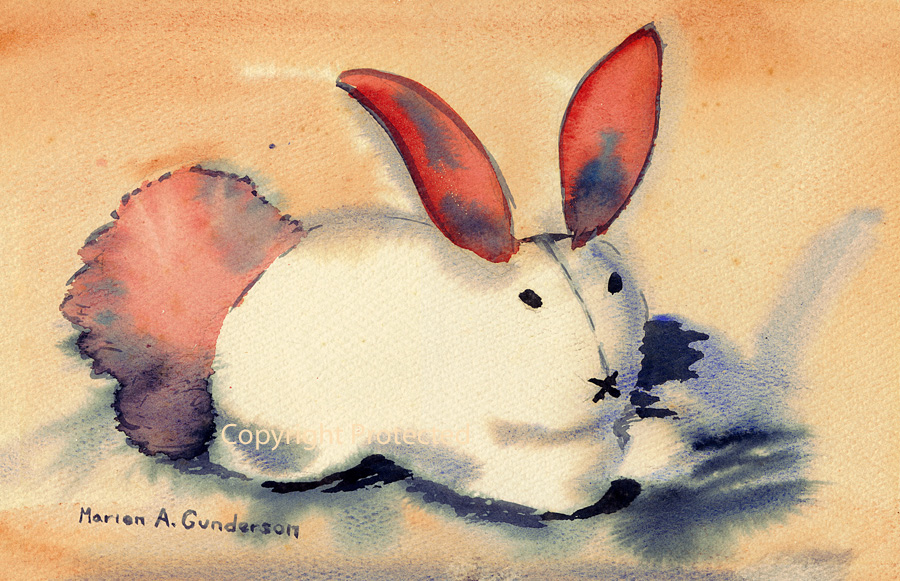
With Easter just around the corner, at present the Bunny prints are in the highest demand. In the actual Bunny prints, the tail and ears look more pink-than-orange than they do on my computer monitor.

Prints have not yet been made of the Hollyhocks painting. However, if you have an interest in having a print of this watercolor, please contact me at mariongundersonart@gmail.com.

*More information about Cathrine Barr and the Barr Art Association is in this post. Within the next year, I hope to have additional information to add about Cathrine and/or the association.

(Click here to go to Louise Shimon’s blog’s home page.)
Back Next Week…

March 12, 2010

I’ve had the flu or food poisoning for the past couple of days but am now (Friday) on the upswing.  I’ll post again sometime early- or mid-next week.

90 Days After a Fog… (Part II)

March 9, 2010

(Click here to go to this blog’s home page.)

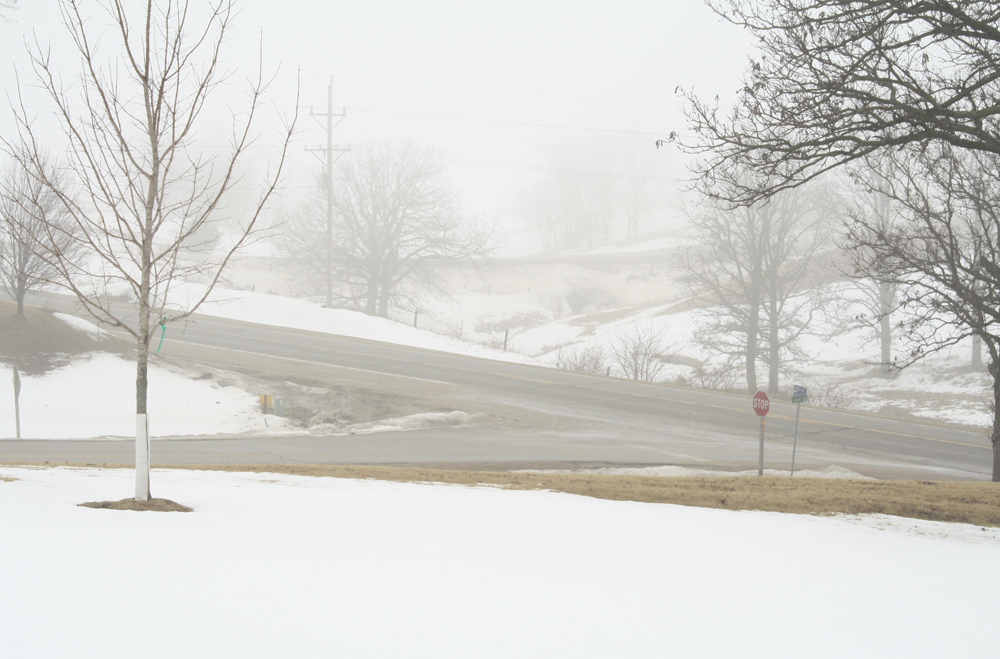
Central Iowa fog on March 8th, 2010. (Click photo to enlarge.)

Although the fog yesterday morning at Perry, Iowa, wasn’t nearly as dense as the fog in northwest Iowa on January 18th and 19th, yesterday’s fog did prevent me from traveling.  It also made me think back to my January 20th post. In that post I referred to the theory suggesting that 90 days after a fog there will be precipitation.

I emailed Elwynn Taylor, Professor of Ag Meteorology at Iowa State University, to ask for his explanation of the 90-days-after-fog-precipitation theory. He was kind enough to respond and to give me permission to quote him.

My question to Elwynn: “Is there a correlation between fog and 90-days-later precipitation, and if so, what is the explanation of the correlation? (Many people I’ve talked with say the 90 day theory is bogus/chance since it precipitates frequently anyway. I’d like to respond intelligently to them.)”

Elwynn’s response: “In the summer the 90-day to fog (in some locations it is the 100 day-to fog) concept is not valid.  As you say, there could be rain about then anyway and statistically that is about how it turns out.

“In the winter a wide-spread Midwest fog is simply the viewing of the ‘breath of the Gulf of Mexico’ and it is much like seeing your own breath on a cold day. Now if the Gulf air is entering Iowa in January (not a common thing) it may very well indicate that the Gulf air flow will be strong and/or early come spring. (Gulf air begins to dominate much of the Midwest after mid-March each year.) If it is early and strong…. yes, this results in a wet spring some 90-days after the fog was first a major thing.”

Well, the dense fog did enter Iowa in January. So it was early…and strong. It will be interesting to see what our spring will be like “some 90-days after the fog was first a major thing,” which I’m thinking was January 18th and 19th.

(Click here to go to Louise Shimon’s blog’s home page.)
Extension Tubes in Macro Photography (Part III)

March 7, 2010

(Click here to go to this blog’s home page. Click here for Part I of “Extension Tubes in Macro Photography.”  Click here for Part II.)

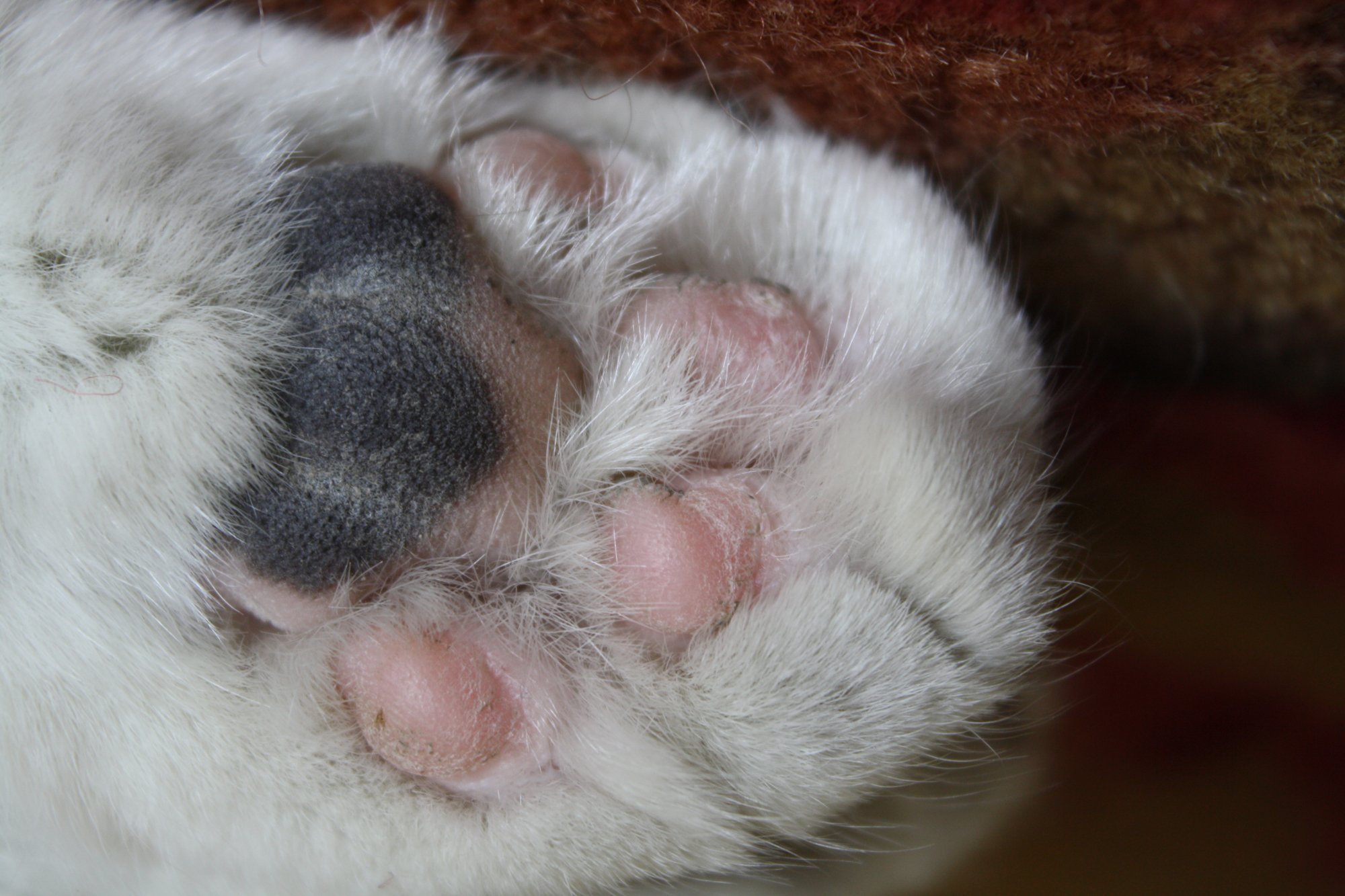
Miss Kitty's paw photographed with an 18-55mm lens and a 12mm extension tube. (Click photo once or twice to magnify detail.)

.

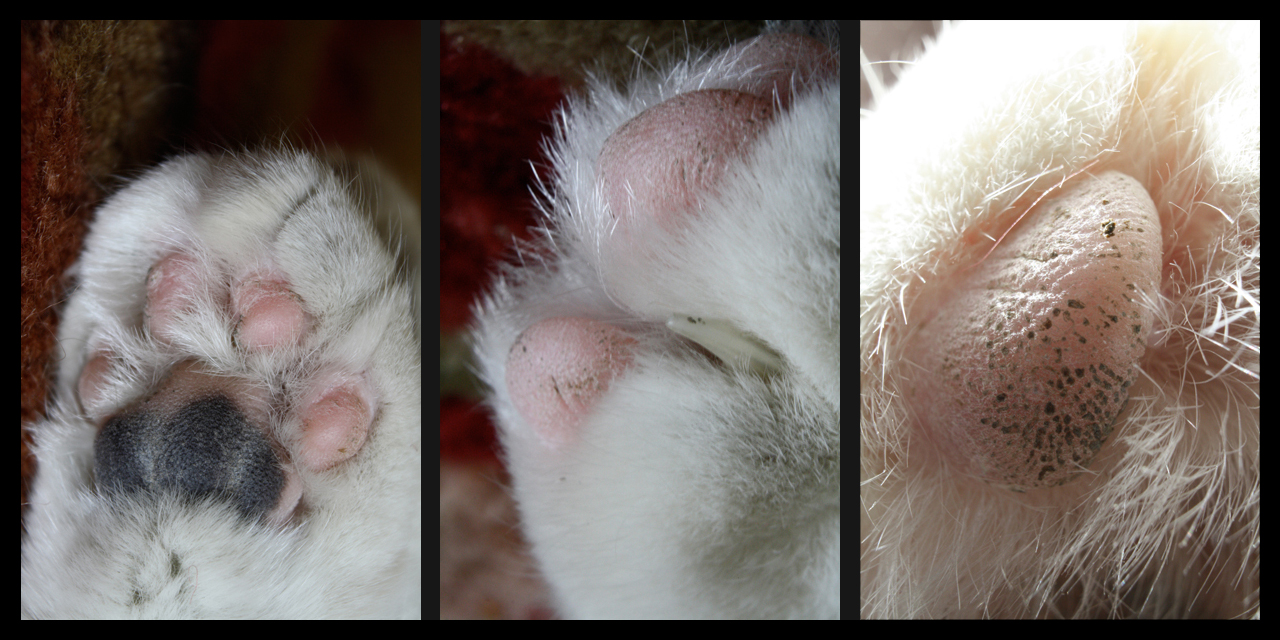
These three images illustrate the limitations of three different lengths of extension tubes. All three photos were taken with an 18-55mm lens in combination with an extension tube. From L to R: 12mm tube, 20mm tube, 36mm tube. (Click photo to enlarge.)

In my Kenko tube set I have three extension tubes: a 12mm tube, a 20 mm tube, and a 36mm tube.

I’d been meaning for awhile to experiment with the extension tubes. Last week when Miss Kitty walked by and rolled over exposing the bottoms of her paws, she instantly became a model.  When I used the 12mm tube, I could get pretty close and focus on Miss Kitty’s entire paw (left photo of the tri-photo above). That was all the closer I could get with the 12mm tube.

When I used the 20mm tube, I could focus even closer on just two of Miss Kitty’s toe pads (middle photo of the tri-photo). Not all of the two pads are in focus, meaning, I think, I need to experiment more with camera settings and/or holding the camera steady.

* * * * * * * *

I’d better post about something else before extension tubes wear out their welcome (if they haven’t already)! I have so much I want to post about that’s been on the back burner for awhile (for example, finishing up about Bill’s and my Oregon travels); yet I enjoy posting spontaneously about whatever topic is at hand. Thank you for sticking with the blog, never knowing what serious or absurd topic the next post will be about.

(Click here to go to Louise Shimon’s blog’s home page.)
Video Chat Wedding Shower: Do that ooVoo that you do so well!

March 5, 2010

(Click here to go to this blog’s home page.)

I’m interjecting a post between Part II and Part III of “Extension Tubes in Macro Photography.” I’ll post Part III by Monday.

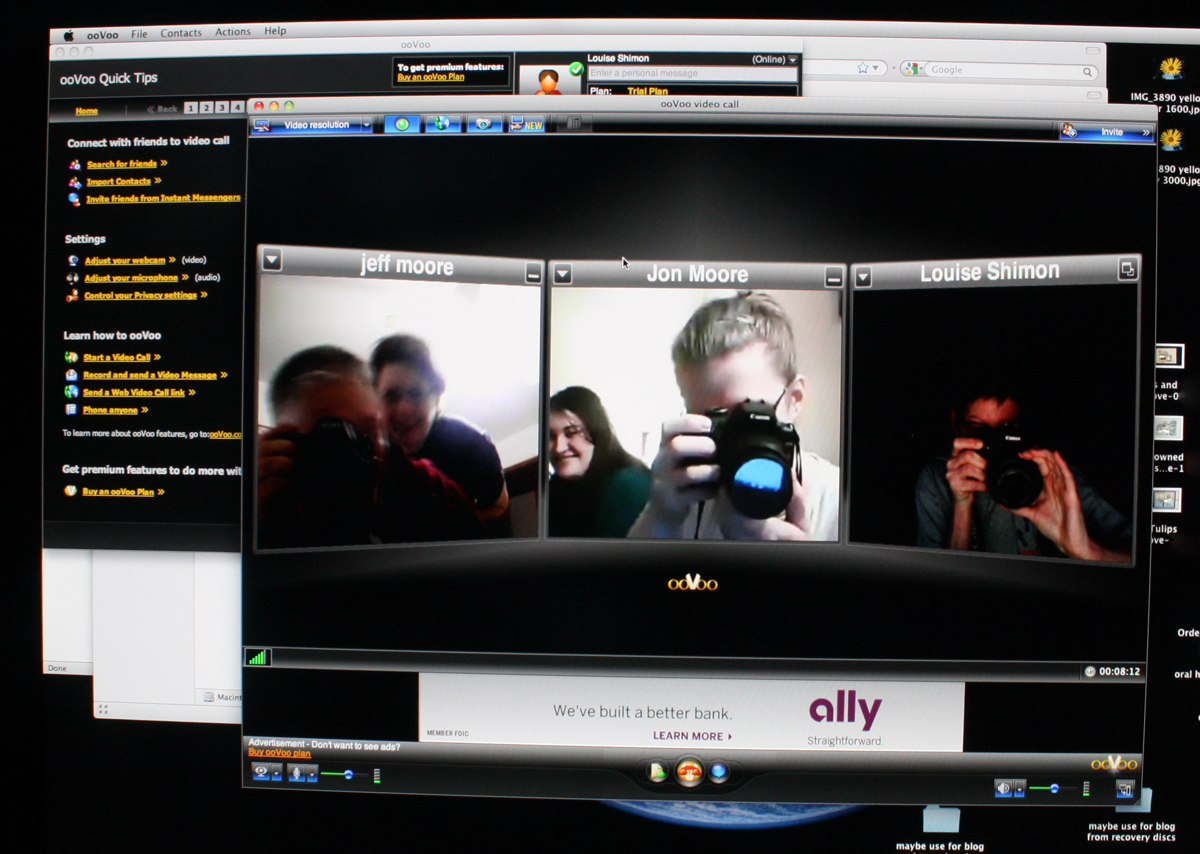
Using ooVoo (www.ooVoo.com) we had three-way video chatting tonight. L to R: Jeff and his better half, Jon and Claire, and me. We'll use ooVoo for the remote Internet wedding shower on Sunday. (Click photo to enlarge.)

Jon and Claire (my nephew and his bride) from Michigan are getting married in April. I thought it would be a fun family time to host a shower for them in Iowa. However, schedules didn’t match up. Hmmm…what to do? There must be some outside-the-box way to pull off a shower.

I talked with Jon’s mom, my next older sister, who is always game for fun, and pulled ideas from the guy at the Apple store and Jon’s brother, Josh. Bingo! We decided to have a “remote”  Internet shower. I’m sure we aren’t the first ones in the wide world doing this, but in our immediate worlds we are!

What we will do is video chat across the Internet. At each location there will be a computer that, at minimum, can handle one-way live video streaming for watching Jon and Claire open gifts. When an observing location’s computer has a built-in or attached camera so that the remote participants can also be viewed via streaming video…the bonus will be two-way streaming video chatting (or three-way, four-way, or more).

Jon and Claire and their parents will be at Jon’s parents’ home in Michigan. Bill and I will be at our Perry, Iowa, home with at least part of the Gunderson family from Rolfe and Omaha. Additional branches of Jon’s extended family will participate in clusters via cyberspace reaching from Florida to Oregon.

Jeff (Jon’s dad) is the designated IT guy for this shower. Before the shower, Jeff is calling the contact person for each participating location to make sure the contact knows how to connect via the Internet to the shower. When Jeff called me tonight, he led me through the simple steps of two-way video chat using ooVoo (www.oovoo.com…I keep accidentally calling it “Voodoo.”) OoVoo is always free for two-way video chatting. Video chatting via ooVoo with up to six other people simultaneously is available for a fee.

By downloading the ooVoo software, I have more options than if I don’t download the software. However, ooVoo may be used satisfactorily without downloading the software.

While Jeff and I were video chatting tonight as he was leading me through some steps/options, Jeff “invited” Jon (who was at his own home) to video chat with us as well. It just happened that Claire was in the vicinity of Jon, and my sister was in the vicinity of Jeff. Being the silly goons that we are, Jon, Jeff and I each got out a camera and simultaneously took a photo of the computer monitor in front of us (i.e., the photo at the top of this post).

Sometime after the shower I’ll report how it went, either by commenting on this post, or by adding a separate post.

(Click here to go to Louise Shimon’s blog’s home page.)
Extension Tubes in Macro Photography (Part II)

March 4, 2010

(Click here to go to this blog’s home page.)

This is the second of three posts about extension tubes used for macro photography.  To view Part I, click here.

If you aren’t into learning about the tubes, you might want to just skip the videos in this post and wait for the photos in Part III.  If you have time to watch only one video from this post, I recommend watching the second one, although I think both of the videos are helpful.

The YouTube video* immediately below, while not polished, gives a helpful visual by comparing two focusing distances: 1. the arm’s-length distance a camera lens would need to be away from the photographed object if an extension tube is not used and 2. the hand’s-length distance a camera lens can be away from that same photographed object if an extension tube is used.

This next 7+-minute video* is the most comprehensive (I think) of the YouTube videos regarding extension tubes. It provides easy-to-understand explanations about three tools used for macro photography: close-up filters, extension tubes and macro lenses.

Tomorrow (Friday) or Saturday I’ll post  a couple more cat paw extension tube photos. Since not everyone is enamored with cats (or extension tubes), it will be the last cat post (and extension tube post) for awhile! (I think.)

* Obviously I had nothing to do with the production of these videos, but I’m certainly glad that someone else took the time to make them available.

(Click here to go to Louise Shimon’s blog’s home page.)

Extension Tubes in Macro Photography

March 1, 2010

(Click here to go to this blog’s home page.)

My 1"-diameter watch photographed with a 36mm extension tube and 18-55mm lens. The end of the camera lens was probably 1" or 2" from my watch. (Notice how, because it is closer to the lens, the heart is not as clearly focused.) (Click on photo to enlarge.)

Last weekend I experimented with one of the photography toys I received for Christmas: a Kenko (brand) extension tube set.

At this site is explanatory information about extension tubes, including a 1/2-minute video at the bottom of the site.

Basically an extension tube enables a person to take a photo focusing closer to the subject than his/her camera would typically allow. The longer the extension tube, the closer a camera lens can be when focusing on an object.

On Thursday or Friday I’ll post more, including photos, regarding the use of extension tubes.  For now, if you have time to read at least the first paragraph, and also to watch the 1/2-minute video at the “this site” link I provided above, it will help toward better understanding of my next post.

I’m sort of like the blind leading the blind on this topic, since I have so little experience using the tubes. I’m just so excited about them that, even with my lack of expertise, I want to post about them. If you are familiar with the tubes and have a better/different/more technically correct way to explain an aspect of the tubes, by all means, please provide your comment(s) below.

One more note…for the previous post, I used a 36mm extension tube with an 18-55mm lens to take a photo of one of Miss Kitty’s claws. The end of the lens was probably about 1″ or 2″ away from Miss Kitty’s claw.

(Click here to go to Louise Shimon’s blog’s home page.)

If It’s Not an Elephant Tusk It’s a(n)…..?

February 28, 2010

(Click here to go to this blog’s home page.)

Ok, so maybe it’s not so difficult to guess what is in this post’s photo, but it makes at least two people think of an elephant tusk (sort of).

By the time you go to bed Tuesday evening I’ll post an explanation for this photo. (The explanation has to do with one of the photography toys I received for Christmas.)

Coming up within the next two weeks — another mention of the 1940s and the Pocahontas, Iowa, grain elevator.

Click photo once (or even twice) to magnify detail.

.

(Click here to go to Louise Shimon’s blog’s home page.)
Pioneers from Kaua’i, Hawaii, to Rolfe, Iowa

February 23, 2010

(Click here to go to this blog’s home page.)

Because I’m catching up on communication regarding Rolfe’s oral history project and I’m also having fun with Jackson, I’ll likely not post again until Monday or Tuesday. In the meantime, if you’d like to read the history of the previously mentioned Tip Top Motel & Cafe on Kaua’i, click here.

* * * * * * * *

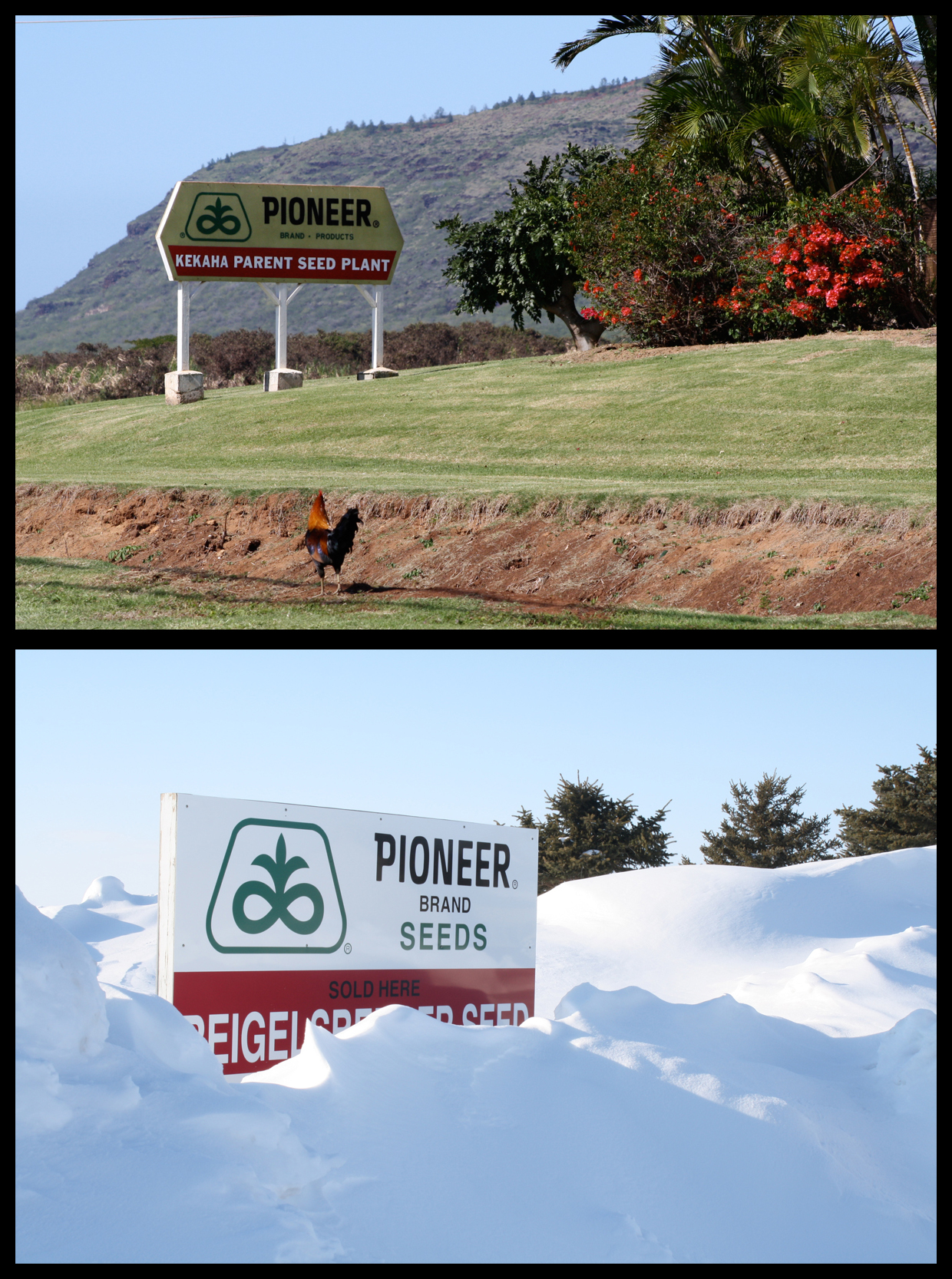
By clicking once (or even twice) on this image of two photos taken eight days apart, you'll magnify the detail.

The top photo was taken nine days ago as Bill and I were driving around the Hawaiian island of Kaua’i. The bottom photo* was taken yesterday, February 22, 2010, as I was driving around rural Rolfe, Iowa. The sign in the lower photo is on the farmstead of Mick and Sue Reigelsberger…which is also the original home of Mouser, and is 1/8 mile from where my father, Deane Gunderson, lives.

I’m not wild about the winter of 2010, and especially would not be if I still had a 35-mile work commute, but I do enjoy experiencing seasons. What a work ethic our pioneers had, enduring the elements, for us to enjoy life as we know it today.

* * * * * * * *

I’ll be back to the blog in about a week, or maybe before if timing works out.

* Photo-posting permission is granted by Mick Reigelsberger.

(Click here to go to Louise Shimon’s blog’s home page.)